THE CLASSIC COLLECTION✦An outlaw’s diary: the CommuneCLASSIC FREE BOOKS
An outlaw’s diary: the Commune
Cécile Tormay
THE CLASSIC COLLECTION · 1880
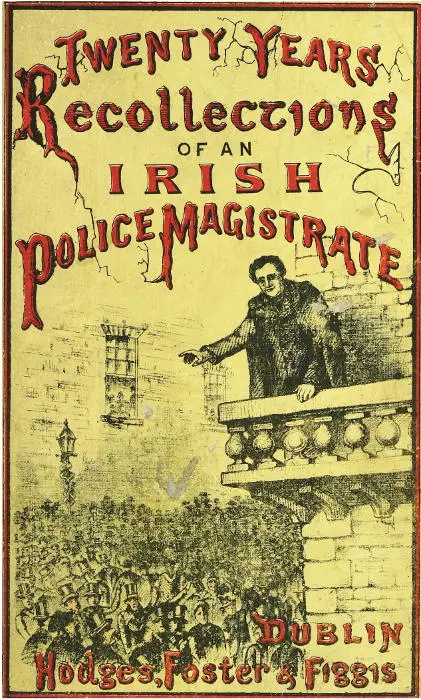
"Twenty Years' Recollections of an Irish Police Magistrate" by Frank Thorpe Porter is a historical account written in the late 19th century. The book offers a collection of narratives recounting incidents from the author's lengthy career as a police magistrate in Dublin, providing insights into the criminal justice system of the time, as well as anecdotes involving various characters connected to law and order. The opening of the memoir presents the case of a man named Lonergan, accused of poisoning his employer, Mr. O'Flaherty. Following a complicated legal process, Lonergan is convicted and sentenced to be hanged and quartered, although he maintains his innocence until the end. The narrative highlights the somber realities of justice in historical Dublin, emphasizing the impact on both the condemned and those around him. The chapter concludes with a dramatic account of Lonergan's eventual escape from execution, illustrating themes of fate, human error, and the complexities of truth versus perception.
Introduction adapted from the source catalogue; source summaries may be automatically generated.
Free to read · English · 141,864 words · No account needed
MAKE TIME FOR A GOOD BOOK
On by default. Untick to stop anonymous reading totals. Each page counts after 10 seconds in view. How this works.
Anonymous counting is on unless you have switched it off.
"We have got in the barley all right, and we are going at the oats to-morrow. I had to lend the horses to-day to Mr. Kimmis. I couldn't refuse, for you know he is a good warrant to obleege us when we want a turn. Nolan is bothering about the rent. He is very cross. You must see and make it out for him, if you were even to beg for it."
One month's imprisonment, with hard labour, provided the mendicant with some "crusts" and "mugs of milk" at the cost of the county. The delinquent did not, I believe, resume his solicitations within our district. The office sergeant who escorted him, with some other prisoners, to Kilmainham, told the clerk at Kingstown on the following morning, that Mr. Bryan stigmatized my decision as "most uncharitable and disgusting."
I did not find mendicancy so persistent in any part of the police district as in Kingstown. If a vagrant was brought up and punished for begging in Rathmines or the Pembroke township, or if the detection occurred at Inchicore, or in the more respectable parts of the city, it was not at all probable that the beggar would be soon found again in the same locality. The Kingstown vagrants, as soon as they were discharged from Kilmainham, generally started off to return and resume their solicitations at the piers and jetty, or about the streets and terraces, which were more devoted to healthful recreation than to professional or commercial affairs. I have no doubt that mendicants from distant places receive more at Kingstown or Bray, from visitors whom they recognize, or who recognize them, than would be given to them if both parties were at home. A lady with whom I was personally acquainted, and whose family residence was near Carlow, has several times, in my presence, given sixpences to beggars who belonged to her own neighbourhood, and I have heard her tell them that Kingstown was a better and more lucky place for them than ever they would find Carlow to be. I shall close my observations on street begging, by deliberately stating from my personal and official experience, that not one penny can be given to any mendicant on our thoroughfares in real, efficient, and merited charity. I would now warn my readers against another kind of begging, which avails itself of very systematic and elaborate means, and sometimes displays considerable educational acquirements, namely, written applications to charitable individuals to alleviate dire distress or succour unmerited misfortune. I know that this system is extensively practised in London, and I have heard that it is reviving in Dublin. I use the term "reviving," because it was completely crushed here in 1844 by the intelligence and activity of the detective division. At that time it was discovered that a confederacy of impostors had been formed in Bridgefoot Street, and that the members of this nefarious association were levying contributions on all in whose dispositions they had ascertained charity and credulity to be united. Forty-one of them were arrested and brought before me, and I committed them for trial on charges of "conspiring to defraud, obtaining money under false pretences, and forgery at common law." They were, however, consigned to Newgate, exactly at the time when the State prosecutions against O'Connell had been commenced; and it was the received opinion in police quarters that they owed their escape--for they were not prosecuted--to a feeling on the part of the attorney-general of that period, that all his attention was demanded in bringing down the eagle, and that none of his energies could be spared to scatter a flock of kites. But they were not relinquished by the detectives, and were brought in detail under the castigation of the law until the confederacy was broken up. Their begging letters and petitions were addressed to all whom they considered likely to yield the slightest attention to their requests. These productions were termed in their slang "Slums." One impostor represented that she was a clergyman's widow, with four female children, the eldest only eleven years of age; that her pious, exemplary, and most affectionate partner had died of malignant fever, contracted whilst whispering the words of Christian consolation to the departing sinner, and imparting the joyful assurance, that the life flickering away, the socket glimmer of a mere earthly light, would be rekindled in a lamp of everlasting duration and unvarying brilliancy. That resigned to her suffering, and adoring the hand from which she had experienced chastening, she was not forbidden to hope that the blessed spirit of charity would be manifested in her relief, and in shielding her helpless, artless babes from the privations of distress in their infancy, and from the still more fearful danger of being, in advanced youth, exposed to the snares of sin and its depraving consequences. A contribution, however small, addressed to Mrs. ----, at No. -- Bridgefoot Street, Dublin, would, it was respectfully hoped, be accorded by Lord ----, or Mr. or Mrs. ----, whose well-known, though unostentatious benevolence, must plead the poor widow's apology for such an intrusion. Another was an unfortunate man, who for many years had earned a respectable livelihood as a commercial agent, and supported a numerous and interesting family by his industry and intelligence, but having unfortunately been in the County of Tipperary, when a contested election was in progress, he unguardedly expressed a wish for the success of the Conservative candidate, and although not a voter, he was set upon by a horde of savage ruffians, and beaten so as to produce paralysis of his lower extremities, and that now nothing remained for him but to entreat the humane consideration of one who could not, if the public testimony of his, or her generous disposition, was to be credited, refuse to sympathize with a parent whose helplessness compelled him to witness, with unavailing anguish, the poignant miseries of the offspring he had hoped, by his honest exertions, to have supported and reared, without submitting to the galling necessity of soliciting that aid which nothing but the most absolute destitution could reconcile him to implore. A military lady announced herself as the widow of color-sergeant Robert Maffett, who having served faithfully for twenty-three years, the four last having been in India, had been severely wounded in a decisive battle in Scinde, and when invalided and pensioned, was unfortunately drowned at Blackwall, in consequence of the boat which was conveying him ashore being accidentally upset. That she and her eight poor orphans had no resource on reaching her native city, where she found that all her relations had died or emigrated, and where she was friendless and alone, but to throw herself upon the charitable feelings of one whose character emboldened her to hope that the humble appeal of the soldier's widow, for herself and her poor orphans, would not be unavailing. These and a thousand other slums were manufactured in Bridgefoot Street, alias Dirty Lane, not an unsuitable name for the locale of such proceedings, and they were invariably accompanied by lists of subscriptions, and magisterial or municipal attestations, admirably got up in the first style of forgery. In the first case to which I have adverted, the "hapless widow" succeeded in getting five pounds from the Lord Chief Justice of Ireland (Pennefather). In the instance of the "military widow," Lady Blakeney was lightened of three pounds. Another slum was circulated by a scoundrel who represented himself to be the son of a gentleman in the south of Ireland, of an old family, and of the pristine faith; that he had been educated at Louvain, had an ardent wish to become a Catholic clergyman, and that one of the most distinguished dignitaries of that church was inclined to ordain him, but his father had died in debt, without leaving him the means of providing even the most humble outfit for such a vocation. One of his missives produced the effect of relieving an alderman's lady of five pounds sterling, which the excellent and worthy matron piously suggested might be useful in providing the embryo priest with vestments.
Your reading position is saved on this browser. Take it to another device with a library code. Reading pages adapt to text, rather than matching a printed edition.
BEHIND THE BOOK
This eBook is for the use of anyone anywhere in the United States and most other parts of the world at no cost and with almost no restrictions whatsoever. You may copy it, give it away or re-use it under the terms of the Project Gutenberg License included with this eBook or online at www.gutenberg.org. If you are not located in the United States, you will have to check the laws of the country where you are located before using this eBook. Read the source licence.
The original source file, including credits and licence, is retained by this library. Request an original-format copy at no charge. Please include the book title and Project Gutenberg identifier #55668.
KEEP YOUR CURIOSITY GOING
Cécile Tormay

Moritz Busch
John L. Ransom
Frances Wright
Cécile Tormay

Mabel Potter Daggett