THE CLASSIC COLLECTION✦An outlaw’s diary: the CommuneCLASSIC FREE BOOKS
An outlaw’s diary: the Commune
Cécile Tormay
THE CLASSIC COLLECTION · 1880
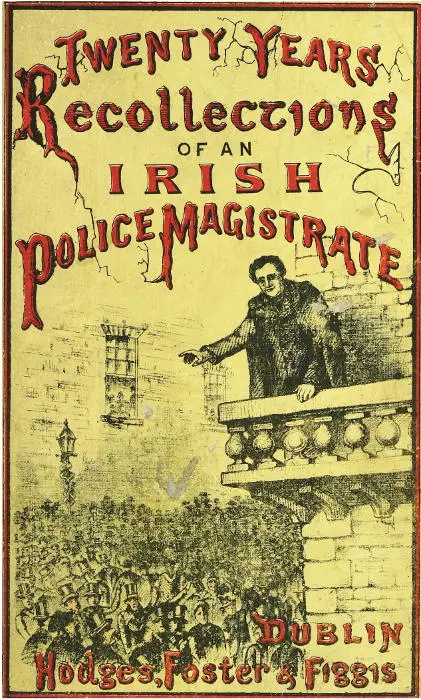
"Twenty Years' Recollections of an Irish Police Magistrate" by Frank Thorpe Porter is a historical account written in the late 19th century. The book offers a collection of narratives recounting incidents from the author's lengthy career as a police magistrate in Dublin, providing insights into the criminal justice system of the time, as well as anecdotes involving various characters connected to law and order. The opening of the memoir presents the case of a man named Lonergan, accused of poisoning his employer, Mr. O'Flaherty. Following a complicated legal process, Lonergan is convicted and sentenced to be hanged and quartered, although he maintains his innocence until the end. The narrative highlights the somber realities of justice in historical Dublin, emphasizing the impact on both the condemned and those around him. The chapter concludes with a dramatic account of Lonergan's eventual escape from execution, illustrating themes of fate, human error, and the complexities of truth versus perception.
Introduction adapted from the source catalogue; source summaries may be automatically generated.
Free to read · English · 141,864 words · No account needed
MAKE TIME FOR A GOOD BOOK
On by default. Untick to stop anonymous reading totals. Each page counts after 10 seconds in view. How this works.
Anonymous counting is on unless you have switched it off.
It may not be inopportune to mention here that I related the foregoing account of the origin of the word "quiz" one day in, I think, the year 1832, at the table of Cornelius Lyne, the facetious and convivial barrister of the Munster Circuit, where he was designated, in contradistinction to the old Irish chieftain, "Con of the hundred battles," "Con of the hundred bottles." Amongst the guests was a gentleman named Montgomery, who resided in Belfast. On hearing my story, he remarked that a quiz has occasionally produced a reality. He proceeded to tell us that when James Madison was President of the United States, a young man connected with one of the most eminent houses in Belfast, thought fit to make an American tour. Having crossed the Atlantic, he passed upwards of eighteen months to his perfect satisfaction. On his return he was greatly pestered by one of his fellow-townsmen, a pushing, plausible, self-sufficient kind of fellow, for letters of introduction to some American friends, the applicant declaring his intention of visiting all the principal cities of the Union. At length the solicited party replied to an urgent entreaty, by declaring that there was no one with whom he felt himself warranted to take such a liberty except his friend Madison. "The President!" exclaimed the importunate teaser; "why it would be invaluable." Acceding to his request, a letter was written commencing with "My dear Mr. Madison," and conveying the assurance, that the attentions which the writer had received would never be forgotten, and that the recollection of such kindness emboldened him to introduce a friend, in the hope that he would be received with even a portion of that urbanity which had been experienced so agreeably, and remembered so gratefully, by his ever faithful and obliged, &c., &c. The traveller departed, and a considerable time elapsed before he reappeared in Belfast. When he returned, his first visit was to the author of the valuable introduction. "My dear friend," said he, "I presented your letter at a public reception. The President was more than polite, he was extremely cordial. I was invited to several delightful parties, and received the utmost attention. It was, however, very extraordinary, that when I called to pay my farewell visit, he asked me several questions in reference to your personal appearance, remarking that you had lapsed from his recollection." This was not so very surprising, for the President had never seen the man whose letter of introduction for the other had been a thorough quiz. At the conclusion of the anecdote which my narrative had elicited from Mr. Montgomery, Tom Moylan, Mr. Lyne's nephew, contributed another. He remarked that the Belfast man had only quizzed a President, but a Dublin man had completely humbugged a king. When George the Fourth was reigning, a Dublin medical doctor wrote a book. He had a copy splendidly bound for presentation, and then went to London, to the royal levee, where he handed a card to the lord-in-waiting, on which his name appeared as attending to present his work on a certain professional subject, and to receive the honor of knighthood. The lord-in-waiting thought that all was right; the king thought so, too. The Dublin doctor knelt down, the king took a sword gave him the slap of dignity, and bade him arise Sir Thomas ----. After the levee, and when the newspapers had published the knighthood as one of the incidents of the day, there were some enquiries about the recipient of the distinction. Who had recommended him? Of what minister was he the protegè? But they were all too late, the knighthood had been conferred. People could only laugh. Canning was reported to have said, that he supposed the doctor claimed the honor by prescription. Although I was not personally acquainted with the medical knight who was the subject of Tom Moylan's anecdote, I have a perfect recollection of him for several years before he was dubbed a "Sir." He resided in St. Peter's parish, Dublin, and was very prominent in the old agitation times antecedent to Catholic Emancipation. At the vestries there could not be a rate or cess proposed to which he had not an amendment or direct negative to offer. On one occasion, at a very crowded parochial meeting, he complained to Archdeacon Torrens, who was presiding, that the vestry-room was too limited a place for such an important discussion as that in which they were engaged. "I move, reverend sir," said he, "that we adjourn to the Churchyard." "My dear doctor," replied the archdeacon, very quaintly, "you will have us there time enough."
Your reading position is saved on this browser. Take it to another device with a library code. Reading pages adapt to text, rather than matching a printed edition.
BEHIND THE BOOK
This eBook is for the use of anyone anywhere in the United States and most other parts of the world at no cost and with almost no restrictions whatsoever. You may copy it, give it away or re-use it under the terms of the Project Gutenberg License included with this eBook or online at www.gutenberg.org. If you are not located in the United States, you will have to check the laws of the country where you are located before using this eBook. Read the source licence.
The original source file, including credits and licence, is retained by this library. Request an original-format copy at no charge. Please include the book title and Project Gutenberg identifier #55668.
KEEP YOUR CURIOSITY GOING
Cécile Tormay

Moritz Busch
John L. Ransom
Frances Wright
Cécile Tormay

Mabel Potter Daggett