THE CLASSIC COLLECTION✦An outlaw’s diary: the CommuneCLASSIC FREE BOOKS
An outlaw’s diary: the Commune
Cécile Tormay
THE CLASSIC COLLECTION · 1880
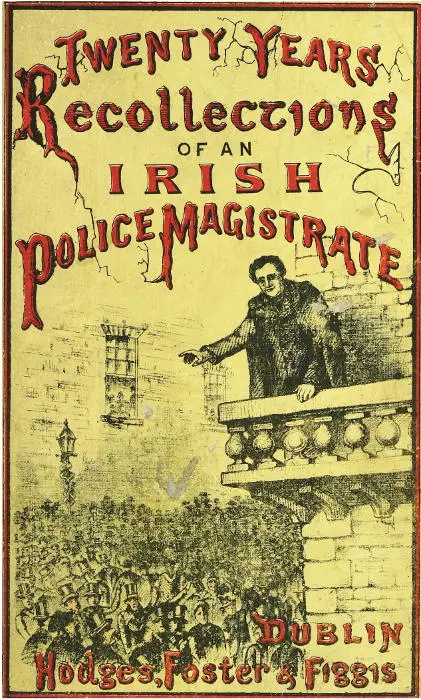
"Twenty Years' Recollections of an Irish Police Magistrate" by Frank Thorpe Porter is a historical account written in the late 19th century. The book offers a collection of narratives recounting incidents from the author's lengthy career as a police magistrate in Dublin, providing insights into the criminal justice system of the time, as well as anecdotes involving various characters connected to law and order. The opening of the memoir presents the case of a man named Lonergan, accused of poisoning his employer, Mr. O'Flaherty. Following a complicated legal process, Lonergan is convicted and sentenced to be hanged and quartered, although he maintains his innocence until the end. The narrative highlights the somber realities of justice in historical Dublin, emphasizing the impact on both the condemned and those around him. The chapter concludes with a dramatic account of Lonergan's eventual escape from execution, illustrating themes of fate, human error, and the complexities of truth versus perception.
Introduction adapted from the source catalogue; source summaries may be automatically generated.
Free to read · English · 141,864 words · No account needed
MAKE TIME FOR A GOOD BOOK
On by default. Untick to stop anonymous reading totals. Each page counts after 10 seconds in view. How this works.
Anonymous counting is on unless you have switched it off.
You gallant-hearted Irishmen,
Come listen to my lay,
The melancholy muse I woo,
She comes in tears to-day.
Oh Wirra! Wirrasthrue, says she,
Sure Dublin's noblest bard
Is took before his tyrants
In the Lower Castle Yard.
In Cook Street was our Printer born,
In Cook Street was he bred,
The legends of Hibernia's land
His young ideas fed,
How Brian Coru and Granyah too,
Did Saxons disregard,
And the flag of green once waved serene
In the Upper Castle Yard.
His first animadversions
Were on the paving stones,
Why should you send your cash to Wales,
To Taffy or to Jones?
Why not lay down, throughout the town,
Your Irish granite hard?
And macadamize the dirty spies
In the Lower Castle Yard?
Colonel Browne, he being a Welshman,
Swore by St. David's bones
He'd prosecute the Irishman
Who dare oppose their stones.
He order'd Whiteside to indict
And carcerate the Bard;
Let him try, says he, Geology,
In the Lower Castle Yard.
But good luck to Frank Thorpe Porter,
That expounder of the laws,
Likewise to Adye Curran,
Who was counsel in the cause.
They tann'd the hide of long Whiteside,
And did him disregard,
And freed our Printer from his fangs,
In the Lower Castle Yard.
I was occasionally sent for by the Chief Secretary of the Lord Lieutenant in reference to matters of a local nature on which it was desirable to obtain prompt and confidential information. I cannot say that any of those functionaries ever applied to me on a subject which I considered very important, and I was never informed what was the ultimate object of the inquiry. I believe that in several instances the wish was to acquire some topics or materials for replies to deputations. It was intimated to me, in 1853, one day about two o'clock, that the Chief Secretary desired to see me immediately, and I accordingly proceeded to his office. He said that he wished to know whether the trade and commerce of Dublin was in a state of healthy progress, or of retrogression as compared with the two previous years. I told him that the files of the Dublin Gazette would enable him fully to ascertain the increase or decrease of bankruptcies within the city in the last year compared with any recent period, and that the Imports and Exports published under the sanction of the Customs authorities could be easily procured and examined. He declined to adopt the course I suggested as being complex, and requiring too much time to ascertain its results; and he then said that he wished me to come on the next day and tell him whether I believed that the general trade and commerce of Dublin were in a better or worse state during the past twelve months than they had been for the two previous years. I attended at the time appointed, and expressed a most decided opinion that the trading community had been far more prosperous in the latter period, and that I believed their business was one half greater than it had been during the terms with which it was to be compared. The Right Honorable functionary asked me when I had arrived at such a conclusion; to which I simply answered that my opinion had been formed since our last interview. I was then interrogated as to what documents I had examined, or what class of traders I had consulted, to which I replied that I had nothing on the subject, and had spoken to a few traders merely as to certain commodities in which I was aware that they dealt. I was asked what commodities I meant, and the Secretary seemed rather surprised when I mentioned coarse papers and packing cordage, in which articles I was informed that they were doing an increased and increasing traffic. I added that when there was a brisk demand for such materials it denoted that the sale of shop goods must be also brisk, just as extensive purchases of seeds, manures, or tillage implements, would indicate greater activity in agricultural or horticultural pursuits. A young gentleman, who acted as private or confidential secretary to the Chief Secretary, was present when I expressed such opinions and my reason for their adoption, and when his principal indulged in a laugh which was, perhaps, somewhat derisive of the importance I ascribed to wrapping papers and twine, he amply participated in the merriment. I then said that I might possibly augment their amusement by imparting the result of another inquiry which I had made, and which tended to confirm my previous statements. I had been informed, in almost all the pre-eminent musical establishments, that there had been a considerable increase in the sale of pianofortes, and I felt perfectly convinced that a pianoforte was very rarely purchased by a person in embarrassed circumstances, whilst it was almost invariably considered a desirable addition to the domestic recreation of a comfortable and solvent family. This statement produced more laughter, and as the interview was not of a secret nature, my references to wrapping-paper, twine, and pianofortes, became sufficiently known to obtain for me a considerable amount of banter. The Secretary subsequently told me that several other persons whom he consulted gave him opinions similar to mine on the commercial state of Dublin, although their calculations and inferences were derived from very different sources. I still entertain the impression that the grounds on which I formed my conclusion were by no means unworthy of consideration.
Your reading position is saved on this browser. Take it to another device with a library code. Reading pages adapt to text, rather than matching a printed edition.
BEHIND THE BOOK
This eBook is for the use of anyone anywhere in the United States and most other parts of the world at no cost and with almost no restrictions whatsoever. You may copy it, give it away or re-use it under the terms of the Project Gutenberg License included with this eBook or online at www.gutenberg.org. If you are not located in the United States, you will have to check the laws of the country where you are located before using this eBook. Read the source licence.
The original source file, including credits and licence, is retained by this library. Request an original-format copy at no charge. Please include the book title and Project Gutenberg identifier #55668.
KEEP YOUR CURIOSITY GOING
Cécile Tormay

Moritz Busch
John L. Ransom
Frances Wright
Cécile Tormay

Mabel Potter Daggett