THE CLASSIC COLLECTION✦An outlaw’s diary: the CommuneCLASSIC FREE BOOKS
An outlaw’s diary: the Commune
Cécile Tormay
THE CLASSIC COLLECTION · 1880
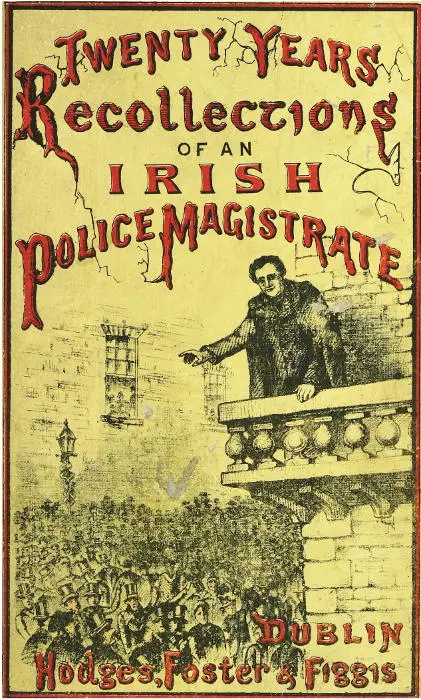
"Twenty Years' Recollections of an Irish Police Magistrate" by Frank Thorpe Porter is a historical account written in the late 19th century. The book offers a collection of narratives recounting incidents from the author's lengthy career as a police magistrate in Dublin, providing insights into the criminal justice system of the time, as well as anecdotes involving various characters connected to law and order. The opening of the memoir presents the case of a man named Lonergan, accused of poisoning his employer, Mr. O'Flaherty. Following a complicated legal process, Lonergan is convicted and sentenced to be hanged and quartered, although he maintains his innocence until the end. The narrative highlights the somber realities of justice in historical Dublin, emphasizing the impact on both the condemned and those around him. The chapter concludes with a dramatic account of Lonergan's eventual escape from execution, illustrating themes of fate, human error, and the complexities of truth versus perception.
Introduction adapted from the source catalogue; source summaries may be automatically generated.
Free to read · English · 141,864 words · No account needed
MAKE TIME FOR A GOOD BOOK
On by default. Untick to stop anonymous reading totals. Each page counts after 10 seconds in view. How this works.
Anonymous counting is on unless you have switched it off.
An infantry regiment of the line was embarked at Kingstown in a very capacious steamer, I believe the Medusa, for Gibraltar or Malta. There was a large quantity of baggage which the men were actively engaged in conveying on board and stowing away. I was sauntering on the jetty when, at one o'clock, they were directed "to knock off for dinner." The meal was served on deck, and consisted of soup, bread, and meat, and the recipients availed themselves of every position in which they could speedily enjoy their repast. The circular seat around the window on the quarter-deck was fully occupied. The soup was brought up in large tin basins, and the bread was amply supplied, ready cut, from wicker baskets. One of the men who occupied the circular seat, seeing a basket of bread placed almost within his reach, stood up, advanced about a yard, and having procured what he required, stepped backward to resume his place. Meanwhile, one of the attendants had placed a large vessel of soup on the portion of the bench apparently vacant, and the soldier sat down in it. With a loud scream, indicative of acute pain, he rushed to the tafferel, and plunged into the sea. He was immediately rescued from the risk of drowning, and having been brought on board, was sent below for medical treatment, and to get his wet clothes changed. I saw him on deck in the course of the afternoon, and he stated that he was suffering very little, and that he would be "all right" very soon. Unless the temperature of the soup was below scalding heat, the instantaneous application of the cold water, although of a saline character, must have been extremely efficacious.
A large ship was quartered to convey the head-quarters of the 11th hussars from Kingstown to Balaklava. A considerable number of horses were embarked, and there were slings fastened to the roof and passing under each animal's body, which supported him whilst sleeping, but without allowing him to lie down. All arrangements for sailing had been completed. A steamer was provided to tow the vessel to the outside of the Kish Bank, and the wind was as favorable as possible for proceeding down the Channel. The captain announced, about ten o'clock, a.m., that he would leave at noon, whereupon three of his crew asked him to defer his departure until the next day, and to allow them to spend the intermediate time ashore. On his refusal, they required him to hoist a signal, which, to the best of my recollection, was a blue shirt, at the foretop, and he complied with their demand, inasmuch as, according to his statement to me, his refusal would subject him to most severe penal consequences. The signal denoted that there were persons on board willing to serve in the Royal Navy; and as soon as it was displayed, a lieutenant who was stationed at Kingstown, on the duty of naval recruiting, went on board, and was informed by the three sailors that they were desirous of joining his service. He acceded to their application, and the captain found himself unable to put to sea for want of sufficient hands, and without any expectation of being able to supply the deficiency for some days. In this emergency, he applied to me to have the men treated as wilful absconders, and to send them back to the ship. I had a communication with the lieutenant, whose name, I think, was Henderson; and whilst he fully admitted the hardship of which the captain complained, he declared that his orders were so stringently imperative that he could exercise no discretion, and had no alternative course to adopt. I observed that by retaining the men there would be a serious injury inflicted by one department of the public service on another, and that it amounted to military exertion being paralyzed by naval interference. He agreed with me as to the injurious effect of having the ship detained, but declared that he was unable to prevent it. I said that under the circumstances, I was inclined to have the men taken and sent back to the vessel from which they had virtually absconded. To this he replied, that he would offer no resistance to the execution of any warrant or order that I might issue, but that he would report the proceeding to the Admiralty. Thereupon, I suggested to the captain to have the ship taken from alongside the jetty to the centre of the harbour, and to stop any further communication with the shore. This was immediately done, and I then sent a warrant for the seamen, and had them conveyed on board, having previously advised them to go of their own accord, which they declined doing, with the intimation that if they ever returned to Ireland, they would smash every bone in my body, even if they were to be hanged the next minute for killing such a d----d old scoundrel. When they arrived at the ship, they told the captain that they would not do any duty, to which he replied that, whilst they refused to work, they need not expect to get any rations. The rest of the crew disapproved of their conduct, and I believe that they soon became reconciled to a resumption of duty. The lieutenant informed me, in a few days after the transaction, that he had fully reported the circumstances to the Admiralty, and that they approved of the course I had adopted, and exonerated him from any censure. I was subsequently informed by him, that on the arrival of the ship at Balaklava, she was boarded by a party from the flag-ship, and the officer in command produced the documents incident to the enlistment of the three men at Kingstown, and claimed them as belonging to the naval service. They had, however, the advantage of being allowed their pay, as seamen in the Queen's service, from the date of their enrolment at Kingstown, and they also had their wages from the vessel in which they had been employed during the voyage to the Crimea. None of them have returned as yet to realize their fearful intention on him whom they designated "a d----d old scoundrel;" and he never entertained the slightest apprehensions of any violent commentary on the course he adopted towards them.
Your reading position is saved on this browser. Take it to another device with a library code. Reading pages adapt to text, rather than matching a printed edition.
BEHIND THE BOOK
This eBook is for the use of anyone anywhere in the United States and most other parts of the world at no cost and with almost no restrictions whatsoever. You may copy it, give it away or re-use it under the terms of the Project Gutenberg License included with this eBook or online at www.gutenberg.org. If you are not located in the United States, you will have to check the laws of the country where you are located before using this eBook. Read the source licence.
The original source file, including credits and licence, is retained by this library. Request an original-format copy at no charge. Please include the book title and Project Gutenberg identifier #55668.
KEEP YOUR CURIOSITY GOING
Cécile Tormay

Moritz Busch
John L. Ransom
Frances Wright
Cécile Tormay

Mabel Potter Daggett