THE CLASSIC COLLECTION✦An outlaw’s diary: the CommuneCLASSIC FREE BOOKS
An outlaw’s diary: the Commune
Cécile Tormay
THE CLASSIC COLLECTION · 1880
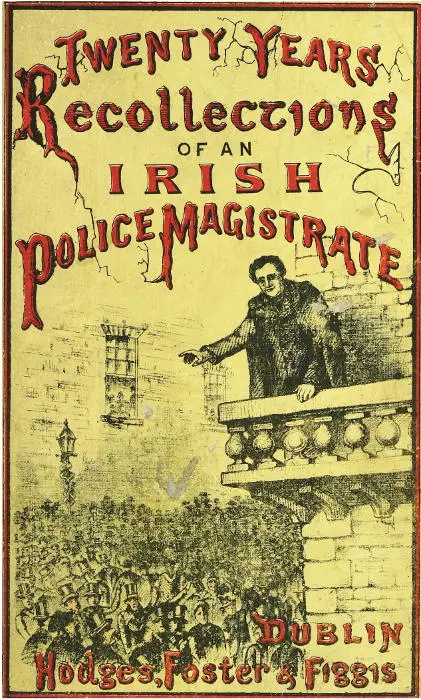
"Twenty Years' Recollections of an Irish Police Magistrate" by Frank Thorpe Porter is a historical account written in the late 19th century. The book offers a collection of narratives recounting incidents from the author's lengthy career as a police magistrate in Dublin, providing insights into the criminal justice system of the time, as well as anecdotes involving various characters connected to law and order. The opening of the memoir presents the case of a man named Lonergan, accused of poisoning his employer, Mr. O'Flaherty. Following a complicated legal process, Lonergan is convicted and sentenced to be hanged and quartered, although he maintains his innocence until the end. The narrative highlights the somber realities of justice in historical Dublin, emphasizing the impact on both the condemned and those around him. The chapter concludes with a dramatic account of Lonergan's eventual escape from execution, illustrating themes of fate, human error, and the complexities of truth versus perception.
Introduction adapted from the source catalogue; source summaries may be automatically generated.
Free to read · English · 141,864 words · No account needed
MAKE TIME FOR A GOOD BOOK
On by default. Untick to stop anonymous reading totals. Each page counts after 10 seconds in view. How this works.
Anonymous counting is on unless you have switched it off.
On my resumption of duty in Dublin, I had very few cases of importance or peculiar interest to dispose of. I may mention one in which two men were charged with being actively engaged in a riotous tumult in Dean Street, and assaulting the police. They had been extremely violent, and one of the constables had been so severely injured as to be incapacitated for duty during several days. In almost all such cases the prosecutors prefer a summary decision; and in the one to which my present remarks apply, I stated that I considered the prisoners, Foley and Magrath, deserved the utmost punishment which I was empowered to award, namely two months' imprisonment with hard labor. The culprits loudly exclaimed against such a judgment, and vociferated that they should get a full and fair trial by a jury. I acceded to their demand, and returned the informations to the next commission of Oyer et Terminer for the city of Dublin. There never was a more complete exemplification of an escape from the frying-pan by a fall into the fire. They were tried and convicted before Baron Richards, and he sentenced them to be imprisoned for twelve months, and kept to hard labor each alternate month. Their repugnance to a summary conviction had received great publicity; and the increased punishment to which they were subjected had the effect of reconciling the delinquents who were subsequently brought to the police-court to the fullest exercise, by the magistrates, of their summary jurisdiction.
In 1853 a prosecution was instituted by a lady, named Kelly, against a Mr. Birch, whom she accused of embezzling or stealing a very considerable sum of money. Her informations were sworn before my colleague, Mr. Magee, and he issued a warrant for the apprehension of Birch, which was delivered to a very intelligent and active officer, who subsequently was promoted to be the chief superintendent. The accused party was supposed to be in France, whither it was intended to send Mr. Ryan with the warrant. I had nothing whatever to do with the case, and I chanced to be sitting beside Mr. Magee when an application was made to him that he should go to France, having his expenses fully paid, and taking with him all the documents relating to the charge, for the information and satisfaction of the French authorities. Mr. Magee at once refused the request, alleging that his health would not admit of rapid travelling, but suggesting that Mr. Porter might undertake the journey, and fetch all the papers likely to induce the French functionaries to consent to the extradition of Birch, in the event of Ryan being able to find him. I consented to this arrangement, and set off for Paris, where I remained for a fortnight without any arrest having been effected of the accused party by the officer holding the warrant. I was never called on to produce the informations, and had no warrant in my possession, nor did I feel the slightest anxiety on the subject. Ryan was proceeding to France, when he ascertained that Birch was in Southampton, and there the capture was effected. A rumor was circulated in Dublin that I had gone to Paris to make a search, personally, for the alleged offender, when, in fact, I had neither the power nor the inclination to interfere beyond producing the informations which had been sworn before my colleague, and to authenticate them if required. My expenses were fully paid, and I found, on returning to Dublin, that the prosecution was abandoned. My short sojourn in the French capital was extremely pleasant; and having made myself known, as a Dublin police-magistrate, by the production of my passport at the prefecture, I experienced very kind and agreeable attentions. A man who spoke English was directed to attend me when visiting the public institutions, and I received a tricolored card, which procured me admission to all the theatres. I am tempted to mention one performance which I saw in a small theatre on the Boulevard near the large barracks, (La Caserne de Prince Eugene.) I do not recollect the title of the piece, but it exhibited the most extraordinary adaptation of machinery that I ever beheld, and the stage-tricks transcended all that I had previously seen or supposed possible. A scene represented a railway terminus, and on the arrival of a train, the engine exploded, and the carriage next to it was torn asunder. One passenger was supposed to have had his head knocked off, his arms separated from his shoulders, and his lower extremities from his hips, and the body, head, and limbs were seen, as the vapour cleared off, lying on the roof of a shed. Ladders were instantly applied, and the passenger was taken down piecemeal. A bench was pushed forward on the platform, it seemed covered with dark cushions, and the trunk of the victim was placed on it, the head was affixed and the lower extremities were attached, an arm added on the left side, when a poodle dog joined in the performance by seizing the other arm and taking it off the stage. Instantly the man arose, apparently with only one arm, and pursued the dog, exclaiming that the cursed poodle should not have his arm for supper. He returned, bringing the arm, and resumed his place on the bench, where the apparent reunion of his frame was completed. A surgeon was supposed to have been sent for, and he came too late to claim any share in the restoration of life and vigor to the dismembered patient. On proceeding to feel the pulse, he was rewarded by a slap on the cheek, accompanied with the contemptuous intimation of "Voici votre honoraire." (Here's your fee.) I may remark that there did not appear to be any dripping of blood on the shed, neither did the platform or bench show any gory stains; and the performers who represented railway officials of the various grades, and passengers, male and female, to the number of twenty at least, intervened four or five times between the bench and the audience, as if actuated by the deepest anxiety for the supposed sufferer. I was not much surprised at the apparent deficiency of the right arm, for I had several times seen the late Pat Brophy, of Dawson Street, Dublin, representing Nelson in a tableau vivant, and he managed on those occasions to appear as if he had lost an arm. The incidents which I have attempted to describe were only stage-tricks, but they were most perfectly accomplished.
Your reading position is saved on this browser. Take it to another device with a library code. Reading pages adapt to text, rather than matching a printed edition.
BEHIND THE BOOK
This eBook is for the use of anyone anywhere in the United States and most other parts of the world at no cost and with almost no restrictions whatsoever. You may copy it, give it away or re-use it under the terms of the Project Gutenberg License included with this eBook or online at www.gutenberg.org. If you are not located in the United States, you will have to check the laws of the country where you are located before using this eBook. Read the source licence.
The original source file, including credits and licence, is retained by this library. Request an original-format copy at no charge. Please include the book title and Project Gutenberg identifier #55668.
KEEP YOUR CURIOSITY GOING
Cécile Tormay

Moritz Busch
John L. Ransom
Frances Wright
Cécile Tormay

Mabel Potter Daggett