THE CLASSIC COLLECTION✦An outlaw’s diary: the CommuneCLASSIC FREE BOOKS
An outlaw’s diary: the Commune
Cécile Tormay
THE CLASSIC COLLECTION · 1880
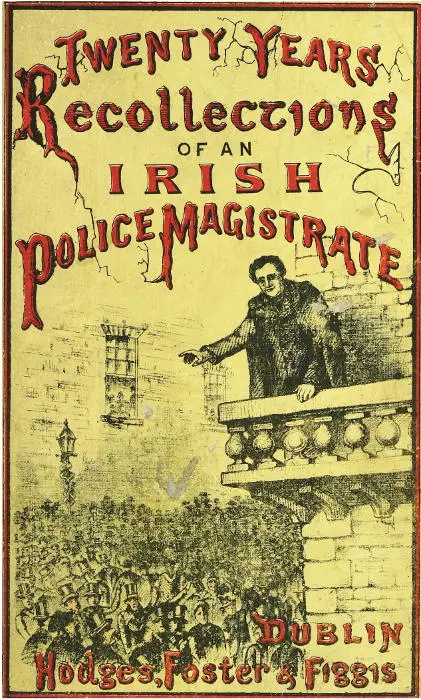
"Twenty Years' Recollections of an Irish Police Magistrate" by Frank Thorpe Porter is a historical account written in the late 19th century. The book offers a collection of narratives recounting incidents from the author's lengthy career as a police magistrate in Dublin, providing insights into the criminal justice system of the time, as well as anecdotes involving various characters connected to law and order. The opening of the memoir presents the case of a man named Lonergan, accused of poisoning his employer, Mr. O'Flaherty. Following a complicated legal process, Lonergan is convicted and sentenced to be hanged and quartered, although he maintains his innocence until the end. The narrative highlights the somber realities of justice in historical Dublin, emphasizing the impact on both the condemned and those around him. The chapter concludes with a dramatic account of Lonergan's eventual escape from execution, illustrating themes of fate, human error, and the complexities of truth versus perception.
Introduction adapted from the source catalogue; source summaries may be automatically generated.
Free to read · English · 141,864 words · No account needed
MAKE TIME FOR A GOOD BOOK
On by default. Untick to stop anonymous reading totals. Each page counts after 10 seconds in view. How this works.
Anonymous counting is on unless you have switched it off.
It would not be in accordance with the objects of my reminiscences to advocate or condemn the political opinions or proceedings of any portion of the community, unless they involved direct incitements to, or the actual adoption of, open violence. In noticing O'Connell as a remarkable public character, I may express my conviction that he had a decided repugnance, even in the hottest times of political excitement, to the application of actual force. It may be said that he could "speak daggers," but he was disposed to "use none."
Whenever I had an opportunity to hear him, whether on legal or political occasions, I availed myself of it, in the anticipation of being highly amused, and I was scarcely ever disappointed. I am tempted to detail two or three of my recollections, which have not been noticed by any of his biographers. I am aware that my expressions must be far inferior to his diction, but my readers will not, I hope, be too severe in criticising my inefficiency.
I was present at the trial of a very beautiful young lady who, with her mother and two other persons, was indicted for conspiring to take away a minor from his parents, and have him married to the young lady in Scotland. The prosecution was conducted with considerable acrimony, and the Gretna-Green bride was described as a person of very tarnished reputation, whose favorite paramour had been a blacksmith. No proofs were adduced of the imputed immorality, and O'Connell, in a speech for the defence, denounced it as a fabrication "which had not even the merit of originality, but was borrowed from the mythological assignment of Vulcan to Venus."
At the commencement of the first viceroyalty of the Marquis Wellesley, a newspaper was started in Parliament Street by a Mr. Hayden. It was called The Morning Star, and its editorial articles were almost exclusively devoted to the most disparaging and insulting productions in reference to the Lord Lieutenant or O'Connell. The latter was never forgotten; and every term of obloquy was put in requisition for his diurnal vilification. Firebrand, Rebel, Arch-mendicant, Liar, Impostor, Schemer, were liberally appropriated to him, and even the shape of his hat, and the mode of carrying his umbrella, became subjects of offensive observation. The attention of the Attorney-General was attracted to an article in The Morning Star, headed "The profligate Lord Wharton," the writer of which stated that the history of the Wharton viceroyalty had never been fully published, because a true description of such a character would be considered as an incredible exaggeration, but that it might now be produced without any apprehension of such an opinion prevailing, inasmuch as its worst details would be found fully equalled in Dublin Castle under the auspices of its present occupant. A criminal information was filed against Mr. Hayden for a libel on the Lord Lieutenant; and he became extremely apprehensive of a severe punishment, resulting from his very offensive comparison of Lord Wellesley with Lord Wharton. He immediately engaged William Ford as his attorney, and the next step was to retain O'Connell as his principal counsel. The latter agreed to act, but required that he should be left completely free to adopt whatever line of defence he preferred, and to manage the case at his own discretion. The trial was held in the King's Bench before Bushe, the Chief Justice, and the opening statement for the prosecution was delivered by the Attorney-General, Plunket. Sir Charles Vernon, who held the appointment of register of newspapers, was the first witness; and he produced the official copy of the paper containing the alleged libel, and it was read by him for the court and jury. O'Connell was then at the outer bar, and occupied a seat on its front row. He submitted to the judge, that when a document was given in evidence, either party could insist on the entire of it being read. To this proposition the Chief Justice acceded, expressing a hope, however, that his time would not be wasted in listening to irrelevant matter. O'Connell then required Sir Charles to read sundry portions of the paper in which "a person named O'Connell" was made the subject of the most defamatory animadversions. The entire auditory were convulsed with laughter, as he gravely proceeded to elicit ardent wishes for the speedy hanging or transportation of the arch-agitator, the apostle of mischief, the disseminator of disaffection, the mendicant patriot, the disgrace to his profession, and the curse of his country. When the case for the prosecution closed, he proceeded to address the jury, and his speech was replete with the highest encomiums on the Marquis Wellesley, to whose Indian government and diplomatic services he referred as exhibiting all the qualities of perfect statesmanship. He then expressed his surprise at the Attorney-General condescending to notice the publication of a mere newspaper squib, which could not possibly affect the illustrious viceroy. In the paper produced there were several unwarrantable attacks upon some person named O'Connell, who had instituted no proceedings against their publisher, although, perhaps, he was very likely to be affected injuriously by them, especially if his livelihood depended upon his character and reputation. Bitterly as he had been assailed, he had remained quiescent, and so regardless of the invectives directed against him, that it was very probable he had no desire whatever to mulct or incarcerate his assailant, but would rather aid in terminating his anxieties, and sending him home to his wife and five children.
Your reading position is saved on this browser. Take it to another device with a library code. Reading pages adapt to text, rather than matching a printed edition.
BEHIND THE BOOK
This eBook is for the use of anyone anywhere in the United States and most other parts of the world at no cost and with almost no restrictions whatsoever. You may copy it, give it away or re-use it under the terms of the Project Gutenberg License included with this eBook or online at www.gutenberg.org. If you are not located in the United States, you will have to check the laws of the country where you are located before using this eBook. Read the source licence.
The original source file, including credits and licence, is retained by this library. Request an original-format copy at no charge. Please include the book title and Project Gutenberg identifier #55668.
KEEP YOUR CURIOSITY GOING
Cécile Tormay

Moritz Busch
John L. Ransom
Frances Wright
Cécile Tormay

Mabel Potter Daggett