THE CLASSIC COLLECTION✦An outlaw’s diary: the CommuneCLASSIC FREE BOOKS
An outlaw’s diary: the Commune
Cécile Tormay
THE CLASSIC COLLECTION · 1880
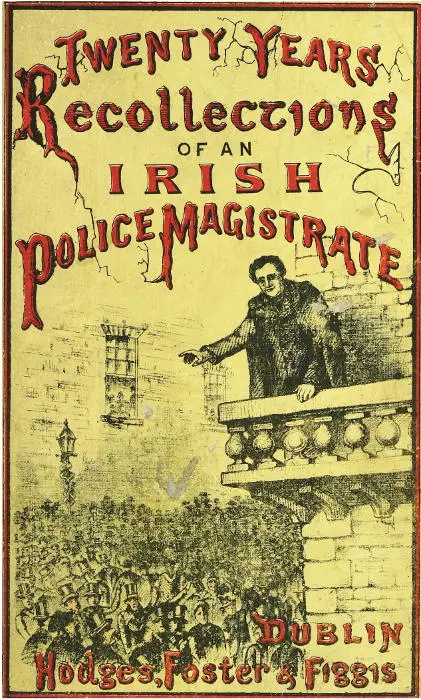
"Twenty Years' Recollections of an Irish Police Magistrate" by Frank Thorpe Porter is a historical account written in the late 19th century. The book offers a collection of narratives recounting incidents from the author's lengthy career as a police magistrate in Dublin, providing insights into the criminal justice system of the time, as well as anecdotes involving various characters connected to law and order. The opening of the memoir presents the case of a man named Lonergan, accused of poisoning his employer, Mr. O'Flaherty. Following a complicated legal process, Lonergan is convicted and sentenced to be hanged and quartered, although he maintains his innocence until the end. The narrative highlights the somber realities of justice in historical Dublin, emphasizing the impact on both the condemned and those around him. The chapter concludes with a dramatic account of Lonergan's eventual escape from execution, illustrating themes of fate, human error, and the complexities of truth versus perception.
Introduction adapted from the source catalogue; source summaries may be automatically generated.
Free to read · English · 141,864 words · No account needed
MAKE TIME FOR A GOOD BOOK
On by default. Untick to stop anonymous reading totals. Each page counts after 10 seconds in view. How this works.
Anonymous counting is on unless you have switched it off.
On the 20th of December, 1841, a little boy named Thomas Patrick Maguire, eight years of age, was playing with some other children in Blackhall Row. The children were of the humblest class, and Maguire was bare-footed. Delahunt, having previously ascertained his name, and that he lived with his mother in Plunket Street, told him that he had been sent to bring him to her. The poor boy went with him, but was not brought home. Delahunt took him to a distant part of the city, and called at his (Delahunt's) brother's lodgings in Little Britain Street, where he stated to his sister-in-law that Maguire was a stray child whom the police had given into his care to take home. He sharpened two knives at his brother's, and after his departure with the child, one of the knives was missed. In the meantime, he brought the little fellow across the city, bought some cakes for him, and took him into a lonely lane in the suburbs, close by Upper Baggot Street, and there between seven and eight o'clock in the evening, he cut the child's throat. In a very short time, the body was found, and taken to a police-station in order to have an inquest held. Delahunt reappeared, and stated that he had passed the end of the lane, and had seen a woman throw the little boy down, and that she passed close to him, and went hurriedly away. He said that he had no idea of the child having been killed at the time, but thought that the woman had chastised him for some offence or naughty trick. He named a woman, and declared that he could swear to her. Unluckily for him, the woman whom he designated had been very sick during the entire day, and confined to bed, to the positive knowledge of several friends and neighbours. Some persons recognised Delahunt as having been with the boy, and amongst them was the woman from whom he had bought the cakes. In a field adjoining the lane where the corpse was discovered, a knife was found, which was sworn to by his sister-in-law as having been sharpened by him, and subsequently missed. She also identified the body of the child as that of the boy whom Delahunt had with him at her residence. He was finally tried and convicted of the murder on the 14th of January, 1842, and was executed on the 5th February. He made a full confession of his guilt, and acknowledged that he had falsely accused Cooney the tinker of murdering the Italian, and that his evidence against the coal-porters was totally unfounded. He disclaimed all malice or ill will against the poor child, Maguire. He declared that he only wanted to be rewarded for convicting some person of murder, and that he could not originate such a charge without the preliminary procurement of a corpse. In a volume of Dickens's periodical, All the Year Round, and under the title of "Old Stories re-told," there is a full narration of murders committed by Burke, Bishop, and Hare, for the purpose of selling the bodies of their victims to anatomical schools. Each distinct case of crime perpetrated by those miscreants was of less aggravated turpitude than the offence for which Delahunt was hanged, for they contemplated the destruction of the sufferer as the consummation of a design, but Delahunt deprived one individual of life on the speculation that he would thereby be enabled to obtain a reward, perhaps a trifling one, by consigning another fellow-creature to the precincts of a gaol, and ultimately to the ignominious horrors of a public execution, for a crime committed by himself, and imputed, by his deliberate perjury, to an innocent being, whose hand was unstained and whose heart was untainted. For a considerable time after his execution, he was reputed, especially amongst the humbler classes, to have been a police spy, and to have been in receipt of frequent subsidies from the detective office. He was never produced in any court as a witness at the instance of the police. In the case of the coal-porters, he applied to me for funds to enable him to remain in Dublin until the trial was held, and I refused his application. He repeatedly offered superintendents and inspectors to swear to cases of illicit or irregular traffic in liquors, but they never believed his statements, nor would they, in any instance, avail themselves of his proffered testimony. No villainy could be more unprofitable than Delahunt's systematic attempts to support himself by false accusations of others. I feel perfectly satisfied that, instead of deriving the wages of an informer or spy from the metropolitan police or from the constabulary, he never cost the public one penny beyond what sufficed for his maintenance in gaol whilst under committal for his diabolical offence, and to provide the halter which he most thoroughly merited.
Your reading position is saved on this browser. Take it to another device with a library code. Reading pages adapt to text, rather than matching a printed edition.
BEHIND THE BOOK
This eBook is for the use of anyone anywhere in the United States and most other parts of the world at no cost and with almost no restrictions whatsoever. You may copy it, give it away or re-use it under the terms of the Project Gutenberg License included with this eBook or online at www.gutenberg.org. If you are not located in the United States, you will have to check the laws of the country where you are located before using this eBook. Read the source licence.
The original source file, including credits and licence, is retained by this library. Request an original-format copy at no charge. Please include the book title and Project Gutenberg identifier #55668.
KEEP YOUR CURIOSITY GOING
Cécile Tormay

Moritz Busch
John L. Ransom
Frances Wright
Cécile Tormay

Mabel Potter Daggett