
Last letters from the living dead man
David Patterson (Spirit) Hatch
THE CLASSIC COLLECTION · 1877
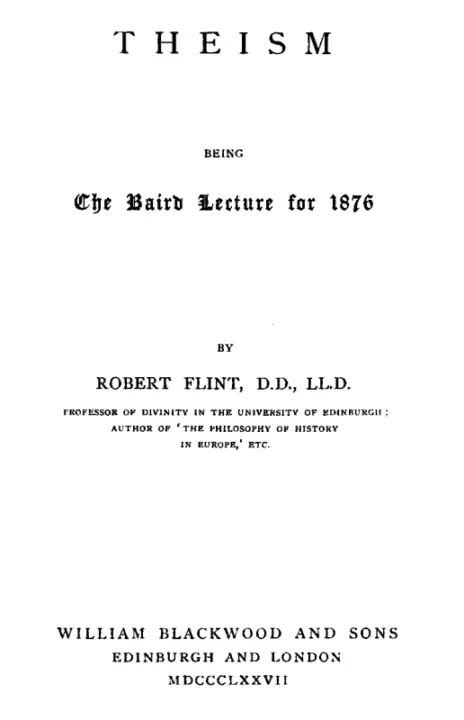
"Theism; Being the Baird Lecture of 1876" by Robert Flint is a religious philosophical treatise written in the late 19th century. The work delves into the nature and validity of belief in God, exploring whether theism can be rationally justified over anti-theistic theories. Flint highlights the importance of understanding the nature of God as a self-existent, perfect being and the implications of belief in God on morality and society. The opening of this volume introduces significant questions regarding the rationality of religious belief. Flint posits that the inquiry should explore the existence of a divine being and whether such belief is justified. He emphasizes that religious belief must be rooted in knowledge, not mere feelings, and lays the groundwork for a thorough examination of theistic proofs by discussing the historical and philosophical context of theism. Flint argues that a worldview devoid of a divine entity ultimately deprives religious experiences of truth and meaning, leading to the idea that all human thought and morality is interconnected with the existence of God.
Introduction adapted from the source catalogue; source summaries may be automatically generated.
Free to read · English · 107,012 words · No account needed
MAKE TIME FOR A GOOD BOOK
On by default. Untick to stop anonymous reading totals. Each page counts after 10 seconds in view. How this works.
Anonymous counting is on unless you have switched it off.
NOTE XIII., page 137.
"Another science regarded as barren of religious applications, and even as sometimes positively injurious, is mathematics. Its principles are, indeed, of so abstruse a nature, that it is not easy to frame out of them a religious argument that is capable of popular illustration. But, in fact, mathematical laws form the basis of nearly all the operations of nature. They constitute, as it were, the very framework of the material world.... It seems, then, that this science forms the very foundation of all arguments for theism, from the arrangements and operations of the material universe. We do, indeed, neglect the foundation, and point only to the superstructure, when we state these arguments. But suppose mathematical laws to be at once struck from existence, and what a hideous case would the universe present! What then would become of the marks of design and unity in nature, and of the theist's argument for the being of a God?... It is said, however, that mathematicians have been unusually prone to scepticism concerning religious truth. If it be so, it probably originates from the absurd attempt to apply mathematical reasoning to moral subjects; or rather, the devotees of this science often become so attached to its demonstrations, that they will not admit any evidence of a less certain character. They do not realise the total difference between moral and mathematical reasonings, and absurdly endeavour to stretch religion on the Procrustean bed of mathematics. No wonder they become sceptics. But the fault is in themselves, not in this science, whose natural tendencies, upon a pure and exalted mind, are favourable to religion."--Hitchcock's Religion of Geology, pp. 387-389.
"Nor can we fail to notice how frequently the law which men have invented proves to have been already known and used in nature. The mathematician devises a geometric locus or an algebraic formula from a priori considerations, and afterward discovers that he has been unwittingly solving a mechanical problem, or explaining the form of a real phenomenon. Thus, for example, in Peirce's 'Integral Calculus,' published in 1843, is a problem invented and solved purely in the enthusiasm of following the analytic symbols; but in 1863 it proved to be a complete prophetic discussion and solution of the problem of two pendulums suspended from one horizontal cord. Thus also Galileo's discussion of the cycloid proved, long afterward, to be a key to problems concerning the pendulum, falling bodies, and resistance to transverse pressure. Four centuries before Christ, Plato and his scholars were occupied upon the eclipse as a purely geometric speculation, and Socrates seemed inclined to reprove them for their waste of time. But in the seventeenth century after Christ, Kepler discovers that the Architect of the heavens had given us magnificent diagrams of the eclipse in the starry heavens; and, since that time, all the navigation and architecture and engineering of the nineteenth century have been built on these speculations of Plato. Equally remarkable is the history of the idea of extreme and mean ratio. Before the Christian era geometers had invented a process for dividing a line in this ratio, that they might use it in an equally abstract and useless problem--the inscribing a regular pentagon in a circle. But it was not until the middle of the present century that it was discovered that this idea is embodied in nature. It is hinted at in some animal forms, it is very thoroughly and accurately expressed in the angles at which the leaves of plants diverge as they grow from the stem, and it is embodied approximately in the revolutions of the planets about the sun.... Now, in all these cases of the embodiment in nature of an idea which men have developed, not by a study of the embodiment, but by an a priori speculation, there seems to us demonstrative evidence that man is made in the image of his Creator; that the thoughts and knowledge of God contain and embrace all possible a priori speculations of men. It is true that God's knowledge is infinite, and beyond our utmost power of conception. But how can we compare the reasonings of Euclid upon extreme and mean ratio with the arrangement of leaves about the stem, and the revolutions of planets around the sun, and not feel that these phenomena of creation express Euclid's idea as exactly as diagrams or Arabic digits could do; and that this idea was, in some form, present in the creation?"--The Natural Foundations of Theology. By T. Hill, D.D., LL.D.
Your reading position is saved on this browser. Take it to another device with a library code. Reading pages adapt to text, rather than matching a printed edition.
BEHIND THE BOOK
This eBook is for the use of anyone anywhere in the United States and most other parts of the world at no cost and with almost no restrictions whatsoever. You may copy it, give it away or re-use it under the terms of the Project Gutenberg License included with this eBook or online at www.gutenberg.org. If you are not located in the United States, you will have to check the laws of the country where you are located before using this eBook. Read the source licence.
The original source file, including credits and licence, is retained by this library. Request an original-format copy at no charge. Please include the book title and Project Gutenberg identifier #45850.
KEEP YOUR CURIOSITY GOING
David Patterson (Spirit) Hatch

David Patterson (Spirit) Hatch

David Patterson (Spirit) Hatch
Coulson Kernahan

Ralph Waldo Emerson
Frances Wright