
Last letters from the living dead man
David Patterson (Spirit) Hatch
THE CLASSIC COLLECTION · 1877
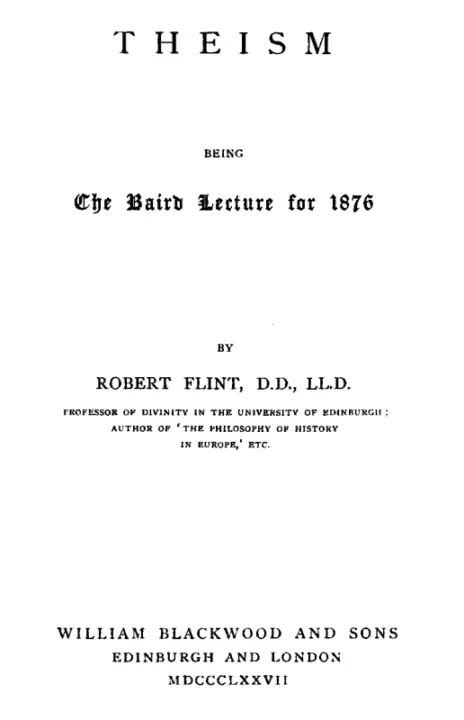
"Theism; Being the Baird Lecture of 1876" by Robert Flint is a religious philosophical treatise written in the late 19th century. The work delves into the nature and validity of belief in God, exploring whether theism can be rationally justified over anti-theistic theories. Flint highlights the importance of understanding the nature of God as a self-existent, perfect being and the implications of belief in God on morality and society. The opening of this volume introduces significant questions regarding the rationality of religious belief. Flint posits that the inquiry should explore the existence of a divine being and whether such belief is justified. He emphasizes that religious belief must be rooted in knowledge, not mere feelings, and lays the groundwork for a thorough examination of theistic proofs by discussing the historical and philosophical context of theism. Flint argues that a worldview devoid of a divine entity ultimately deprives religious experiences of truth and meaning, leading to the idea that all human thought and morality is interconnected with the existence of God.
Introduction adapted from the source catalogue; source summaries may be automatically generated.
Free to read · English · 107,012 words · No account needed
MAKE TIME FOR A GOOD BOOK
On by default. Untick to stop anonymous reading totals. Each page counts after 10 seconds in view. How this works.
Anonymous counting is on unless you have switched it off.
When man apprehends God as powerful, wise, and good--as possessed of will, reason, and righteousness--obviously he thinks of Him as bearing some likeness to himself, as having in an infinite or perfect measure qualities which human creatures have in a finite and imperfect measure. This can be no stumbling-block to any one who believes that God made man in His image, after His likeness. If man be in some respects like God, God must, of course, be in some respects like man. Power and freedom, knowledge and wisdom, love, goodness, and justice, are, according to this view, finitely in man, because they are infinitely in God. But it is a view which excites in certain minds deep aversion. There are men who protest, in the name of religion, in the name of God, against this anthropomorphic theism, as they call it. According to them, to attribute to God any human qualities, even the highest and best, is to limit and degrade Him--is contrary to reason and contrary to piety--is idolatrous and profane. The Psalmist represents the Lord as reproaching the wicked for supposing that He was like them in their wickedness--"altogether such an one as themselves;" but the modern philosophers to whom I am referring are horrified at the thought that the most righteous man, even in his righteousness, has any likeness to God. According to them, to think of God as wise is to dishonour Him, and to declare Him holy is to calumniate Him. To think of Him as foolish, and to pronounce Him wicked, are, in their eyes, only a little more irreverent and no more irrational.
"We must not fall down and worship," writes one of these philosophers, "as the source of our life and virtue, the image which our own minds have set up. Why is such idolatry any better than that of the old wood and stone? If we worship the creations of our minds, why not also those of our hands? The one is, indeed, a more refined self-adoration than the other; but the radical error remains the same in both. The old idolaters were wrong, not because they worshipped themselves, but because they worshipped their creation as if it were their creator; and how can any anthropomorphic theory 'escape the same condemnation'?"[14] The writer does not see that God can only be thought of as wise and righteous and free because the mind of man is His creation, so that His being thus thought of can be no proof that He is its creation. The fact that we can think of God as wise and righteous and free is no evidence that He is an image which our own minds have set up. The man who draws such an inference from such a premiss can be no dispassionate reasoner. And certainly the fact that we can think of God as possessed of intellectual and moral perfections is no reason for our not falling down and worshipping Him, and no evidence that our doing so is idolatry. To fall down and worship any being whom we do not know to possess these characteristics is what would clearly be idolatry. And this idolatry is what the philosophers to whom I refer are manifestly chargeable with encouraging. When they have rejected the living, personal, righteous, loving God, in whom humanity has so long trusted, they can only suggest as a substitute for Him a mysterious Power which is wholly unknown, and even unknowable. Great is their simplicity if they fancy that they can persuade men to receive any such god as that, or if they fancy that men would be any better for a faith so vague and empty. To believe in we know not what, is directly contrary to reason; to worship it would be "an idolatry no better than that of the old wood and stone." What we know is often not the creation of our minds: the unknowable is in itself nothing at all to us, and, as a thought, is always the mere creation of our minds; it is different for each creature, each mind; it is the mere result and reflection of our finiteness. There can be no unknown or unknowable to an infinite mind. To worship what is unknowable would be, therefore, simply to worship our own ignorance--one of the creations of our minds least worthy, perhaps, of being worshipped. There is, at least, no kind of worship less entitled "to escape condemnation," even as anthropomorphic idolatry, than the worship of the Unknowable,--the god proposed to us by some as the alone true God, belief in whom--perhaps I should rather say, belief in which--is to be the final and perfect reconciliation of science and religion.
Your reading position is saved on this browser. Take it to another device with a library code. Reading pages adapt to text, rather than matching a printed edition.
BEHIND THE BOOK
This eBook is for the use of anyone anywhere in the United States and most other parts of the world at no cost and with almost no restrictions whatsoever. You may copy it, give it away or re-use it under the terms of the Project Gutenberg License included with this eBook or online at www.gutenberg.org. If you are not located in the United States, you will have to check the laws of the country where you are located before using this eBook. Read the source licence.
The original source file, including credits and licence, is retained by this library. Request an original-format copy at no charge. Please include the book title and Project Gutenberg identifier #45850.
KEEP YOUR CURIOSITY GOING
David Patterson (Spirit) Hatch

David Patterson (Spirit) Hatch

David Patterson (Spirit) Hatch
Coulson Kernahan

Ralph Waldo Emerson
Frances Wright