
Last letters from the living dead man
David Patterson (Spirit) Hatch
THE CLASSIC COLLECTION · 1877
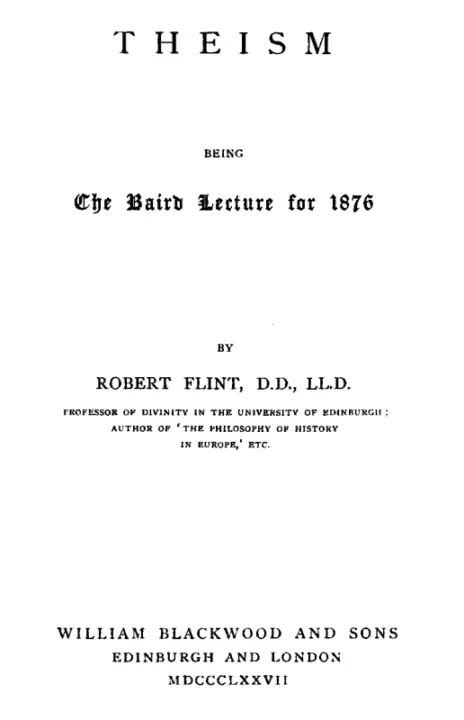
"Theism; Being the Baird Lecture of 1876" by Robert Flint is a religious philosophical treatise written in the late 19th century. The work delves into the nature and validity of belief in God, exploring whether theism can be rationally justified over anti-theistic theories. Flint highlights the importance of understanding the nature of God as a self-existent, perfect being and the implications of belief in God on morality and society. The opening of this volume introduces significant questions regarding the rationality of religious belief. Flint posits that the inquiry should explore the existence of a divine being and whether such belief is justified. He emphasizes that religious belief must be rooted in knowledge, not mere feelings, and lays the groundwork for a thorough examination of theistic proofs by discussing the historical and philosophical context of theism. Flint argues that a worldview devoid of a divine entity ultimately deprives religious experiences of truth and meaning, leading to the idea that all human thought and morality is interconnected with the existence of God.
Introduction adapted from the source catalogue; source summaries may be automatically generated.
Free to read · English · 107,012 words · No account needed
MAKE TIME FOR A GOOD BOOK
On by default. Untick to stop anonymous reading totals. Each page counts after 10 seconds in view. How this works.
Anonymous counting is on unless you have switched it off.
Those who refuse to refer the order and adaptations in the universe to a designing intelligence are bound to account for them in some other way. Has this been done? Has any person succeeded in tracing them back to any other principle which can be reasonably regarded as their cause, or as adequate to their production? This is the question which we have now to consider.
Matter, some would have us believe, is the origin of the order of the universe. Grant it, and there is still the question--What is the origin of matter?--to be disposed of. We have seen that this is a question which we are bound to raise; we have seen that there are strong reasons for holding that matter had an origin, had a beginning in time, and none whatever for regarding it as self-existent and eternal. The very existence of order and system, of mechanical adjustments and organic adaptations in the universe, seems to prove that matter must have had a beginning. If certain collocations of matter evince design, and must have had a beginning, the adaptation of the parts to form the collocation evinces design, and implies a beginning. And if matter had a beginning, its cause can only have been mind. To say that it originated with chance or necessity is plainly absurd. Chance and necessity are meaningless terms unless mind or matter be presupposed. There can be no accidents where neither mind nor matter exists. There can be no chance where there is no law. Chance or accident is what occurs when two or more independent series of phenomena meet, without their meeting having been premeditated and provided for. When one series of causes leads a man to pass a house at a given moment of a given day, and another series of causes, coexistent with but wholly independent of the former series, determines that a heavy body shall fall from the roof of that house at that moment of that day and kill that man, the consequence--his death--is what may be properly called an accident, or matter of chance. One who believes, indeed, in the omniscience and universal foreordination and government of God, will hold that even in such a case the accident or chance is merely apparent; but he will not deny the right of the atheist to speak of chance or accident in this way, or to explain as matters of chance whatever he can. The word chance, or accident, can have no intelligible sense, however, unless there be such independent series of phenomena--unless there be mental and material existences, mental and material laws. Chance cannot be conceived of, even by the atheist, as the origin of existence. The same may be said of necessity. Matter or mind may act necessarily, but necessity cannot act without matter or mind. If it be requisite, therefore, to seek a cause for matter, mind alone can be assigned as its cause. If we are justified in seeking for the origin of matter at all, our choice of an answer lies between mind and absurdity, between a real and sufficient cause and an imaginary and inconceivable cause. Besides, how could matter of itself produce order, even if it were self-existent and eternal? It is far more unreasonable to believe that the atoms or constituents of matter produced of themselves, without the action of a Supreme Mind, this wonderful universe, than that the letters of the English alphabet produced the plays of Shakespeare, without the slightest assistance from the human mind known by that famous name. These atoms might, perhaps, now and then, here and there, at great distances and long intervals, produce, by a chance contact, some curious collocation or compound; but never could they produce order or organisation, on an extensive scale or of a durable character, unless ordered, arranged, and adjusted in ways of which intelligence alone can be the ultimate explanation. To believe that their fortuitous and undirected movements could originate the universe, and all the harmonies and utilities and beauties which abound in it, evinces a credulity far more extravagant than has ever been displayed by the most superstitious of religionists. Yet no consistent materialist can refuse to accept this colossal chance-hypothesis. All the explanations of the order of the universe which materialists, from Democritus and Epicurus to Diderot and Lange, have devised, rest on the assumption that the elements of matter, being eternal, must pass through infinite combinations, and that one of these must be our present world--a special collocation among the countless millions of collocations, past and future. Throw the letters of the Greek alphabet, it has been said, an infinite number of times, and you must produce the Iliad and all Greek books. The theory of probabilities, I need hardly say, requires us to believe nothing so absurd. Throw letters together without thought through all eternity, and you will never make them express thought. All the letters in the Iliad might have been tossed and jumbled together from morning to night by the hands of the whole human race, from the beginning of the world until now, and the first line of the Iliad would have been still to compose, had not the genius of Homer been inspired to sing the wrath of Achilles and the war around Troy. But what is the Iliad to the hymn of creation, and the drama of providence? Were these glorious works composed by the mere jumbling together of atoms, which were not even prepared beforehand to form things, as letters are to form words, and which had to shake themselves into order without the help of any hand? They may believe that who can. It seems to me that it ought to be much easier to believe all the Arabian Nights.
Your reading position is saved on this browser. Take it to another device with a library code. Reading pages adapt to text, rather than matching a printed edition.
BEHIND THE BOOK
This eBook is for the use of anyone anywhere in the United States and most other parts of the world at no cost and with almost no restrictions whatsoever. You may copy it, give it away or re-use it under the terms of the Project Gutenberg License included with this eBook or online at www.gutenberg.org. If you are not located in the United States, you will have to check the laws of the country where you are located before using this eBook. Read the source licence.
The original source file, including credits and licence, is retained by this library. Request an original-format copy at no charge. Please include the book title and Project Gutenberg identifier #45850.
KEEP YOUR CURIOSITY GOING
David Patterson (Spirit) Hatch

David Patterson (Spirit) Hatch

David Patterson (Spirit) Hatch
Coulson Kernahan

Ralph Waldo Emerson
Frances Wright