
Last letters from the living dead man
David Patterson (Spirit) Hatch
THE CLASSIC COLLECTION · 1877
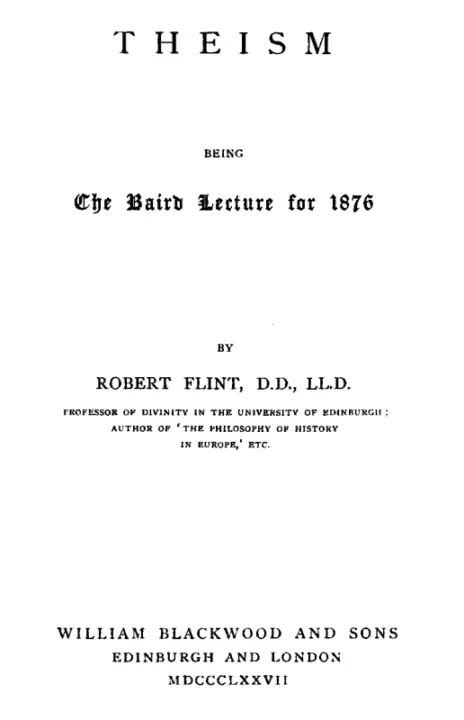
"Theism; Being the Baird Lecture of 1876" by Robert Flint is a religious philosophical treatise written in the late 19th century. The work delves into the nature and validity of belief in God, exploring whether theism can be rationally justified over anti-theistic theories. Flint highlights the importance of understanding the nature of God as a self-existent, perfect being and the implications of belief in God on morality and society. The opening of this volume introduces significant questions regarding the rationality of religious belief. Flint posits that the inquiry should explore the existence of a divine being and whether such belief is justified. He emphasizes that religious belief must be rooted in knowledge, not mere feelings, and lays the groundwork for a thorough examination of theistic proofs by discussing the historical and philosophical context of theism. Flint argues that a worldview devoid of a divine entity ultimately deprives religious experiences of truth and meaning, leading to the idea that all human thought and morality is interconnected with the existence of God.
Introduction adapted from the source catalogue; source summaries may be automatically generated.
Free to read · English · 107,012 words · No account needed
MAKE TIME FOR A GOOD BOOK
On by default. Untick to stop anonymous reading totals. Each page counts after 10 seconds in view. How this works.
Anonymous counting is on unless you have switched it off.
In an article concerning the cosmological problem, published in the first number of the 'Vierteljahrsschrift f. Wissenschaftliche Philosophie,' Professor Wundt rejects the theory in question on extremely weak grounds. "It is easy to see," he says, "that, in the case of the English physicists at least, the desire of harmonising the data of the exact sciences with theological conceptions has not been without influence on this limitation of the universe." The rashness displayed by such a statement, and the utter want of evidence or probability for it, as regards men like Thomson or Tait, need not be pointed out. Besides, Clausius and Helmholtz are neither English physicists nor likely to be influenced by theological conceptions. Will it be believed that, notwithstanding this charge against others, Professor Wundt's own reasoning is not scientific, but merely anti-theological? Such is the case. If the Thomsonian theory be admitted, a place is left for creative action, for miracle; and this, he argues, is a contradiction of the principle of causality. Therefore the theory must be rejected. It is to be regretted that so eminent a man of science should employ so unscientific an argument.
There is obviously a very widespread unwillingness to accept the Thomsonian theory; but, so far as I am aware, good reasons have not yet been given for its rejection. The contrast between the reception which it has received and that which has been accorded to the Darwinian theory is certainly curious, and probably instructive.
NOTE XII., page 130.
The argument for the Divine existence which proceeds on the principle of causality is generally called the cosmological argument, but sometimes, and perhaps more accurately, the ætiological argument. The proof from order is not unfrequently termed cosmological. It is impossible to keep the ætiological argument entirely separate either from the ontological or cosmological argument. Ætiological reasoning may be detected as a creative factor in the rudest religious creeds. The search for causes began not with the origin of philosophy but with the origin of religion. Passages like Ps. xc. 1, 2, cii. 26-28; Rom. i. 19, 20; Heb. i. 10-12--have been referred to as anticipations of the argument. Wherever nature is spoken of in Scripture, it is as the work of an uncreated being, of a free and sovereign mind. Aristotle gave a formal expression to the ætiological argument by inferring from the motion of the universe the existence of a first unmoved mover--Phys., vii. 1, 2, viii. 7, 9, 15. Cicero repeated his reasoning, and tells us it had been also employed by Carneades, De Nat. Deor., ii. 9, iii. 12, 13. Well known is St Augustine's "Interrogavi terram, et dixit: non sum. Interrogavi mare et abyssos--et responderunt: non sumus deus tuus, quære super nos. Interrogavi coelum, solem, lunam, stellas: neque nos sumus deus, quem quæris, inquiunt. Et dixi omnibus iis--dicite mihi de illo aliquid. Et exclamaverunt voce magna: ipse fecit nos. Interrogavi mundi molem de Deo meo et respondit mihi: non ego sum, sed ipse me fecit."--Conf., x. 6. Diodorus of Tarsus (Phot. Bib. Cod., 223, p. 209 Bekk.), and John of Damascus (De Fid. Orth., i. 3), inferred the necessity of a creative unity from the mutability and corruptibility of worldly things. Thomas Aquinas argued on the principle of causality in three ways--viz.: 1. From motion to a first moving principle, which is not moved by any other principle; 2. From effects to a first efficient cause; and 3. From the possible and contingent to what is in itself necessary.--Summa. P. i., Qu. 2, 3. Most of the theologians of the sixteenth, seventeenth, and eighteenth centuries who treat of the proofs of the Divine existence, employ in some form the argument from causation. Thus, in Pearson 'On the Creed' and Charnock's 'Discourses on the Existence and Attributes of God' will be found good examples of how it was presented in this country in the seventeenth century. Hume's speculations on causation attracted attention to it. The philosophers of the Scottish school and their adherents among the theologians laboured to present it in a favourable light. In Germany, Leibnitz (Théodicée, I. c. 7) and Wolff (Rational Thoughts of God, § 928) laid stress on the accidental contingent character of the world and its contents, and, relying on the principle of the sufficient reason, concluded that there must be a universal and permanent cause of all that is changing and transitory, an absolute ground of all that is relative and derivative. Further, Wolff and his followers raised on this reasoning a large amount of metaphysical speculation as to the nature of a necessary cause, the properties of an absolute Being, which was of a very questionable sort in itself, and had no proper connection with the so-called cosmological argument. To this argument, as stated by Wolff, Kant applied his transcendental criticism, and proved, as he thought, that it was "a perfect nest of dialectical assumptions." His argumentation may be allowed to have had force against Wolff, but it is weak wherever it is relevant to the ætiological proof rightly understood. In fact, his objections openly proceed on the assumption that the principle of causality is only applicable within the sphere of sense experience. If this be true, no objections, of course, are necessary. As a rule, the ætiological argument is not skilfully or even carefully treated in the works of recent German theologians. It has been expounded, however, with great philosophical ability and with a rare wealth of scientific knowledge, by Professor Ulrici of Halle, in the work entitled 'Gott und die Natur.' A translation of this treatise would confer a real service both on the theology and philosophy of this country.
Your reading position is saved on this browser. Take it to another device with a library code. Reading pages adapt to text, rather than matching a printed edition.
BEHIND THE BOOK
This eBook is for the use of anyone anywhere in the United States and most other parts of the world at no cost and with almost no restrictions whatsoever. You may copy it, give it away or re-use it under the terms of the Project Gutenberg License included with this eBook or online at www.gutenberg.org. If you are not located in the United States, you will have to check the laws of the country where you are located before using this eBook. Read the source licence.
The original source file, including credits and licence, is retained by this library. Request an original-format copy at no charge. Please include the book title and Project Gutenberg identifier #45850.
KEEP YOUR CURIOSITY GOING
David Patterson (Spirit) Hatch

David Patterson (Spirit) Hatch

David Patterson (Spirit) Hatch
Coulson Kernahan

Ralph Waldo Emerson
Frances Wright