
Last letters from the living dead man
David Patterson (Spirit) Hatch
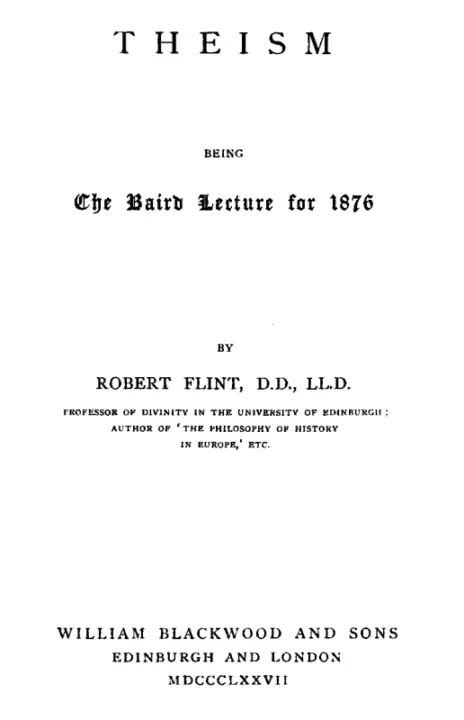
THE CLASSIC COLLECTION · 1877
"Theism; Being the Baird Lecture of 1876" by Robert Flint is a religious philosophical treatise written in the late 19th century. The work delves into the nature and validity of belief in God, exploring whether theism can be rationally justified over anti-theistic theories. Flint highlights the importance of understanding the nature of God as a self-existent, perfect being and the implications of belief in God on morality and society. The opening of this volume introduces significant questions regarding the rationality of religious belief. Flint posits that the inquiry should explore the existence of a divine being and whether such belief is justified. He emphasizes that religious belief must be rooted in knowledge, not mere feelings, and lays the groundwork for a thorough examination of theistic proofs by discussing the historical and philosophical context of theism. Flint argues that a worldview devoid of a divine entity ultimately deprives religious experiences of truth and meaning, leading to the idea that all human thought and morality is interconnected with the existence of God.
Introduction adapted from the source catalogue; source summaries may be automatically generated.
Free to read · English · 107,012 words · No account needed
MAKE TIME FOR A GOOD BOOK
On by default. Untick to stop anonymous reading totals. Each page counts after 10 seconds in view. How this works.
Anonymous counting is on unless you have switched it off.
Conscience reveals a purpose as well as declares a law. Its very existence is a proof of purpose. The eye is not more certainly given us in order that we may see, than conscience is given us in order that we may use all our powers in a righteous and beneficent manner. Is it conceivable that any other than a righteous God would have bestowed on us such a gift, such a faculty? Would an intelligent but unrighteous God have made us to hate and despise what is characteristic of his own nature? Would he have made us better than himself? The purpose which conscience reveals is certainly not our own purpose, just as the law which it declares is not the law of our own will. The purpose which finds its expression in conscience, and our own purpose, are often felt by us to be in direct antagonism. Our souls may be tortured by the conflict between them. But in all phases of the conflict we are sensible that it is our purpose which ought to be abandoned; that the purpose which we dislike is that which we are bound to accept and to obey. In this way, also, conscience speaks to us of a righteous God by speaking in His name. If the inference from effect to cause, from manifestation of purpose to intelligence, is good anywhere, it is good here; and it warrants us to believe that the First Cause of conscience is a righteous Being.[37]
[37] See Appendix XXVII.
All the feelings, emotions, and affections which gather around the apprehension of right and wrong, which accompany the sense of duty or conviction of obligation, point to the same conclusion. The consciousness of good or ill desert, remorse and self-approval, moral hopes and fears, concur in referring to a holy God. They imply that man is a person related not merely to things and laws, but to another person who is his rightful and righteous Judge. The atheist himself, when he grieves even for secret and private sins, or enjoys the inner peace which only his own heart knoweth, mourns and rejoices as if in the presence of a higher personal Being--the God whom he denies. Neither his sorrow nor his satisfaction is fully intelligible if his soul have before it only an impersonal law or the abstract nature of things; both presuppose that he has some kind of consciousness of being under the cognisance of a Person possessed of moral attributes. If men felt that they were responsible for their evil thoughts and words and deeds to no one higher than themselves or their fellows, is it conceivable that the consciousness of guilt and the fear of retribution would have been what experience and history testify them to have been? Would prayers and penances and sacrifices have prevailed so widely, if the law of right and wrong when broken had been merely felt to be broken--if there were no underlying sense of the existence of One behind the law whose righteousness must be satisfied, and whose wrath must be turned away by the breaker of the law? Would there have been in that case any moral conflicts in the human heart akin to those which a Sophocles or a Shakespeare has delineated? Were there no God, there ought to be no fear of God awakened even by crime; but atheism itself cannot protect a criminal when alive to his guilt from being haunted and appalled by fears of a judgment and a justice more terrible than those of man. When we are perfectly willing to bear any pain which the mere laws of nature attach to our sins, and when our reason assures us that we have nothing to fear on account of them from the law or even the opinion of society, why, if our moral natures are not seared and deadened, do we yet fear, and fear most when most alone? "Inanimate things," says Dr Newman, "cannot stir our affections; these are correlative with persons. If, as is the case, we feel responsibility, are ashamed, are frightened, at transgressing the voice of conscience, this implies that there is One to whom we are responsible, before whom we are ashamed, whose claims upon us we fear. If, on doing wrong, we feel the same tearful, broken-hearted sorrow which overwhelms us on hurting a mother; if, on doing right, we enjoy the same seeming serenity of mind, the same soothing, satisfactory delight which follows on one receiving praise from a father,--we certainly have within us the image of some person to whom our love and veneration look, in whose smile we find our happiness, for whom we yearn, towards whom we direct our pleadings, in whose anger we are troubled and waste away. These feelings in us are such as require for their exciting cause an intelligent being; we are not affectionate towards a stone, nor do we feel shame before a horse or a dog; we have no remorse or compunction in breaking mere human law: yet, so it is, conscience excites all these painful emotions, confusion, foreboding, self-condemnation; and, on the other hand, it sheds upon us a deep peace, a sense of security, a resignation, and a hope, which there is no sensible, no earthly object to elicit. 'The wicked flees, when no one pursueth;' then why does he flee? Whence his terror? Who is it that he sees in solitude, in darkness, in the hidden chambers of his heart? If the cause of these emotions does not belong to this visible world, the Object to which his perception is directed must be Supernatural and Divine; and thus the phenomena of conscience, as a dictate, avail to impress the imagination with the picture of a Supreme Governor, a Judge, holy, just, powerful, all-seeing, retributive."[38]
Your reading position is saved on this browser. Take it to another device with a library code. Reading pages adapt to text, rather than matching a printed edition.
BEHIND THE BOOK
This eBook is for the use of anyone anywhere in the United States and most other parts of the world at no cost and with almost no restrictions whatsoever. You may copy it, give it away or re-use it under the terms of the Project Gutenberg License included with this eBook or online at www.gutenberg.org. If you are not located in the United States, you will have to check the laws of the country where you are located before using this eBook. Read the source licence.
The original source file, including credits and licence, is retained by this library. Request an original-format copy at no charge. Please include the book title and Project Gutenberg identifier #45850.
KEEP YOUR CURIOSITY GOING
David Patterson (Spirit) Hatch

David Patterson (Spirit) Hatch

David Patterson (Spirit) Hatch
Coulson Kernahan

Ralph Waldo Emerson
Frances Wright