
Last letters from the living dead man
David Patterson (Spirit) Hatch
THE CLASSIC COLLECTION · 1877
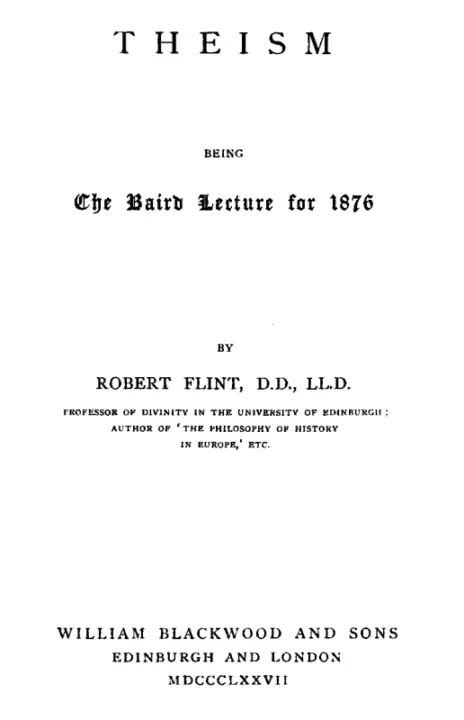
"Theism; Being the Baird Lecture of 1876" by Robert Flint is a religious philosophical treatise written in the late 19th century. The work delves into the nature and validity of belief in God, exploring whether theism can be rationally justified over anti-theistic theories. Flint highlights the importance of understanding the nature of God as a self-existent, perfect being and the implications of belief in God on morality and society. The opening of this volume introduces significant questions regarding the rationality of religious belief. Flint posits that the inquiry should explore the existence of a divine being and whether such belief is justified. He emphasizes that religious belief must be rooted in knowledge, not mere feelings, and lays the groundwork for a thorough examination of theistic proofs by discussing the historical and philosophical context of theism. Flint argues that a worldview devoid of a divine entity ultimately deprives religious experiences of truth and meaning, leading to the idea that all human thought and morality is interconnected with the existence of God.
Introduction adapted from the source catalogue; source summaries may be automatically generated.
Free to read · English · 107,012 words · No account needed
MAKE TIME FOR A GOOD BOOK
On by default. Untick to stop anonymous reading totals. Each page counts after 10 seconds in view. How this works.
Anonymous counting is on unless you have switched it off.
The argument from conscience, like all the other theistic arguments, is extremely simple. It is the obvious inference from the most obvious facts of our moral consciousness. It demands of us no subtle analysis of conscience. It is not dependent on the truth of some one particular theory as to the origin of conscience. It is based directly on what cannot be denied or disputed,--the existence of conscience, the existence of certain moral judgments and feelings common to the experience of all men. Conscience exists. It exists as a consciousness of moral law; as an assertion of a rule of duty; as a sense of responsibility. When it pronounces an action right, it does so because it recognises it to be conformed to law; when it pronounces an action wrong, it does so because it recognises it to fall short of or to transgress law. It acts as the judge of all that we do, and as such it accuses or excuses, condemns or approves, punishes or rewards us, with a voice of authority, which we may so far disregard, but the legitimacy of which we cannot dispute. It claims to rule over body and soul, heart and mind, all our appetites, affections, and faculties; and the claim is implicitly admitted even by those who have most interest in denying it. But it does not rule, nor pretend to rule, as an autocratic authority; it does not give us, nor pretend to give us, a law of its own: on the contrary, it claims to rule in us only in virtue of recognising a law which is over us; its authority is derived wholly from a law which it interprets and applies, but does not create. It thus speaks not of itself but as the deputy of another. It unequivocally declares itself a delegated authority. Some may say that the law of conscience is set by man's own will, and that the will is a law unto itself; but this assertion cannot bear examination. The will apart from reason and conscience is a mere force, not a true will. It has a rational law only through its connection with reason, a moral law only through its connection with conscience. Whoever affirms that the will is its own law must grossly abuse language, and signify by the term will what others mean by reason and will, conscience and will. He must do worse than this, bad as it is. He must contradict the plain dictates of his own consciousness. The will and its law are distinctly felt to be not one but two. The will is clearly realised in our moral experience as not legislative, as not giving itself a law but as being under a law, the law which conscience apprehends. To identify the will and its law is to confound entirely distinct things. For the will to rule the will, it would need at once to command and to obey, to be bond and free, dependent and independent. To be its own rule were for it to be without rule. Conscience claims to rule my will in virtue of a law which cannot be the expression of my will, and which cannot be anything else than the expression of another will; one often in antagonism to mine--one always better than mine--one which demands from me an unvarying and complete obedience. It comes to me and speaks to me in defiance of my will; when my will is set against hearing it, and still more against obeying it; when my will is bent on stifling and drowning its voice. It warns, threatens, condemns, and punishes me, against my will, and with a voice of authority as the delegate or deputy of a perfectly good and holy will which has an absolute right to rule over me, to control and sway all my faculties; which searches me and knows me; which besets me behind and before. Whose is this perfect, authoritative, supreme will, to which all consciences, even the most erring, point back? Whose, if not God's? Those who object that this argument is a mere verbal inference, or that it rests on a double meaning of the word law, do not understand it, simple as it is. They may be honest enough disputants, but their objection is strangely superficial. In the utterly irrelevant criticism of a word they lose sight of a great fact, and so necessarily fail to perceive its momentous significance. From no mere word, whether law or any other, but from that consciousness of moral dependence which no moral creature can shake off, which conscience implies in every exercise, which reveals itself in a thousand ways in the hearts and lives of men, do we conclude that there is One on whom we morally depend, that we have a holy Creator and Judge to deal with. Reason takes no mere name, but it takes the fact that man feels himself under a law of duty, that he is conscious of obligation and responsibility, that he has a conscience which does not counsel but which commands him to do what is right and to resist what is wrong; and it finds this fact inexplicable, this consciousness a delusion, this conscience a false witness--unless there be a holy God, a Moral Governor.
Your reading position is saved on this browser. Take it to another device with a library code. Reading pages adapt to text, rather than matching a printed edition.
BEHIND THE BOOK
This eBook is for the use of anyone anywhere in the United States and most other parts of the world at no cost and with almost no restrictions whatsoever. You may copy it, give it away or re-use it under the terms of the Project Gutenberg License included with this eBook or online at www.gutenberg.org. If you are not located in the United States, you will have to check the laws of the country where you are located before using this eBook. Read the source licence.
The original source file, including credits and licence, is retained by this library. Request an original-format copy at no charge. Please include the book title and Project Gutenberg identifier #45850.
KEEP YOUR CURIOSITY GOING
David Patterson (Spirit) Hatch

David Patterson (Spirit) Hatch

David Patterson (Spirit) Hatch
Coulson Kernahan

Ralph Waldo Emerson
Frances Wright