THE CLASSIC COLLECTION✦In quest of the perfect bookCLASSIC FREE BOOKS
In quest of the perfect book
William Dana Orcutt
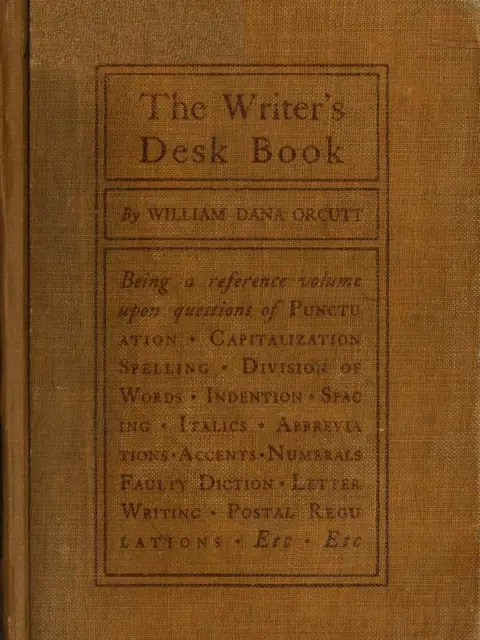
THE CLASSIC COLLECTION · 1912
"The Writer's Desk Book" by William Dana Orcutt is a reference guide on writing mechanics and conventions, likely written in the early 20th century. The book addresses various aspects of writing, including punctuation, capitalization, spelling, and letter writing. It aims to provide clarity and guidance for writers by outlining the rules and principles that enhance effective communication. The opening of the book introduces its nature as a practical reference, listing contents that cover a wide array of topics essential for proper writing. Topics include punctuation marks, rules for capitalization, spelling considerations, as well as guidelines for letter writing and postal regulations. The text emphasizes the importance of correct punctuation and provides detailed rules and examples to ensure clarity and consistency in written communication. This foundational approach suggests that the volume serves as a beneficial tool for both aspiring and seasoned writers seeking to refine their craft.
Introduction adapted from the source catalogue; source summaries may be automatically generated.
Free to read · English · 35,564 words · No account needed
MAKE TIME FOR A GOOD BOOK
On by default. Untick to stop anonymous reading totals. Each page counts after 10 seconds in view. How this works.
Anonymous counting is on unless you have switched it off.
«Must», should not be used for had to or was obliged: e.g., The hour arrived when he must [had to] decide. In its proper use it refers to the present or future: e.g., The hour will arrive when he must decide {108}
«Mutual», should not be used in the sense of “shared in common,” as it means “reciprocal.” It can refer to but two persons or things. Mutual friendship is that which exists between two friends; common friendship that which is shared by two friends for a third
«Negligence», implies failure to conform to an established custom; neglect means “a failure to act”
«Neither», signifies one of two. In designating one of three or more,
say No one
«News», is singular in construction
«Nice», should not be used loosely; as, She was nice to us. It means keenness in discrimination; as, It was a fine point, nicely considered. The incorrect use of this word is an Americanism especially offensive to the English. Oscar Wilde, when in America, remarked, “I think nice is a nasty word,” to which his hearer retorted, “I don’t think nasty is a nice word”
«No place», should be written nowhere
«Nor», see «Or»
«Not . . . but», forms a double negative: e.g., I have not asked you but once should be I have asked you but once
«Notorious», is not a synonym for celebrated or famous. It means
“of bad repute”
«Nowhere near», is a vulgarism for not nearly
NUMBER: pronouns are often used which differ in number from their antecedents: e.g., Nobody should feel that their [his] interests have been neglected; Each of the ladies, like two excellent actresses, were [was] perfect in their [her] parts [part]. Singular nouns are sometimes used with plural verbs, or the reverse: e.g., None but the brave deserve [deserves] the fair; There’s [there are] the boys
«Of», is sometimes wrongly used for have: e.g., I shouldn’t of [have] come if I had known
«Or», should not be used with neither. Use nor {109}
«Ought», should never be combined with had: e.g., You hadn’t ought to do that should be You ought not to do that
«Out loud», should never be used for aloud
«Partake of», should not be used in the sense of eat. It means “to
share with others”
«Party», should not be used for person
«Per», should not be used with English words. Say One dollar a year, or One dollar per annum
«Perception», means the inlet of all the materials of knowledge; apperception means the knowledge that one possesses these materials. A man with perception knows; a man with apperception knows that he knows
Your reading position is saved on this browser. Take it to another device with a library code. Reading pages adapt to text, rather than matching a printed edition.
William Dana Orcutt
William Dana Orcutt
William Dana Orcutt
William Dana Orcutt
BEHIND THE BOOK
This eBook is for the use of anyone anywhere in the United States and most other parts of the world at no cost and with almost no restrictions whatsoever. You may copy it, give it away or re-use it under the terms of the Project Gutenberg License included with this eBook or online at www.gutenberg.org. If you are not located in the United States, you will have to check the laws of the country where you are located before using this eBook. Read the source licence.
The original source file, including credits and licence, is retained by this library. Request an original-format copy at no charge. Please include the book title and Project Gutenberg identifier #54025.
KEEP YOUR CURIOSITY GOING

Charles G. (Charles Griffith) Ross
Hannah Webster Foster

Emily Lawless
Edwin Hamlin Carr

Charles De Lano Hine
Andrew Ure