THE CLASSIC COLLECTION✦In quest of the perfect bookCLASSIC FREE BOOKS
In quest of the perfect book
William Dana Orcutt
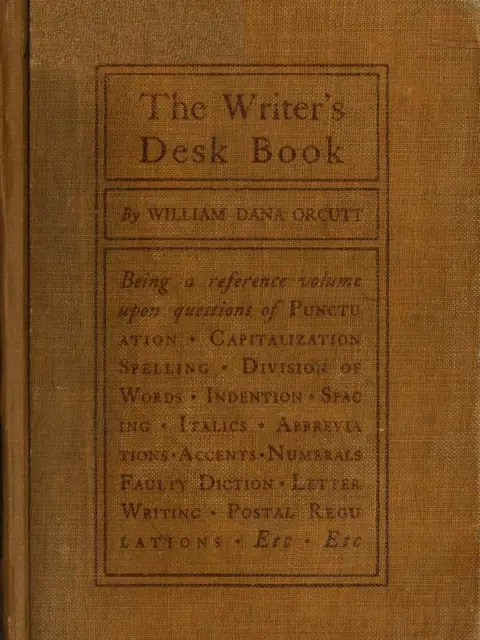
THE CLASSIC COLLECTION · 1912
"The Writer's Desk Book" by William Dana Orcutt is a reference guide on writing mechanics and conventions, likely written in the early 20th century. The book addresses various aspects of writing, including punctuation, capitalization, spelling, and letter writing. It aims to provide clarity and guidance for writers by outlining the rules and principles that enhance effective communication. The opening of the book introduces its nature as a practical reference, listing contents that cover a wide array of topics essential for proper writing. Topics include punctuation marks, rules for capitalization, spelling considerations, as well as guidelines for letter writing and postal regulations. The text emphasizes the importance of correct punctuation and provides detailed rules and examples to ensure clarity and consistency in written communication. This foundational approach suggests that the volume serves as a beneficial tool for both aspiring and seasoned writers seeking to refine their craft.
Introduction adapted from the source catalogue; source summaries may be automatically generated.
Free to read · English · 35,564 words · No account needed
MAKE TIME FOR A GOOD BOOK
On by default. Untick to stop anonymous reading totals. Each page counts after 10 seconds in view. How this works.
Anonymous counting is on unless you have switched it off.
2. Spell out names of companies, railroads, etc., using the ampersand (&) only between proper names: e.g., Brown & Sharpe Manufacturing Company; Norfolk & Western Railroad; but American Smelting and Refining Company. If names of railroads are abbreviated, use no space between the letters: e.g., N.Y., N.H. & H.R.R.
3. Abbreviate United States when immediately associated with the name of an officer of the army or navy, as Lieut. John Doe, U.S.A.; when it is the name of an organization of the army or navy, as First Regiment U.S.V.; when preceding the name of a government vessel, as U.S.S. Brooklyn.
4. In referring to plays, specify act, scene, and line, also part if necessary: e.g., 2 Henry IV, I, ii, 1–7.
5. Christian names should be spelled in full, as John, George, Charles, except in an {67} original signature, or when following copy in a quotation.
6. When necessary to abbreviate Christian names, use the forms Dan., Edw., Sam., Thos., etc. Alex, Ben, Ed, and Sam are not always abbreviations, and copy should be followed as regards period. Use the following list:
Alex. Alexander
And. Andrew
Anth. Anthony
Ap. Appius
Arch. Archibald
Aug. August, Augustus
Benj. Benjamin
C. Caesar
Caes. Aug. Caesar Augustus
Cath. Catherine
Chas. Charles
Dan. Daniel
Eben. Ebenezer
Edm. Edmund
Edw. Edward
Eliz. Elizabeth
Esd. Esdras
Esth. Esther
Ez. Ezra
Ezek. Ezekiel
Ferd. Ferdinand
Fran. Francis
Fred. Frederic, Frederick
Geo. George
Herbt. Herbert
Hos. Hosea {68}
Jas. James
Jona. Jonathan
Jos. Joseph
Josh. Joshua
Matt. Matthew
Nath. Nathaniel
Pet. Peter
Phil. Philip, Philander
Philem. Philemon
Reg. Reginald
Richd. Richard
Robt. Robert
Sam. Samuel
Theo. Theodore
Thos. Thomas
Tim. Timothy
Wm. William
1. In ordinary body matter use generally accepted abbreviations of titles when they are immediately prefixed to names.
2. Do not abbreviate a title used as part of a name: e.g., Bishop Lawrence, not Bp. Lawrence.
3. Such titles as Mr., Mrs., Messrs., Gen., Dr., Hon., Rev., when prefixed to names, may be abbreviated; but Colonel, Major, Professor, President, ex-President, etc., are better spelled in full. Compound titles, such as Major-General, Lieutenant-Colonel, Rear-Admiral, etc., should also be spelled and both {69} words capitalized. Where a person has been mentioned by name and title, and is afterward mentioned by title only, the title should be capitalized. Where initials of a name are used, abbreviate the title: e.g., Col. T. G. Benson, of the Second Illinois Regiment, has returned from Havana. The Colonel’s friends gave him a warm reception.
Your reading position is saved on this browser. Take it to another device with a library code. Reading pages adapt to text, rather than matching a printed edition.
William Dana Orcutt
William Dana Orcutt
William Dana Orcutt
William Dana Orcutt
BEHIND THE BOOK
This eBook is for the use of anyone anywhere in the United States and most other parts of the world at no cost and with almost no restrictions whatsoever. You may copy it, give it away or re-use it under the terms of the Project Gutenberg License included with this eBook or online at www.gutenberg.org. If you are not located in the United States, you will have to check the laws of the country where you are located before using this eBook. Read the source licence.
The original source file, including credits and licence, is retained by this library. Request an original-format copy at no charge. Please include the book title and Project Gutenberg identifier #54025.
KEEP YOUR CURIOSITY GOING

Charles G. (Charles Griffith) Ross
Hannah Webster Foster

Emily Lawless
Edwin Hamlin Carr

Charles De Lano Hine
Andrew Ure