THE CLASSIC COLLECTION✦In quest of the perfect bookCLASSIC FREE BOOKS
In quest of the perfect book
William Dana Orcutt
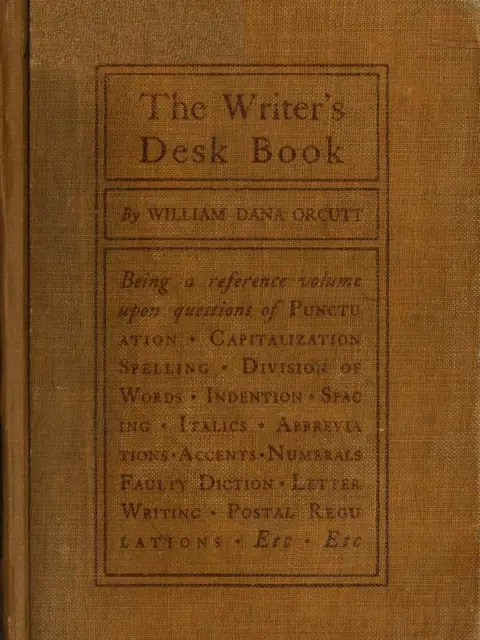
THE CLASSIC COLLECTION · 1912
"The Writer's Desk Book" by William Dana Orcutt is a reference guide on writing mechanics and conventions, likely written in the early 20th century. The book addresses various aspects of writing, including punctuation, capitalization, spelling, and letter writing. It aims to provide clarity and guidance for writers by outlining the rules and principles that enhance effective communication. The opening of the book introduces its nature as a practical reference, listing contents that cover a wide array of topics essential for proper writing. Topics include punctuation marks, rules for capitalization, spelling considerations, as well as guidelines for letter writing and postal regulations. The text emphasizes the importance of correct punctuation and provides detailed rules and examples to ensure clarity and consistency in written communication. This foundational approach suggests that the volume serves as a beneficial tool for both aspiring and seasoned writers seeking to refine their craft.
Introduction adapted from the source catalogue; source summaries may be automatically generated.
Free to read · English · 35,564 words · No account needed
MAKE TIME FOR A GOOD BOOK
On by default. Untick to stop anonymous reading totals. Each page counts after 10 seconds in view. How this works.
Anonymous counting is on unless you have switched it off.
16. A word in the past tense, pronounced as one syllable, should not be
divided: e.g., beamed.
17. The separation of two initials of a person’s name, or such combination as B.C., A.M., should be avoided.
18. A divided word that will appear on the last line of one page and the top line of the next page is to be avoided.
19. Separating a divisional mark (a) or (b) from the matter to which it pertains should be avoided.
20. Adjectives ending in -ical should be divided upon the i: e.g., musi-cal, not music-al or mu-sical.
21. Word endings -tion, -sion, -tial, -cial, -tive, etc., are
treated as one syllable.
22. In compound words additional hyphens should be avoided: e.g., music-lesson, not music-les-son.
Keep prefixes, roots, suffixes, etc., as distinct as possible.
NOTE. Division of words in French, Italian, German, and Spanish, may be found in De Vinne’s “Correct Composition,” pp. 434–446. {55}
In prose manuscript, each paragraph should be written with regular
indention.
2. When paragraphs are numbered, the figure should be written where the capital letter of the first word would otherwise be placed.
3. In poetry, lines which overrun should be written with reverse
indention.
4. When poetry is quoted in a prose composition, it should begin on a new line. If the continuation of the prose writing does not call for a new paragraph, the next line of prose text begins without indention.
5. When a prose quotation is introduced, it should be treated as in Rule 4 if it contains more than a single sentence; otherwise it is “run in,” with the proper quotation-marks and punctuation.
6. There are different forms of indention in typography which are used for different purposes, viz.:
«Irregular indention.»— For this form of indention there are no specified rules, and it is used principally in certain styles of poetry and in display work. {56}
«En échelon indention» is largely used for display in posters and advertisements. It consists in the diagonal arrangement of words, thus:
«Hanging indention», which makes the first
line of full width and indents all the
following lines one or more ems on the
left, as shown in these four lines.
«Half-diamond indention» was used largely by
early printers, particularly by Aldus,
not only for title-pages, but also
for chapter endings. It consists
in arranging all lines
right and left
thus
«Lozenge indention» requires an arrangement of the lines in this manner:
IT IS ALWAYS A
TROUBLESOME THING
TO ACCOMPLISH AS IT TAKES
MUCH EXPERIMENTING
TO GAIN RESULTS
BLOCKED INDENTION CALLS FOR
AN ARRANGEMENT OF THE WORDS
IN SUCH A MANNER THAT THE
LINES ARE ALL OF EQUAL LENGTH
Your reading position is saved on this browser. Take it to another device with a library code. Reading pages adapt to text, rather than matching a printed edition.
William Dana Orcutt
William Dana Orcutt
William Dana Orcutt
William Dana Orcutt
BEHIND THE BOOK
This eBook is for the use of anyone anywhere in the United States and most other parts of the world at no cost and with almost no restrictions whatsoever. You may copy it, give it away or re-use it under the terms of the Project Gutenberg License included with this eBook or online at www.gutenberg.org. If you are not located in the United States, you will have to check the laws of the country where you are located before using this eBook. Read the source licence.
The original source file, including credits and licence, is retained by this library. Request an original-format copy at no charge. Please include the book title and Project Gutenberg identifier #54025.
KEEP YOUR CURIOSITY GOING

Charles G. (Charles Griffith) Ross
Hannah Webster Foster

Emily Lawless
Edwin Hamlin Carr

Charles De Lano Hine
Andrew Ure