THE CLASSIC COLLECTION✦In quest of the perfect bookCLASSIC FREE BOOKS
In quest of the perfect book
William Dana Orcutt
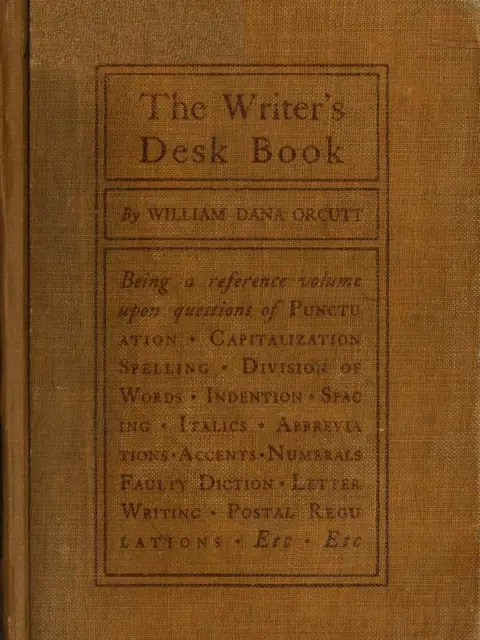
THE CLASSIC COLLECTION · 1912
"The Writer's Desk Book" by William Dana Orcutt is a reference guide on writing mechanics and conventions, likely written in the early 20th century. The book addresses various aspects of writing, including punctuation, capitalization, spelling, and letter writing. It aims to provide clarity and guidance for writers by outlining the rules and principles that enhance effective communication. The opening of the book introduces its nature as a practical reference, listing contents that cover a wide array of topics essential for proper writing. Topics include punctuation marks, rules for capitalization, spelling considerations, as well as guidelines for letter writing and postal regulations. The text emphasizes the importance of correct punctuation and provides detailed rules and examples to ensure clarity and consistency in written communication. This foundational approach suggests that the volume serves as a beneficial tool for both aspiring and seasoned writers seeking to refine their craft.
Introduction adapted from the source catalogue; source summaries may be automatically generated.
Free to read · English · 35,564 words · No account needed
MAKE TIME FOR A GOOD BOOK
On by default. Untick to stop anonymous reading totals. Each page counts after 10 seconds in view. How this works.
Anonymous counting is on unless you have switched it off.
INFINITIVE: the verb should never be separated from to, the sign of the infinitive word, by an adverb: e.g., It is not possible for me to absolutely promise should be to promise absolutely
-ING: when using verbal nouns ending in -ing be careful to distinguish them from participles having the same ending. A verbal noun must never be preceded by an adverb: e.g., That proved of as little use as his afterward trying to explain his presence there should be as his trying afterward to explain
«Inside of», is a vulgarism when used in the sense of within: e.g., The snow will be gone inside of [within] a week
«Invent», see «Discover»
«Kind», is singular. The common expression those kind is absolutely wrong. Say this kind or these kinds, that kind or those kinds
«Kind of», should not be followed by the article a or an. Say What kind of man is he? not What kind of a man is he? {107}
«Lady», see «Gentleman»
«Lady friend», see «Gentleman friend»
«Last», should not be used for latest. “Have you read my last book?” asked the author. “I hope so,” was the frank reply
«Latter», signifies one of two persons or things. In making reference to one of three or more, say The last
«Lay», should not be confused with lie. Hens lay, men lie
«Less», is a vulgarism when used for fewer: e.g., There were less [fewer] accidents in football this season
«Liable», should not be used for likely: e.g., It is liable [likely] to rain today. Its proper sense is shown in the sentence, He is liable to arrest
«Like», is a vulgarism when used for as or as if: e.g., I wish I could sing like [as] you do. See also «Love»
«Likely», means “any probability”; liable means an “unpleasant
probability”
«Loan», is not in accord with good usage when used as a verb: Say, He lent me a dollar, and The loan was of real assistance
«Locate», is a vulgarism when used for settle. Say, He settled in Boston, and He located his business in Cambridge
«Love», describes that which appeals to our affections; like, that which appeals to our taste, appetite or fancy
«Luxuriant», means “superabundant”; luxurious means “consequent upon
luxury”
«Mad», means “insane,” and is not a synonym for angry
«Man», see «Gentleman»
«May», see «Can»
«Me», is often wrongly used for I: e.g., Between you and I [me]; It is me [I]; You know as well as me [I]
«Means», may be either singular or plural. Say, No other means was at hand, or Various means were suggested
«Most», should not be used for almost
Your reading position is saved on this browser. Take it to another device with a library code. Reading pages adapt to text, rather than matching a printed edition.
William Dana Orcutt
William Dana Orcutt
William Dana Orcutt
William Dana Orcutt
BEHIND THE BOOK
This eBook is for the use of anyone anywhere in the United States and most other parts of the world at no cost and with almost no restrictions whatsoever. You may copy it, give it away or re-use it under the terms of the Project Gutenberg License included with this eBook or online at www.gutenberg.org. If you are not located in the United States, you will have to check the laws of the country where you are located before using this eBook. Read the source licence.
The original source file, including credits and licence, is retained by this library. Request an original-format copy at no charge. Please include the book title and Project Gutenberg identifier #54025.
KEEP YOUR CURIOSITY GOING

Charles G. (Charles Griffith) Ross
Hannah Webster Foster

Emily Lawless
Edwin Hamlin Carr

Charles De Lano Hine
Andrew Ure