THE CLASSIC COLLECTION✦In quest of the perfect bookCLASSIC FREE BOOKS
In quest of the perfect book
William Dana Orcutt
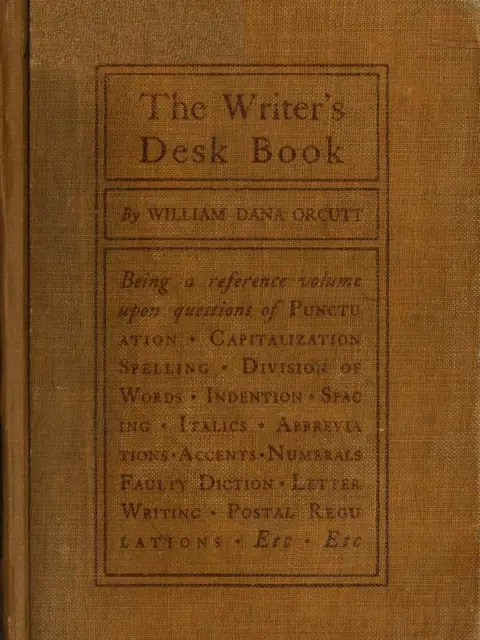
THE CLASSIC COLLECTION · 1912
"The Writer's Desk Book" by William Dana Orcutt is a reference guide on writing mechanics and conventions, likely written in the early 20th century. The book addresses various aspects of writing, including punctuation, capitalization, spelling, and letter writing. It aims to provide clarity and guidance for writers by outlining the rules and principles that enhance effective communication. The opening of the book introduces its nature as a practical reference, listing contents that cover a wide array of topics essential for proper writing. Topics include punctuation marks, rules for capitalization, spelling considerations, as well as guidelines for letter writing and postal regulations. The text emphasizes the importance of correct punctuation and provides detailed rules and examples to ensure clarity and consistency in written communication. This foundational approach suggests that the volume serves as a beneficial tool for both aspiring and seasoned writers seeking to refine their craft.
Introduction adapted from the source catalogue; source summaries may be automatically generated.
Free to read · English · 35,564 words · No account needed
MAKE TIME FOR A GOOD BOOK
On by default. Untick to stop anonymous reading totals. Each page counts after 10 seconds in view. How this works.
Anonymous counting is on unless you have switched it off.
«Can’t seem», should not be used for seem unable: e.g., I can’t seem [seem unable] to find it
CASE: the nominative is sometimes wrongly used for the objective case: e.g., Let He [Him] who made thee answer that
«Childlike», means that belonging to the child; childish, means the
weakness of the child
«Come», see «Go»
«Common», see «Mutual»
«Confess», should not be used in the sense of admit, in cases in which no idea of confession enters
«Conscious», see «Aware»
«Continual», meaning “frequently repeated acts,” should not be confused with continuous meaning “uninterrupted action”: e.g., Continual nagging spoils the disposition, and The continuous flowing of a stream
«Deadly», which means “that which inflicts death,” should not be confused with deathly, which means “that which resembles death”: e.g., A deadly poison, and A deathly pallor {104}
«Decided», means “strong,” decisive means “final.” A decided opinion does not mean the same as a decisive opinion
«Definite», means “well-defined”; definitive means “final”
«Demean», which signifies “to behave” oneself, should not be used for degrade or debase
«Different», should never be followed by the word than. Say,
Different from
«Directly», should not be used for as soon as: e.g., Directly [as
soon as] he arrived
«Discover», is to find something which previously existed; invent is to produce something for the first time
«Don’t», is a contraction of do not. One may say, I don’t, but not He don’t. Say, He doesn’t
«Each other», should not be misused for one another. One may say, The two cousins were devoted to each other; or Many suggestions were made, following one another in rapid succession
«Effect», see «Affect»
«Egoists», are those who made the ego the basis of their philosophy; egotists are those who worship themselves
«Either», should not be used to designate more than two persons or things. To designate one of three or more, say Any one
«Enormity», describes deeds of unusual horror; enormousness describes things of unusual size
«Enthuse» (verb), is not recognized by good usage. I became enthused should be written I became enthusiastic
«Every place», should be written everywhere
«Excellent», should never be qualified as it is a superlative: e.g., most excellent, very excellent, and the like are impossible. (See also «Superlatives»)
«Except» (verb), signifies “to exclude”: e.g., Present company excepted. As a preposition it means “with the exception.” It should not be confused with accept, which signifies “to receive” {105}
«Exceptional», describes a case outside the operation of a rule; exceptionable is that which is open to criticism: e.g., Exceptionable conduct is that to which exception can be taken
Your reading position is saved on this browser. Take it to another device with a library code. Reading pages adapt to text, rather than matching a printed edition.
William Dana Orcutt
William Dana Orcutt
William Dana Orcutt
William Dana Orcutt
BEHIND THE BOOK
This eBook is for the use of anyone anywhere in the United States and most other parts of the world at no cost and with almost no restrictions whatsoever. You may copy it, give it away or re-use it under the terms of the Project Gutenberg License included with this eBook or online at www.gutenberg.org. If you are not located in the United States, you will have to check the laws of the country where you are located before using this eBook. Read the source licence.
The original source file, including credits and licence, is retained by this library. Request an original-format copy at no charge. Please include the book title and Project Gutenberg identifier #54025.
KEEP YOUR CURIOSITY GOING

Charles G. (Charles Griffith) Ross
Hannah Webster Foster

Emily Lawless
Edwin Hamlin Carr

Charles De Lano Hine
Andrew Ure