THE CLASSIC COLLECTION✦In quest of the perfect bookCLASSIC FREE BOOKS
In quest of the perfect book
William Dana Orcutt
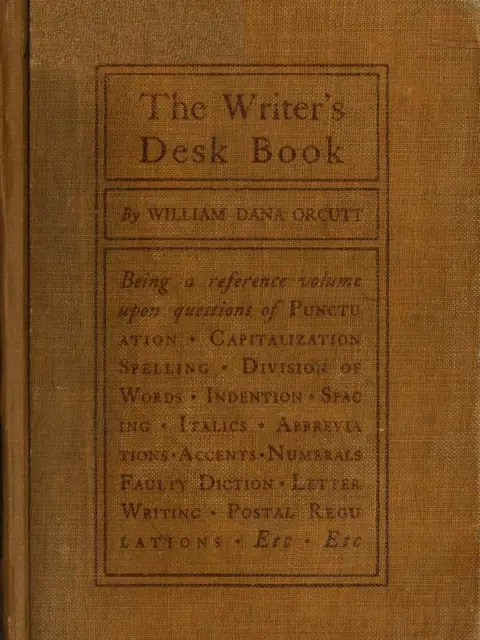
THE CLASSIC COLLECTION · 1912
"The Writer's Desk Book" by William Dana Orcutt is a reference guide on writing mechanics and conventions, likely written in the early 20th century. The book addresses various aspects of writing, including punctuation, capitalization, spelling, and letter writing. It aims to provide clarity and guidance for writers by outlining the rules and principles that enhance effective communication. The opening of the book introduces its nature as a practical reference, listing contents that cover a wide array of topics essential for proper writing. Topics include punctuation marks, rules for capitalization, spelling considerations, as well as guidelines for letter writing and postal regulations. The text emphasizes the importance of correct punctuation and provides detailed rules and examples to ensure clarity and consistency in written communication. This foundational approach suggests that the volume serves as a beneficial tool for both aspiring and seasoned writers seeking to refine their craft.
Introduction adapted from the source catalogue; source summaries may be automatically generated.
Free to read · English · 35,564 words · No account needed
MAKE TIME FOR A GOOD BOOK
On by default. Untick to stop anonymous reading totals. Each page counts after 10 seconds in view. How this works.
Anonymous counting is on unless you have switched it off.
ARTICLES: when superfluous, are misleading and should be omitted; but it is more frequently the case that necessary articles are omitted: e.g., The army and navy signifies a single organization. Insert a before navy
«As», should not be used as a causal conjunction: e.g., Do not expect me (as) I am too uncertain of my time. The word as stands here as a contraction of inasmuch as. Substitute a semicolon: e.g., Do not expect me; I am too uncertain of my time.
«As . . . as», see «So . . . as»
«At», is often incorrectly used for in: e.g., They are living at
[in] Florence
«At length», does not mean the same as at last. Say At length he showed signs of relenting, and At last he relented
«Aught», is frequently confused with naught. It means “anything,” whereas the symbol 0 means “nothing”
«Avail», should be used with of only with some form of be; otherwise to is the proper word: e.g., He called lustily, but of [to] no avail; or He called lustily, but [it was] of no avail
«Aware», is used in relation to things outside of ourselves; conscious in relation to sensations or things within ourselves
«Awful», should not be used loosely. It means “inspiring with awe.” To say I had an awfully good time is as ridiculous as it is meaningless
«Badly», should not be used for very much or a great deal. The expression, If you don’t care to do a thing very badly, do it very badly, shows the absurdity. Do not confuse the adjective with the adverb. He looks badly means “He makes a bad use of his eyes.” He looks bad is correct
«Bank on», a slang expression not recognized by good usage. Say rely
on or trust in {103}
«Beg», should never be used without the word leave, when asking permission. In correspondence one often sees the expressions, I beg to state, I beg to differ. One should say, I beg leave to state, I beg leave to differ
«Bring», see «Take»
«But», is sometimes used as a preposition, and when so used takes the objective case: e.g., The invitation included all but him is correct
«Can», denotes power, and should not be used for may, which denotes permission. The following sentence shows the correct use of both words: He may do it if he can
«Cannot but», should not be used interchangeably with can but, as the two expressions differ in meaning: e.g., I can but try means “All I can do is to try”; I cannot but try means “I cannot help trying”
Your reading position is saved on this browser. Take it to another device with a library code. Reading pages adapt to text, rather than matching a printed edition.
William Dana Orcutt
William Dana Orcutt
William Dana Orcutt
William Dana Orcutt
BEHIND THE BOOK
This eBook is for the use of anyone anywhere in the United States and most other parts of the world at no cost and with almost no restrictions whatsoever. You may copy it, give it away or re-use it under the terms of the Project Gutenberg License included with this eBook or online at www.gutenberg.org. If you are not located in the United States, you will have to check the laws of the country where you are located before using this eBook. Read the source licence.
The original source file, including credits and licence, is retained by this library. Request an original-format copy at no charge. Please include the book title and Project Gutenberg identifier #54025.
KEEP YOUR CURIOSITY GOING

Charles G. (Charles Griffith) Ross
Hannah Webster Foster

Emily Lawless
Edwin Hamlin Carr

Charles De Lano Hine
Andrew Ure