
Last letters from the living dead man
David Patterson (Spirit) Hatch
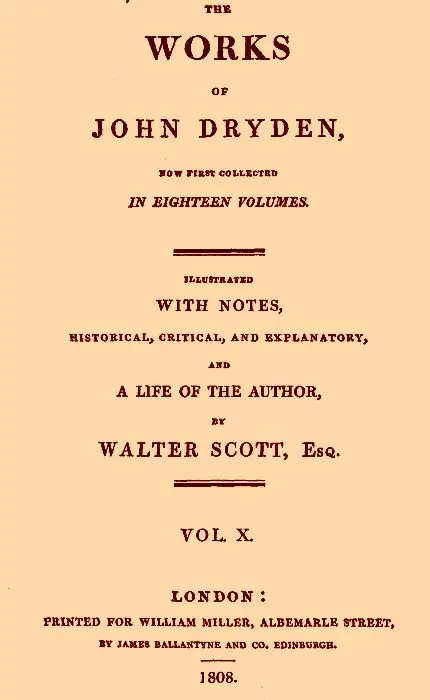
THE CLASSIC COLLECTION · 1633
"The Works of John Dryden, now first collected in eighteen volumes. Volume 10" is a collection of literary works, specifically poetry and essays, compiled from the writings of John Dryden and published during the early 19th century. This volume includes Dryden's poem "Religio Laici," which discusses theological matters and presents his perspectives on faith and religion amidst the complexities of his time. The works likely engage with themes of Christianity, sectarianism, and personal belief. The opening of this volume presents "Religio Laici," an epistolary poem where Dryden articulates his beliefs as a layman amidst a tumultuous religious landscape. He navigates the contentious debates between various religious factions, aiming for a rational exposition of faith that reconciles differing viewpoints. Dryden addresses objections to revealed religion versus rational inquiry, emphasizing the importance of individual reason tempered with faith. His arguments suggest a yearning for a balanced perspective, advocating for personal conviction while also acknowledging the authority of the Church of England despite recognizing the shortcomings within traditions.
Introduction adapted from the source catalogue; source summaries may be automatically generated.
Free to read · English · 135,998 words · No account needed
MAKE TIME FOR A GOOD BOOK
On by default. Untick to stop anonymous reading totals. Each page counts after 10 seconds in view. How this works.
Anonymous counting is on unless you have switched it off.
[Footnote 208: Note XII.]
[Footnote 209: ----Sinistra cava prædixit ab ilice Cornix.]
[Footnote 210: Alluding to the table of Icarus:
Icarus Icariis nomina fecit aquis.
Chelidonian, from χελιδὼν a swallow.]
[Footnote 211: Otherwise called martlets. DRYDEN.]
[Footnote 212: A parody on Lee's famous rant in "Œdipus."
"May there not be a glimpse, one starry spark,
But gods meet gods, and jostle in the dark."
]
[Footnote 213: An old Saxon word for a village.]
[Footnote 214: It is a vulgar idea, that a dead swallow, suspended in the air, intimates a change of wind, by turning its bill to the point from which it is to blow.]
[Footnote 215: Note XIV.]
[Footnote 216: Century White, See Note XV.]
[Footnote 217: The Hind intimates, that, as the sunshine of Catholic prosperity, in the fable, depended upon the king's life, there existed those among her enemies, who would fain have it shortened. But from this insinuation she exempts the church of England, and only expresses her fears, that her passive principles would incline her to neutrality.]
[Footnote 217a: Note C: Note XVI.]
[Footnote 218: Louis XIV. whose revocation of the Edict of Nantes has been so frequently alluded to. As that monarch did not proceed to the extremity of capital punishment against the Huguenots, Dryden contends his edicts were more merciful than the penal laws, by which mass-priests are denounced as guilty of high treason.]
[Footnote 219: Note XVII.]
[Footnote 220: The poet alludes to the enchantress Duessa, who, when disrobed by Prince Arthur, was changed from a beautiful woman into
A loathly wrinkled hag, ill-favoured, old, Whose secret filth good manners biddeth not be told.
SPENSER'S Fairy Queen, Book I, canto 8.
]
[Footnote 221: Note XVIII.]
[Footnote 222: The fiend in the Book of Tobit, who haunted Raguel's daughter, is frighted away, by fumigation, by Tobias her bridegroom. Thus, Milton:
----Better pleased
Than Asmodeus with the fishy fume,
That drove him, though enamoured, from the spouse
Of Tobit's son, and with a vengeance sent
From Media post to Egypt, there fast bound.
Par. Lost, Book IV.
]
[Footnote 223: A proverbial expression, taken from our author's alteration of the "Tempest." See Vol. III. p. 176.]
[Footnote 224: Æneid, lib. vii. 1. 213.]
[Footnote 225: Note XIX.]
[Footnote 226: Two pamphlets were published, urging the necessity of an alliance between the church of England and the Dissenters; and warmly exhorting the latter not to be cajoled to serve the purposes of their joint enemies of Rome, by the pretended toleration which was held out as a snare to them. One of these, called "Reflections on the Declaration of Indulgence," is ascribed to Burnet; the other, called "Advice to Dissenters," is supposed to come from the masterly pen of Halifax.]
[Footnote 227: Ον Βριαρεων καλέουσι θεοι, ανδρες δε τεπαντες Αιγααιων.]
[Footnote 228: Note XX.]
Your reading position is saved on this browser. Take it to another device with a library code. Reading pages adapt to text, rather than matching a printed edition.
BEHIND THE BOOK
This eBook is for the use of anyone anywhere in the United States and most other parts of the world at no cost and with almost no restrictions whatsoever. You may copy it, give it away or re-use it under the terms of the Project Gutenberg License included with this eBook or online at www.gutenberg.org. If you are not located in the United States, you will have to check the laws of the country where you are located before using this eBook. Read the source licence.
The original source file, including credits and licence, is retained by this library. Request an original-format copy at no charge. Please include the book title and Project Gutenberg identifier #51652.
KEEP YOUR CURIOSITY GOING
David Patterson (Spirit) Hatch

David Patterson (Spirit) Hatch

David Patterson (Spirit) Hatch

Ralph Waldo Emerson

Maurice Baring

Oscar Wilde & James McNeill Whistler