
Last letters from the living dead man
David Patterson (Spirit) Hatch
THE CLASSIC COLLECTION · 1633
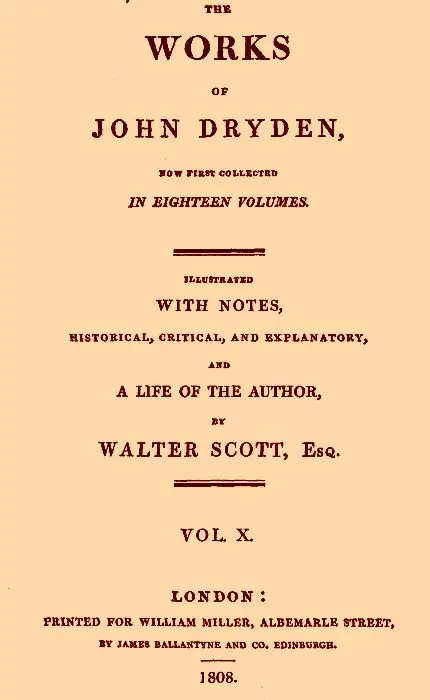
"The Works of John Dryden, now first collected in eighteen volumes. Volume 10" is a collection of literary works, specifically poetry and essays, compiled from the writings of John Dryden and published during the early 19th century. This volume includes Dryden's poem "Religio Laici," which discusses theological matters and presents his perspectives on faith and religion amidst the complexities of his time. The works likely engage with themes of Christianity, sectarianism, and personal belief. The opening of this volume presents "Religio Laici," an epistolary poem where Dryden articulates his beliefs as a layman amidst a tumultuous religious landscape. He navigates the contentious debates between various religious factions, aiming for a rational exposition of faith that reconciles differing viewpoints. Dryden addresses objections to revealed religion versus rational inquiry, emphasizing the importance of individual reason tempered with faith. His arguments suggest a yearning for a balanced perspective, advocating for personal conviction while also acknowledging the authority of the Church of England despite recognizing the shortcomings within traditions.
Introduction adapted from the source catalogue; source summaries may be automatically generated.
Free to read · English · 135,998 words · No account needed
MAKE TIME FOR A GOOD BOOK
On by default. Untick to stop anonymous reading totals. Each page counts after 10 seconds in view. How this works.
Anonymous counting is on unless you have switched it off.
[Footnote 229: The power claimed, and liberally exercised, by the king, of dispensing with the penal statutes.]
[Footnote 230: That is, wishing the accession of the Prince of Orange, then the presumptive heir of the crown.]
[Footnote 231: Note XXI.]
[Footnote 232: The refugee Huguenots. See Note XXII.]
[Footnote 233: James II. See Note XXIII.]
[Footnote 234: The Catholic chapel in Whitehall.]
[Footnote 235: The clergy of the church of England, and those of London in particular. See Note XXIV.]
[Footnote 236: The Catholic clergy, maintained by King James.]
[Footnote 237: The cock is made an emblem of the regular clergy of Rome, on account of their nocturnal devotions and mattins.]
[Footnote 238: The Nuns.]
[Footnote 239: Note XXV.]
[Footnote 240: The worship of images, charged upon the Romish church by Protestants as idolatrous.]
[Footnote 241: Note XXVI.]
[Footnote 242: The Doves.]
[Footnote 243: The laws imposing the penalty of high treason on priests
saying mass in England.]
[Footnote 244: The Roman Catholic nobility, excluded from the House of Peers by the imposition of the test.]
[Footnote 245: Hemlock.]
[Footnote 246: Quos Jupiter vult perdere, prius dementat.]
[Footnote 247: The foolish fable of Mahomet accustoming a pigeon to pick peas from his ear, to found his pretensions to inspiration, is well known.]
[Footnote 248: Gilbert Burnet, D. D. afterwards Bishop of Salisbury.
See Note XXVII.]
[Footnote 249: Note XXVIII.]
[Footnote 250: Note XXIX.]
[Footnote 251: Note XXX.]
[Footnote 252: ----timeo Danaos et dona ferentes. Æneid, II. lib.]
[Footnote 253: Note XXXI.]
[Footnote 254: Note XXXII.]
[Footnote 255: Note XXXIII.]
[Footnote 256: The promise to maintain the church of England, made in James's first proclamation after his accession; and which the church party alleged he had now broken. Note XXXIV.]
[Footnote 257: See note XXXIII.]
[Footnote 258: Declaration of indulgence. Note XXXV.]
[Footnote 259: Note XXXVI.]
[Footnote 260: The tyrant of Syracuse, who, after being dethroned,
taught a school at Corinth.]
[Footnote 261: Quisque suæ fortunæ faber. SALLUST.]
[Footnote 262: Note XXXVII.]
[Footnote 263: Note XXXVIII.]
Your reading position is saved on this browser. Take it to another device with a library code. Reading pages adapt to text, rather than matching a printed edition.
BEHIND THE BOOK
This eBook is for the use of anyone anywhere in the United States and most other parts of the world at no cost and with almost no restrictions whatsoever. You may copy it, give it away or re-use it under the terms of the Project Gutenberg License included with this eBook or online at www.gutenberg.org. If you are not located in the United States, you will have to check the laws of the country where you are located before using this eBook. Read the source licence.
The original source file, including credits and licence, is retained by this library. Request an original-format copy at no charge. Please include the book title and Project Gutenberg identifier #51652.
KEEP YOUR CURIOSITY GOING
David Patterson (Spirit) Hatch

David Patterson (Spirit) Hatch

David Patterson (Spirit) Hatch

Ralph Waldo Emerson

Maurice Baring

Oscar Wilde & James McNeill Whistler