
Last letters from the living dead man
David Patterson (Spirit) Hatch
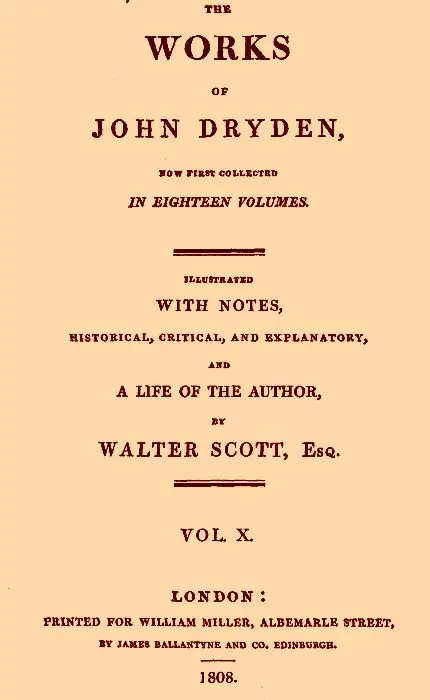
THE CLASSIC COLLECTION · 1633
"The Works of John Dryden, now first collected in eighteen volumes. Volume 10" is a collection of literary works, specifically poetry and essays, compiled from the writings of John Dryden and published during the early 19th century. This volume includes Dryden's poem "Religio Laici," which discusses theological matters and presents his perspectives on faith and religion amidst the complexities of his time. The works likely engage with themes of Christianity, sectarianism, and personal belief. The opening of this volume presents "Religio Laici," an epistolary poem where Dryden articulates his beliefs as a layman amidst a tumultuous religious landscape. He navigates the contentious debates between various religious factions, aiming for a rational exposition of faith that reconciles differing viewpoints. Dryden addresses objections to revealed religion versus rational inquiry, emphasizing the importance of individual reason tempered with faith. His arguments suggest a yearning for a balanced perspective, advocating for personal conviction while also acknowledging the authority of the Church of England despite recognizing the shortcomings within traditions.
Introduction adapted from the source catalogue; source summaries may be automatically generated.
Free to read · English · 135,998 words · No account needed
MAKE TIME FOR A GOOD BOOK
On by default. Untick to stop anonymous reading totals. Each page counts after 10 seconds in view. How this works.
Anonymous counting is on unless you have switched it off.
Dame, said the Panther, times are mended well, Since late among the Philistines you fell.[140] The toils were pitched, a spacious tract of ground With expert huntsmen was encompassed round; The inclosure narrowed; the sagacious power Of hounds and death drew nearer every hour. 'Tis true, the younger lion[141] 'scaped the snare, But all your priestly calves lay struggling there, As sacrifices on their altars laid;[142] } While you, their careful mother, wisely fled,} Not trusting destiny to save your head. } For, whate'er promises you have applied } To your unfailing church, the surer side} Is four fair legs in danger to provide; } And whate'er tales of Peter's chair you tell, } Yet, saving reverence of the miracle, } The better luck was yours to 'scape so well.--} As I remember, said the sober Hind, Those toils were for your own dear self designed, As well as me; and with the self-same throw, To catch the quarry[143] and the vermin too,-- Forgive the slanderous tongues that called you so. Howe'er you take it now, the common cry Then ran you down for your rank loyalty,[144] Besides, in popery they thought you nurst, As evil tongues will ever speak the worst, Because some forms, and ceremonies some You kept, and stood in the main question dumb. Dumb you were born indeed; but, thinking long, The test, it seems, at last has loosed your tongue:[145] And to explain what your forefathers meant, By real presence in the sacrament, After long fencing pushed against a wall, } Your salvo comes, that he's not there at all: } There changed your faith, and what may change may fall.} Who can believe what varies every day, Nor ever was, nor will be at a stay?-- Tortures may force the tongue untruths to tell, And I ne'er owned myself infallible, Replied the Panther: grant such presence were, Yet in your sense I never owned it there. A real virtue we by faith receive, And that we in the sacrament believe.-- Then, said the Hind, as you the matter state, Not only Jesuits can equivocate; For real, as you now the word expound, From solid substance dwindles to a sound. Methinks, an Æsop's fable you repeat; You know who took the shadow for the meat: Your church's substance thus you change at will, And yet retain your former figure still. I freely grant you spoke to save your life; For then you lay beneath the butcher's knife. Long time you fought, redoubled battery bore, But, after all, against yourself you swore, Your former self; for every hour your form Is chopped and changed, like winds before a storm. Thus fear and interest will prevail with some; For all have not the gift of martyrdom.-- The Panther grinned at this, and thus replied: That men may err was never yet denied; But, if that common principle be true, The canon, dame, is levelled full at you. But, shunning long disputes, I fain would see That wonderous wight, Infallibility. Is he from heaven, this mighty champion, come? Or lodged below in subterranean Rome? First, seat him somewhere, and derive his race, Or else conclude that nothing has no place.-- Suppose, though I disown it, said the Hind, The certain mansion were not yet assigned; The doubtful residence no proof can bring Against the plain existence of the thing. Because philosophers may disagree, } If sight by emission, or reception be, } Shall it be thence inferred, I do not see?[146]} But you require an answer positive, } Which yet, when I demand, you dare not give; } For fallacies in universals live.[147] } I then affirm, that this unfailing guide In pope and general councils must reside; Both lawful, both combined; what one decrees } By numerous votes, the other ratifies: } On this undoubted sense the church relies.[148]} 'Tis true, some doctors in a scantier space, I mean, in each apart, contract the place. Some, who to greater length extend the line, The church's after-acceptation join. This last circumference appears too wide; The church diffused is by the council tied, As members by their representatives Obliged to laws, which prince and senate gives. Thus, some contract, and some enlarge the space;} In pope and council, who denies the place, } Assisted from above with God's unfailing grace? } Those canons all the needful points contain; Their sense so obvious, and their words so plain, That no disputes about the doubtful text Have hitherto the labouring world perplexed. If any should in after-times appear, New councils must be called, to make the meaning clear; Because in them the power supreme resides, And all the promises are to the guides.[149] This may be taught with sound and safe defence; But mark how sandy is your own pretence, Who, setting councils, pope, and church aside, Are every man his own presuming guide.[150] The sacred books, you say, are full and plain, And every needful point of truth contain; All who can read interpreters may be. Thus, though your churches disagree, Yet every saint has to himself alone The secret of this philosophic stone. These principles your jarring sects unite, When differing doctors and disciples fight. Though Luther, Zuinglius, Calvin, holy chiefs, Have made a battle-royal of beliefs; Or, like wild horses, several ways have whirled The tortured text about the Christian world; Each Jehu lashing on with furious force, That Turk or Jew could not have used it worse; No matter what dissension leaders make, Where every private man may save a stake: Ruled by the scripture and his own advice, Each has a blind bye-path to Paradise; Where, driving in a circle slow or fast, Opposing sects are sure to meet at last. A wonderous charity you have in store } For all reformed to pass the narrow door;} So much, that Mahomet had scarcely more. } For he, kind prophet, was for damning none; But Christ and Moses were to save their own: Himself was to secure his chosen race, Though reason good for Turks to take the place, And he allowed to be the better man, In virtue of his holier Alcoran. True, said the Panther, I shall ne'er deny My brethren may be saved as well as I: Though Huguenots condemn our ordination, Succession, ministerial vocation; And Luther, more mistaking what he read, Misjoins the sacred body with the bread:[151] Yet, lady, still remember I maintain, The word in needful points is only plain.-- Needless, or needful, I not now contend, For still you have a loop-hole for a friend, Rejoined the matron; but the rule you lay } Has led whole flocks, and leads them still astray,} In weighty points, and full damnation's way. } For, did not Arius first, Socinus now, The Son's eternal Godhead disavow? And did not these by gospel texts alone Condemn our doctrine, and maintain their own? Have not all heretics the same pretence To plead the scriptures in their own defence? How did the Nicene council then decide That strong debate? was it by scripture tried? No, sure; to that the rebel would not yield; Squadrons of texts he marshalled in the field: That was but civil war, an equal set, Where piles with piles, and eagles eagles met.[152] With texts point-blank and plain he faced the foe, And did not Satan tempt our Saviour so? The good old bishops took a simpler way; Each asked but what he heard his father say, Or how he was instructed in his youth, And by tradition's force upheld the truth.[153] The Panther smiled at this;--And when, said she, Were those first councils disallowed by me? Or where did I at sure tradition strike, Provided still it were apostolic?[154] Friend, said the Hind, you quit your former ground, Where all your faith you did on scripture found: Now 'tis tradition joined with holy writ; But thus your memory betrays your wit. No, said the Panther; for in that I view, When your tradition's forged, and when 'tis true. I set them by the rule, and, as they square,} Or deviate from undoubted doctrine there, } This oral fiction, that old faith declare.--} Hind. The council steered, it seems, a different course; They tried the scripture by tradition's force: But you tradition by the scripture try; } Pursued by sects, from this to that you fly,} Nor dare on one foundation to rely. } The word is then deposed, and in this view, You rule the scripture, not the scripture you. Thus said the dame, and, smiling, thus pursued: I see, tradition then is disallowed, When not evinced by scripture to be true, And scripture, as interpreted by you. But here you tread upon unfaithful ground, Unless you could infallibly expound; Which you reject as odious popery, And throw that doctrine back with scorn on me. Suppose we on things traditive divide, And both appeal to scripture to decide; By various texts we both uphold our claim, Nay, often, ground our titles on the same: After long labour lost, and time's expence, Both grant the words, and quarrel for the sense. Thus all disputes for ever must depend; For no dumb rule can controversies end. Thus, when you said,--Tradition must be tried By sacred writ, whose sense yourselves decide, You said no more, but that yourselves must be The judges of the scripture sense, not we. Against our church-tradition you declare, And yet your clerks would sit in Moses' chair; At least 'tis proved against your argument, The rule is far from plain, where all dissent.-- If not by scriptures, how can we be sure, Replied the Panther, what tradition's pure? For you may palm upon us new for old; All, as they say, that glitters, is not gold. How but by following her, replied the dame, To whom derived from sire to son they came; Where every age does on another move, And trusts no farther than the next above; Where all the rounds like Jacob's ladder rise, The lowest hid in earth, the topmost in the skies? Sternly the savage did her answer mark, Her glowing eye-balls glittering in the dark, And said but this:--Since lucre was your trade, Succeeding times such dreadful gaps have made, 'Tis dangerous climbing: To your sons and you I leave the ladder, and its omen too.[155] Hind. The Panther's breath was ever famed for sweet; But from the Wolf such wishes oft I meet. You learned this language from the Blatant Beast,[156] Or rather did not speak, but were possessed. As for your answer, 'tis but barely urged: You must evince tradition to be forged; Produce plain proofs; unblemished authors use As ancient as those ages they accuse; Till when, 'tis not sufficient to defame; An old possession stands, till elder quits the claim. Then for our interest, which is named alone To load with envy, we retort your own; For, when traditions in your faces fly, Resolving not to yield, you must decry. As when the cause goes hard, the guilty man Excepts, and thins his jury all he can; So when you stand of other aid bereft, You to the twelve apostles would be left. Your friend the Wolf did with more craft provide To set those toys, traditions, quite aside;[157] And fathers too, unless when, reason spent, He cites them but sometimes for ornament. But, madam Panther, you, though more sincere, Are not so wise as your adulterer; The private spirit is a better blind, Than all the dodging tricks your authors find. For they, who left the scripture to the crowd,} Each for his own peculiar judge allowed; } The way to please them was to make them proud.} Thus with full sails they ran upon the shelf; Who could suspect a cozenage from himself? On his own reason safer 'tis to stand, Than be deceived and damned at second-hand. But you, who fathers and traditions take, And garble some, and some you quite forsake, Pretending church-authority to fix, And yet some grains of private spirit mix, Are, like a mule, made up of different seed, And that's the reason why you never breed; At least, not propagate your kind abroad, For home dissenters are by statutes awed. And yet they grow upon you every day, } While you, to speak the best, are at a stay, } For sects, that are extremes, abhor a middle way:} Like tricks of state, to stop a raging flood,} Or mollify a mad-brained senate's mood; } Of all expedients never one was good. } Well may they argue, nor can you deny, If we must fix on church authority, Best on the best, the fountain, not the flood; That must be better still, if this be good. Shall she command, who has herself rebelled? Is antichrist by antichrist expelled? Did we a lawful tyranny displace, To set aloft a bastard of the race? Why all these wars to win the book, if we } Must not interpret for ourselves, but she?} Either be wholly slaves, or wholly free. } For purging fires traditions must not fight; But they must prove episcopacy's right.[158] Thus, those led horses are from service freed; You never mount them but in time of need. Like mercenaries, hired for home defence, They will not serve against their native prince. Against domestic foes of hierarchy These are drawn forth, to make fanatics fly; But, when they see their countrymen at hand, } Marching against them under church-command, } Straight they forsake their colours, and disband.--} Thus she; nor could the Panther well enlarge With weak defence against so strong a charge; But said:--For what did Christ his word provide, If still his church must want a living guide? And if all-saving doctrines are not there, Or sacred penmen could not make them clear, From after-ages we should hope in vain For truths which men inspired could not explain.-- Before the word was written, said the Hind, Our Saviour preached his faith to human kind: From his apostles the first age received Eternal truth, and what they taught believed. Thus, by tradition faith was planted first, Succeeding flocks succeeding pastors nursed. This was the way our wise Redeemer chose, } Who sure could all things for the best dispose,} To fence his fold from their encroaching foes. } He could have writ himself, but well foresaw The event would be like that of Moses' law; Some difference would arise, some doubts remain, Like those which yet the jarring Jews maintain. No written laws can be so plain, so pure, But wit may gloss, and malice may obscure; Not those indited by his first command, A prophet graved the text, an angel held his hand. Thus faith was ere the written word appeared, And men believed not what they read, but heard. But since the apostles could not be confined To these, or those, but severally designed Their large commission round the world to blow, To spread their faith, they spread their labours too. Yet still their absent flock their pains did share; They hearkened still, for love produces care. And as mistakes arose, or discords fell, Or bold seducers taught them to rebel, As charity grew cold, or faction hot, Or long neglect their lessons had forgot, For all their wants they wisely did provide, And preaching by epistles was supplied; So, great physicians cannot all attend, But some they visit, and to some they send. Yet all those letters were not writ to all; Nor first intended but occasional, Their absent sermons; nor, if they contain All needful doctrines, are those doctrines plain. Clearness by frequent preaching must be wrought They writ but seldom, but they daily taught; And what one saint has said of holy Paul, "He darkly writ," is true applied to all. For this obscurity could heaven provide } More prudently than by a living guide, } As doubts arose, the difference to decide?} A guide was therefore needful, therefore made; And, if appointed, sure to be obeyed. Thus, with due reverence to the apostles' writ, By which my sons are taught, to which submit, I think, those truths, their sacred works contain, The church alone can certainly explain; That following ages, leaning on the past, May rest upon the primitive at last. Nor would I thence the word no rule infer, But none without the church-interpreter; Because, as I have urged before, 'tis mute, And is itself the subject of dispute. But what the apostles their successors taught, } They to the next, from them to us is brought, } The undoubted sense which is in scripture sought.} From hence the church is armed, when errors rise, } To stop their entrance, and prevent surprise; } And, safe entrenched within, her foes without defies.} By these all festering sores her councils heal,} Which time or has disclosed, or shall reveal; } For discord cannot end without a last appeal. } Nor can a council national decide, } But with subordination to her guide: } (I wish the cause were on that issue tried.)} Much less the scripture; for suppose debate Betwixt pretenders to a fair estate, Bequeathed by some legator's last intent;[159] (Such is our dying Saviour's testament:) The will is proved, is opened, and is read, The doubtful heirs their differing titles plead; All vouch the words their interest to maintain, And each pretends by those his cause is plain. Shall then the testament award the right? No, that's the Hungary for which they fight; The field of battle, subject of debate; The thing contended for, the fair estate. The sense is intricate, 'tis only clear What vowels and what consonants are there. Therefore 'tis plain, its meaning must be tried Before some judge appointed to decide.-- Suppose, the fair apostate said, I grant, The faithful flock some living guide should want, Your arguments an endless chace pursue: } Produce this vaunted leader to our view,} This mighty Moses of the chosen crew.-- } The dame, who saw her fainting foe retired, With force renewed, to victory aspired; And, looking upward to her kindred sky, } As once our Saviour owned his Deity, } Pronounced his words--"She whom ye seek am I."[160]} Nor less amazed this voice the Panther heard, Than were those Jews to hear a God declared. Then thus the matron modestly renewed: Let all your prophets and their sects be viewed, And see to which of them yourselves think fit The conduct of your conscience to submit; Each proselyte would vote his doctor best, With absolute exclusion to the rest: Thus would your Polish diet disagree, And end, as it began, in anarchy; Yourself the fairest for election stand, Because you seem crown-general of the land; But soon against your superstitious lawn Some presbyterian sabre would be drawn;[161] In your established laws of sovereignty } The rest some fundamental flaw would see,} And call rebellion gospel-liberty. } To church-decrees your articles require Submission mollified, if not entire.[162] Homage denied, to censures you proceed; But when Curtana[163] will not do the deed, You lay that pointless clergy-weapon by, And to the laws, your sword of justice, fly. Now this your sects the more unkindly take, (Those prying varlets hit the blots you make,) Because some ancient friends of yours declare, Your only rule of faith the scriptures are, Interpreted by men of judgment sound, Which every sect will for themselves expound; Nor think less reverence to their doctors due For sound interpretation, than to you. If then, by able heads, are understood Your brother prophets, who reformed abroad; Those able heads expound a wiser way, That their own sheep their shepherd should obey. But if you mean yourselves are only sound, } That doctrine turns the reformation round, } And all the rest are false reformers found;} Because in sundry points you stand alone, } Not in communion joined with any one; } And therefore must be all the church, or none.} Then, till you have agreed whose judge is best, Against this forced submission they protest; While sound and sound a different sense explains, Both play at hardhead till they break their brains; And from their chairs each other's force defy, While unregarded thunders vainly fly. I pass the rest, because your church alone Of all usurpers best could fill the throne. But neither you, nor any sect beside, } For this high office can be qualified, } With necessary gifts required in such a guide.} For that, which must direct the whole, must be} Bound in one bond of faith and unity; } But all your several churches disagree. } The consubstantiating church[164] and priest Refuse communion to the Calvinist; The French reformed from preaching you restrain, } Because you judge their ordination vain;[165] } And so they judge of yours, but donors must ordain.} In short, in doctrine, or in discipline, Not one reformed can with another join; But all from each, as from damnation, fly: No union they pretend, but in non-popery. Nor, should their members in a synod meet, Could any church presume to mount the seat, Above the rest, their discords to decide; None would obey, but each would be the guide; And face to face dissensions would increase, For only distance now preserves the peace. All in their turns accusers, and accused; Babel was never half so much confused; What one can plead, the rest can plead as well;} For amongst equals lies no last appeal, } And all confess themselves are fallible. } Now, since you grant some necessary guide, All who can err are justly laid aside; Because a trust so sacred to confer } Shows want of such a sure interpreter;} And how can he be needful who can err?} Then, granting that unerring guide we want, That such there is you stand obliged to grant; Our Saviour else were wanting to supply Our needs, and obviate that necessity. It then remains, that church can only be The guide, which owns unfailing certainty; Or else you slip your hold, and change your side, Relapsing from a necessary guide. But this annexed condition of the crown, } Immunity from errors, you disown; } Here then you shrink, and lay your weak pretensions down.[166]} For petty royalties you raise debate; } But this unfailing universal state } You shun; nor dare succeed to such a glorious weight;} And for that cause those promises detest, With which our Saviour did his church invest; But strive to evade, and fear to find them true, As conscious they were never meant to you; All which the mother-church asserts her own, And with unrivalled claim ascends the throne. So, when of old the Almighty Father sate In council, to redeem our ruined state, Millions of millions, at a distance round, } Silent the sacred consistory crowned, } To hear what mercy, mixt with justice, could propound;} All prompt, with eager pity, to fulfil The full extent of their Creator's will: But when the stern conditions were declared, A mournful whisper through the host was heard, And the whole hierarchy, with heads hung down, Submissively declined the ponderous proffer'd crown. Then, not till then, the Eternal Son from high Rose in the strength of all the Deity; Stood forth to accept the terms, and underwent } A weight which all the frame of heaven had bent,} Nor he himself could bear, but as Omnipotent. } Now, to remove the least remaining doubt, That even the blear-eyed sects may find her out, Behold what heavenly rays adorn her brows, } What from his wardrobe her beloved allows, } To deck the wedding-day of his unspotted spouse![167]} Behold what marks of majesty she brings, Richer than ancient heirs of eastern kings! Her right hand holds the sceptre and the keys, To show whom she commands, and who obeys; With these to bind, or set the sinner free, With that to assert spiritual royalty. One in herself, not rent by schism, but sound, Entire, one solid shining diamond; Not sparkles shattered into sects like you: One is the church, and must be to be true; One central principle of unity; } As undivided, so from errors free; } As one in faith, so one in sanctity.} Thus she, and none but she, the insulting rage Of heretics opposed from age to age; Still when the giant-brood invades her throne, } She stoops from heaven, and meets them half way down,} And with paternal thunder vindicates her crown. } But like Egyptian sorcerers you stand, } And vainly lift aloft your magic wand, } To sweep away the swarms of vermin from the land;} You could, like them, with like infernal force, Produce the plague, but not arrest the course. But when the boils and blotches, with disgrace And public scandal, sat upon the face, Themselves attacked, the Magi strove no more, } They saw God's finger, and their fate deplore; } Themselves they could not cure of the dishonest sore.[168]} Thus one, thus pure, behold her largely spread, Like the fair ocean from her mother-bed; From east to west triumphantly she rides, All shores are watered by her wealthy tides. The gospel-sound, diffused from pole to pole, Where winds can carry, and where waves can roll, The self-same doctrine of the sacred page Conveyed to every clime, in every age. Here let my sorrow give my satire place, To raise new blushes on my British race. Our sailing ships like common-sewers we use, } And through our distant colonies diffuse } The draught of dungeons, and the stench of stews;} Whom, when their home-bred honesty is lost, We disembogue on some far Indian coast, Thieves, pandars, palliards,[169] sins of every sort; Those are the manufactures we export, And these the missioners our zeal has made; } For, with my country's pardon, be it said, } Religion is the least of all our trade. } Yet some improve their traffic more than we;} For they on gain, their only god, rely, } And set a public price on piety. } ndustrious of the needle and the chart, They run full sail to their Japonian mart; Preventing fear, and, prodigal of fame, } Sell all of Christian to the very name,[170] } Nor leave enough of that to hide their naked shame.} Thus, of three marks, which in the creed we view, Not one of all can be applied to you; Much less the fourth. In vain, alas! you seek The ambitious title of apostolic:[171] God-like descent! 'tis well your blood can be Proved noble in the third or fourth degree; For all of ancient that you had before, } I mean what is not borrowed from our store,} Was error fulminated o'er and o'er; } Old heresies condemned in ages past, By care and time recovered from the blast.[172] 'Tis said with ease, but never can be proved, The church her old foundations has removed, And built new doctrines on unstable sands: Judge that, ye winds and rains! you proved her, yet she stands. Those ancient doctrines charged on her for new, Show, when, and how, and from what hands they grew. We claim no power, when heresies grow bold, To coin new faith, but still declare the old. How else could that obscene disease be purged, When controverted texts are vainly urged? To prove tradition new, there's somewhat more Required, than saying, 'twas not used before. Those monumental arms are never stirred, Till schism or heresy call down Goliah's sword. Thus, what you call corruptions, are, in truth, The first plantations of the gospel's youth; Old standard faith; but cast your eyes again, } And view those errors which new sects maintain, } Or which of old disturbed the church's peaceful reign;} And we can point each period of the time, When they began, and who begot the crime; Can calculate how long the eclipse endured, Who interposed, what digits were obscured: Of all which are already passed away, We know the rise, the progress, and decay. Despair at our foundations then to strike, Till you can prove your faith apostolic; A limpid stream drawn from the native source; Succession lawful in a lineal course. Prove any church, opposed to this our head, So one, so pure, so unconfinedly spread, Under one chief of the spiritual state, The members all combined, and all subordinate; Show such a seamless coat, from schism so free, In no communion joined with heresy;-- If such a one you find, let truth prevail; } Till when, your weights will in the balance fail;} A church unprincipled kicks up the scale. } But if you cannot think, (nor sure you can Suppose in God what were unjust in man,) That He, the fountain of eternal grace, } Should suffer falsehood for so long a space} To banish truth, and to usurp her place; } That seven successive ages should be lost, And preach damnation at their proper cost;[173] That all your erring ancestors should die, Drowned in the abyss of deep idolatry; If piety forbid such thoughts to rise, Awake, and open your unwilling eyes: God hath left nothing for each age undone, } From this to that wherein he sent his Son; } Then think but well of him, and half your work is done.} See how his church, adorned with every grace, } With open arms, a kind forgiving face, } Stands ready to prevent her long-lost son's embrace!} Not more did Joseph o'er his brethren weep, Nor less himself could from discovery keep, When in the crowd of suppliants they were seen, And in their crew his best-loved Benjamin. That pious Joseph in the church behold, } To feed your famine, and refuse your gold; } The Joseph you exiled, the Joseph whom you sold.[174]} Thus, while with heavenly charity she spoke, A streaming blaze the silent shadows broke; Shot from the skies a cheerful azure light; } The birds obscene to forests winged their flight, } And gaping graves received the wandering guilty sprite.} Such were the pleasing triumphs of the sky, For James his late nocturnal victory; The pledge of his almighty Patron's love, The fireworks which his angels made above.[175] I saw myself the lambent easy light[176] Gild the brown horror, and dispel the night; The messenger with speed the tidings bore; } News, which three labouring nations did restore;} But heaven's own Nuntius was arrived before. } By this, the Hind had reached her lonely cell, And vapours rose, and dews unwholesome fell; When she, by frequent observation wise, } As one who long on heaven had fixed her eyes,} Discerned a change of weather in the skies. } The western borders were with crimson spread, The moon descending looked all flaming red; She thought good manners bound her to invite The stranger dame to be her guest that night. 'Tis true, coarse diet, and a short repast, } She said, were weak inducements to the taste } Of one so nicely bred, and so unused to fast;} But what plain fare her cottage could afford, A hearty welcome at a homely board, Was freely hers; and, to supply the rest, An honest meaning, and an open breast; Last, with content of mind, the poor man's wealth, A grace-cup to their common patron's[177] health. This she desired her to accept, and stay, For fear she might be wildered in her way, Because she wanted an unerring guide, And then the dew-drops on her silken hide Her tender constitution did declare, } Too lady-like a long fatigue to bear, } And rough inclemencies of raw nocturnal air.[178]} But most she feared, that, travelling so late,} Some evil-minded beasts might lie in wait, } And without witness wreak their hidden hate. } The Panther, though she lent a listening ear, Had more of lion in her than to fear; Yet wisely weighing, since she had to deal With many foes their numbers might prevail, Returned her all the thanks she could afford, And took her friendly hostess at her word; Who, entering first her lowly roof, a shed } With hoary moss and winding ivy spread, } Honest enough to hide an humble hermit's head,} Thus graciously bespoke her welcome guest: } So might these walls, with your fair presence blest,} Become your dwelling-place of everlasting rest; } Not for a night, or quick revolving year, Welcome an owner, not a sojourner. This peaceful seat my poverty secures; War seldom enters but where wealth allures: Nor yet despise it; for this poor abode, Has oft received, and yet receives a God; A God, victorious of a Stygian race, Here laid his sacred limbs, and sanctified the place. This mean retreat did mighty Pan[179] contain;} Be emulous of him, and pomp disdain, } And dare not to debase your soul to gain.[180]} The silent stranger stood amazed to see Contempt of wealth, and wilful poverty; And, though ill habits are not soon controuled, Awhile suspended her desire of gold. But civilly drew in her sharpened paws, } Not violating hospitable laws, } And pacified her tail, and licked her frothy jaws.} The Hind did first her country cates provide; Then couched herself securely by her side.
Your reading position is saved on this browser. Take it to another device with a library code. Reading pages adapt to text, rather than matching a printed edition.
BEHIND THE BOOK
This eBook is for the use of anyone anywhere in the United States and most other parts of the world at no cost and with almost no restrictions whatsoever. You may copy it, give it away or re-use it under the terms of the Project Gutenberg License included with this eBook or online at www.gutenberg.org. If you are not located in the United States, you will have to check the laws of the country where you are located before using this eBook. Read the source licence.
The original source file, including credits and licence, is retained by this library. Request an original-format copy at no charge. Please include the book title and Project Gutenberg identifier #51652.
KEEP YOUR CURIOSITY GOING
David Patterson (Spirit) Hatch

David Patterson (Spirit) Hatch

David Patterson (Spirit) Hatch

Ralph Waldo Emerson

Maurice Baring

Oscar Wilde & James McNeill Whistler