
Last letters from the living dead man
David Patterson (Spirit) Hatch
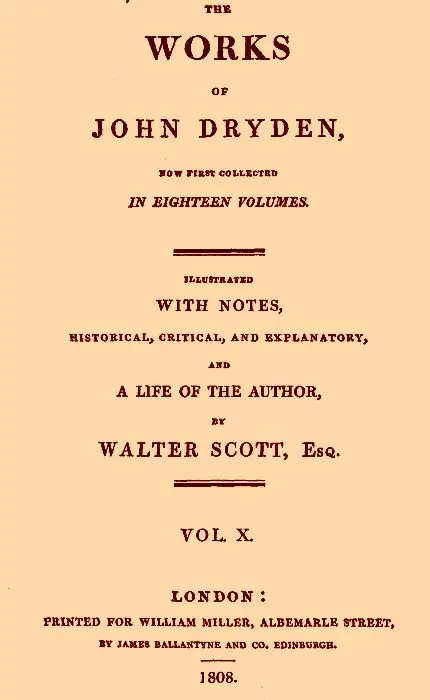
THE CLASSIC COLLECTION · 1633
"The Works of John Dryden, now first collected in eighteen volumes. Volume 10" is a collection of literary works, specifically poetry and essays, compiled from the writings of John Dryden and published during the early 19th century. This volume includes Dryden's poem "Religio Laici," which discusses theological matters and presents his perspectives on faith and religion amidst the complexities of his time. The works likely engage with themes of Christianity, sectarianism, and personal belief. The opening of this volume presents "Religio Laici," an epistolary poem where Dryden articulates his beliefs as a layman amidst a tumultuous religious landscape. He navigates the contentious debates between various religious factions, aiming for a rational exposition of faith that reconciles differing viewpoints. Dryden addresses objections to revealed religion versus rational inquiry, emphasizing the importance of individual reason tempered with faith. His arguments suggest a yearning for a balanced perspective, advocating for personal conviction while also acknowledging the authority of the Church of England despite recognizing the shortcomings within traditions.
Introduction adapted from the source catalogue; source summaries may be automatically generated.
Free to read · English · 135,998 words · No account needed
MAKE TIME FOR A GOOD BOOK
On by default. Untick to stop anonymous reading totals. Each page counts after 10 seconds in view. How this works.
Anonymous counting is on unless you have switched it off.
Thus did the gentle Hind her fable end,
Nor would the Panther blame it, nor commend;
But, with affected yawnings at the close,
Seemed to require her natural repose;
For now the streaky light began to peep,
And setting stars admonished both to sleep.
The Dame withdrew, and, wishing to her guest
The peace of heaven, betook herself to rest:
Ten thousand angels on her slumbers wait,
With glorious visions of her future state.
[Footnote 184: Note I.]
[Footnote 185: The Declaration of Indulgence.]
[Footnote 186: The Convocation.]
[Footnote 187: The adherence of the church of England to the interests of James, while he was an exile at Brussels, and the Bill of Exclusion against him was in dependence, is here, as in other places, made the subject of panegyric. Had the church joined with the sectaries, the destruction of the Catholics, at the time of the plot, would have been inevitable.]
[Footnote 188: The church of England complained, with great reason, of the coldness which they experienced from James, in whose behalf they had exerted themselves so successfully.]
[Footnote 189: An old sea-term, signifying to run before the wind.]
[Footnote 190: Une querelle Allemande is the well-known French phrase for a quarrel picked without cause. The Hind insinuates, that the Panther, conscious of superior force, meant to take such cause of quarrel at the English Catholics, as Louis had raked up against the Huguenots, which, therefore, might be styled rather a French than a German quarrel.]
[Footnote 191: Note II.]
[Footnote 192: Note III.]
[Footnote 193: The different parts of the body were assigned to different planets. The old almanacks have a naked figure in front, surrounded by the usual planetary emblems, which dart their rays on the parts which they govern. What Scorpio claims, if not apparent from the context, may be there found.]
[Footnote 194: Note IV.]
[Footnote 195: Alluding to the charges brought against Dryden himself by Stillingfleet. See Note V.]
[Footnote 196: Note VI.]
[Footnote 197: Note VII.]
[Footnote 198: This is our author's own averment in his "Defence of the Papers of the Duchess of York." See Note VIII.]
[Footnote 199: The latitudinarian, or moderate clergy above-mentioned, and particularly Stillingfleet.]
[Footnote 200: Note IX.]
[Footnote 201: Note X.]
[Footnote 202: Stillingfleet's Vindication, which contains the imputations complained of by Dryden, bears this licence: "Imprimatur, Henricus Maurice Rmo. P. D. Wilhelmo Archiep. Cant. a sacris. January 10, 1686."]
[Footnote 203: In these, and in the following beautiful lines, the poet, who had complained of Stillingfleet's having charged him with atheism, expresses his resolution to submit to this reproach with Christian meekness, and without retaliation.]
[Footnote 204: Stillingfleet. See Note XI.]
[Footnote 205: Note XII.]
[Footnote 206: See Introduction, p. 114; also Note VIII.]
[Footnote 207: The penal laws, though suspended by the king's Declaration of Indulgence, were not thereby abrogated.]
Your reading position is saved on this browser. Take it to another device with a library code. Reading pages adapt to text, rather than matching a printed edition.
BEHIND THE BOOK
This eBook is for the use of anyone anywhere in the United States and most other parts of the world at no cost and with almost no restrictions whatsoever. You may copy it, give it away or re-use it under the terms of the Project Gutenberg License included with this eBook or online at www.gutenberg.org. If you are not located in the United States, you will have to check the laws of the country where you are located before using this eBook. Read the source licence.
The original source file, including credits and licence, is retained by this library. Request an original-format copy at no charge. Please include the book title and Project Gutenberg identifier #51652.
KEEP YOUR CURIOSITY GOING
David Patterson (Spirit) Hatch

David Patterson (Spirit) Hatch

David Patterson (Spirit) Hatch

Ralph Waldo Emerson

Maurice Baring

Oscar Wilde & James McNeill Whistler