THE CLASSIC COLLECTION✦A dead man’s diaryCLASSIC FREE BOOKS
A dead man’s diary
Coulson Kernahan
THE CLASSIC COLLECTION · 1906
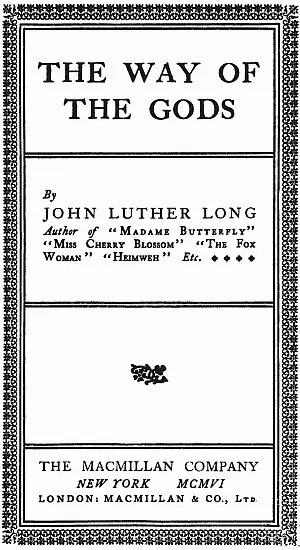
"The Way of the Gods" by John Luther Long is a novel written in the early 20th century. The narrative centers around the character Shijiro Arisuga, a samurai struggling with the weight of duty and honor in a rapidly changing Japan influenced by Western ideals and militarism. Long's work delves into the concepts of happiness and sorrow, portraying the complexities of existence, particularly through the lens of Japanese culture and beliefs. At the start of the story, the opening explores the philosophical underpinnings of joy and sorrow within Japanese society, illustrating that one's happiness often comes at a cost to others. Shijiro recalls five pivotal moments in his life that he deems the happiest, signaling his reflections on loyalty to the emperor and family legacy. The narrative further introduces Shijiro's interactions with various characters, including his uncles, and sets the stage for the conflicts he will face regarding his identity, societal expectations, and the looming presence of love in the form of Yoné, his childhood companion. The text reveals the struggles of a young boy caught between tradition and a desire for personal fulfillment amidst the backdrop of a historic and culturally rich setting.
Introduction adapted from the source catalogue; source summaries may be automatically generated.
Free to read · English · 38,598 words · No account needed
MAKE TIME FOR A GOOD BOOK
On by default. Untick to stop anonymous reading totals. Each page counts after 10 seconds in view. How this works.
Anonymous counting is on unless you have switched it off.
Suddenly Hoshiko saw the hand of the gods in this, also, and went to Jones. Was not this a part of the way she had prayed to be shown? And she had impiously rebelled! Because of her rebellion she went with a certain alacrity.
Jones smiled often at Hoshiko. So often that Arisuga could not but
notice it.
"The yellow dragon of Hanayama covets the dove of Arisuga," he laughed. "Yet doves are not good for dragons. This will be better."
He handed her the small toilet sword which Japanese women carry.
"I have heard," said Jones to Shijiro one day, "that Japanese husbands often rent their wives to pay their debts."
"That is true, lord," bowed his little butler.
"For a year, don't you know, or six months, or something like that?"
"It is true, lord," repeated the butler.
"And that the wives really like it?"
"True, lord," answered Arisuga.
"They don't lose caste after the--er--debt has been paid, but go back to
their husbands?"
"True, lord."
"Well, that's a pretty sensible arrangement. You Jap chaps are always sensible; and"--the yellow fangs came out--"I am your creditor for a couple of thousand dollars. Arisuga, I am willing to be so paid and to pay you a couple more thousand than you owe me! Then your passage will be safe. I don't believe, now, it will be otherwise. I have got you in too deep a hole."
Jones laughed hoarsely at his own cunning.
Arisuga received the suggestion as he would have received an unimportant
business proposition.
"I will consider and let the enlightened eijinsan know," he said. This, also, as if it were the mere oriental courtesy of bargaining--the sloth which is polite.
"I guess it will be all right," laughed Jones. "Take your time. No one is proof against the blandishments of American gold. Even oriental virtue yields to it. Don't you think it will be all right?"--a bit anxiously.
"Let the honorable American lord so think," said Arisuga. "I will
consider."
"I shan't be niggardly, understand. If you are not satisfied with a couple of thousands, we'll make it a quartette. She is about the dearest little morsel I have ever seen."
"Ha, ha!" laughed Arisuga, with American politeness, this time.
"Ha, ha!" laughed Jones.
And Hoshiko, taking her cue, laughed too, out of the palest face she had ever had. For she was present--though she was not thought to know English enough to understand what was said.
Your reading position is saved on this browser. Take it to another device with a library code. Reading pages adapt to text, rather than matching a printed edition.
BEHIND THE BOOK
This eBook is for the use of anyone anywhere in the United States and most other parts of the world at no cost and with almost no restrictions whatsoever. You may copy it, give it away or re-use it under the terms of the Project Gutenberg License included with this eBook or online at www.gutenberg.org. If you are not located in the United States, you will have to check the laws of the country where you are located before using this eBook. Read the source licence.
The original source file, including credits and licence, is retained by this library. Request an original-format copy at no charge. Please include the book title and Project Gutenberg identifier #33616.
KEEP YOUR CURIOSITY GOING
Coulson Kernahan

Maurice Baring
Frances Wright
Cécile Tormay

Frederic Jesup Stimson

W. H. P. (William Henry Pope) Jarvis