THE CLASSIC COLLECTION✦A dead man’s diaryCLASSIC FREE BOOKS
A dead man’s diary
Coulson Kernahan
THE CLASSIC COLLECTION · 1906
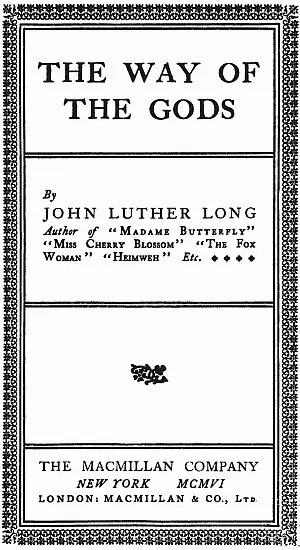
"The Way of the Gods" by John Luther Long is a novel written in the early 20th century. The narrative centers around the character Shijiro Arisuga, a samurai struggling with the weight of duty and honor in a rapidly changing Japan influenced by Western ideals and militarism. Long's work delves into the concepts of happiness and sorrow, portraying the complexities of existence, particularly through the lens of Japanese culture and beliefs. At the start of the story, the opening explores the philosophical underpinnings of joy and sorrow within Japanese society, illustrating that one's happiness often comes at a cost to others. Shijiro recalls five pivotal moments in his life that he deems the happiest, signaling his reflections on loyalty to the emperor and family legacy. The narrative further introduces Shijiro's interactions with various characters, including his uncles, and sets the stage for the conflicts he will face regarding his identity, societal expectations, and the looming presence of love in the form of Yoné, his childhood companion. The text reveals the struggles of a young boy caught between tradition and a desire for personal fulfillment amidst the backdrop of a historic and culturally rich setting.
Introduction adapted from the source catalogue; source summaries may be automatically generated.
Free to read · English · 38,598 words · No account needed
MAKE TIME FOR A GOOD BOOK
On by default. Untick to stop anonymous reading totals. Each page counts after 10 seconds in view. How this works.
Anonymous counting is on unless you have switched it off.
"I can touch the other mat," laughed Arisuga.
"And I," laughed his wife, doing the same.
"What!" cried the soldier. "I am taller than you are."
Then Hoshiko understood that she ought not to have said that. It was heinous to make herself the equal of her lord in anything.
"No, lord," she hastened to say, "I lied--a little lie--while we
sported. I am sorry."
"It is no lie," laughed happy Arisuga once more; for you will remember that all her daintiness was then his, and that he was not like other Japanese husbands; "we are exactly the same height."
"No, no, no, lord," pleaded Hoshiko, who fearfully knew that it was so, "you are much taller than miserable small me."
And, to prove it, she bent her knees within her kimono and stood beside him, for he had risen to prove the matter.
But he detected the bent knees and straightened them, and, lo! there was not a shadow of difference in their height.
And when the little soldier laughed and was very happy about it, she laughed too, timorously at first, then more joyously than he. For to be his equal in something, and to see him happy about it--well, she supposed that no Japanese girl had ever before such felicity, and perhaps she was right.
So, in their playing and laughter, he cried:
"And I shall be punished for my haughty spirit in thinking I was, and
you shall be rewarded for the humility of yours in thinking you were
not."
And the manner of this punishment and reward was for him to strip off her kimono and put it on himself, and his uniform and put it on her. Oh, you may be sure that she tried to fly in her terror of him, that she fought and wept and at last utterly exhausted had to let him have his way--even to tucking her splendid hair under his military cap. She lay there happily crushed and disgraced until he had made himself so like her that she hardly knew him.
But she would not see herself until he brought the mirror and told her that he was looking at himself. Then she looked, and it was true. With staring eyes she stood upon her feet and passed the mirror up and down.
Then suddenly she saw the smiling face of a god in the mirror also, and knew that this was to be the fashion of the reincarnation she had begged of the gods.
She whispered her husband to look into the mirror.
"There is the face of a god there!"
Arisuga looked and laughed, but saw no god.
Your reading position is saved on this browser. Take it to another device with a library code. Reading pages adapt to text, rather than matching a printed edition.
BEHIND THE BOOK
This eBook is for the use of anyone anywhere in the United States and most other parts of the world at no cost and with almost no restrictions whatsoever. You may copy it, give it away or re-use it under the terms of the Project Gutenberg License included with this eBook or online at www.gutenberg.org. If you are not located in the United States, you will have to check the laws of the country where you are located before using this eBook. Read the source licence.
The original source file, including credits and licence, is retained by this library. Request an original-format copy at no charge. Please include the book title and Project Gutenberg identifier #33616.
KEEP YOUR CURIOSITY GOING
Coulson Kernahan

Maurice Baring
Frances Wright
Cécile Tormay

Frederic Jesup Stimson

W. H. P. (William Henry Pope) Jarvis