THE CLASSIC COLLECTION✦A dead man’s diaryCLASSIC FREE BOOKS
A dead man’s diary
Coulson Kernahan
THE CLASSIC COLLECTION · 1906
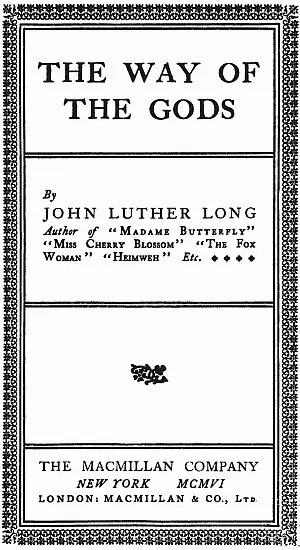
"The Way of the Gods" by John Luther Long is a novel written in the early 20th century. The narrative centers around the character Shijiro Arisuga, a samurai struggling with the weight of duty and honor in a rapidly changing Japan influenced by Western ideals and militarism. Long's work delves into the concepts of happiness and sorrow, portraying the complexities of existence, particularly through the lens of Japanese culture and beliefs. At the start of the story, the opening explores the philosophical underpinnings of joy and sorrow within Japanese society, illustrating that one's happiness often comes at a cost to others. Shijiro recalls five pivotal moments in his life that he deems the happiest, signaling his reflections on loyalty to the emperor and family legacy. The narrative further introduces Shijiro's interactions with various characters, including his uncles, and sets the stage for the conflicts he will face regarding his identity, societal expectations, and the looming presence of love in the form of Yoné, his childhood companion. The text reveals the struggles of a young boy caught between tradition and a desire for personal fulfillment amidst the backdrop of a historic and culturally rich setting.
Introduction adapted from the source catalogue; source summaries may be automatically generated.
Free to read · English · 38,598 words · No account needed
MAKE TIME FOR A GOOD BOOK
On by default. Untick to stop anonymous reading totals. Each page counts after 10 seconds in view. How this works.
Anonymous counting is on unless you have switched it off.
"Having settled it that he practises the art of music, I will surprise you with the information that he also pretends to the sister art of poesy," laughed Asami. "He is the author of 'The Great Death'!"
"What!"
From half a dozen of them.
And they broke into the song: hoarse, iron, clanging, mongolian! Within the six notes of the old Japanese scale!
(Do not be surprised at this. The Japanese army is full of poets. Indeed, the Japanese land is full of them. They will spin you a complete comedy or tragedy between seventeen or thirty-seven syllables. And, to practise poetry is not there as here, heinous to one's friends. I know of a gunner who sat cross-legged under his gun behind Poutuloff and wrote a poem concerning The-Moon-in-a-Moat. It was finished as the Russians got his range and dropped a covey of shrapnel upon him. After the smoke cleared they found him dead. And he is forgotten. But his poem was also found and lived on.)
This was "The Great Death" of Shijiro Arisuga.
"Yell of metal,
Strake of flame!
Death-wound spurting
In my face!
Hail Red Death!"
"Banzai!" cried Jokichi.
"Teikoku Banzai!" yelled Asami.
And, after the tumult, Yasuki, the reserved, himself said:--
"By Shaka, it is the very Yamato Damashii itself! The spirit of young
Japan."
"Nippon Denji!" laughed jolly Kitsushima.
"Yes! The Boys in Blue--as they called them in America in 1864."
Matsumoto had been to Princeton. But the thought of war--giving his soul for his emperor--made him as mad as they who had never left their native soil.
"I take all back," cried Nijin, into the tumult.
"And I," yelled Yasuki, who had agreed with him.
"Let him in!" shrilled Matsumoto and Jokichi together. "If he can write
songs--"
"And let him sing! Let him sing war-songs!" adjured Kitsushima!
Still, the happy Nijin, out of propriety of his office, as
recruiting-major, pretended to wish to stem the current started by the
song.
"One moment!" he cried.
But they laughed him down and again started the war-song.
"I will have a moment!"
"Take two!" shouted Jokichi.
"Singing and fighting are two very different occupations."
"No, they are precisely the same," laughed Kitsushima.
"I deny it!"
It was a fierce yell from Nijin, who was happiest, to pretend tremendous
anger.
"I affirm it!" laughed Jokichi, into his face.
"Pretender!" cried Asami, shaking a happy fist at his superior.
Asami and Nijin stood with Zanzi for his admission.
Still, Nijin said in thunder:--
"Remember! poets never practise their preaching."
Nevertheless, if he had entered then, Arisuga would have been chosen, by acclaim, because of his song.
Your reading position is saved on this browser. Take it to another device with a library code. Reading pages adapt to text, rather than matching a printed edition.
BEHIND THE BOOK
This eBook is for the use of anyone anywhere in the United States and most other parts of the world at no cost and with almost no restrictions whatsoever. You may copy it, give it away or re-use it under the terms of the Project Gutenberg License included with this eBook or online at www.gutenberg.org. If you are not located in the United States, you will have to check the laws of the country where you are located before using this eBook. Read the source licence.
The original source file, including credits and licence, is retained by this library. Request an original-format copy at no charge. Please include the book title and Project Gutenberg identifier #33616.
KEEP YOUR CURIOSITY GOING
Coulson Kernahan

Maurice Baring
Frances Wright
Cécile Tormay

Frederic Jesup Stimson

W. H. P. (William Henry Pope) Jarvis