THE CLASSIC COLLECTION✦A dead man’s diaryCLASSIC FREE BOOKS
A dead man’s diary
Coulson Kernahan
THE CLASSIC COLLECTION · 1906
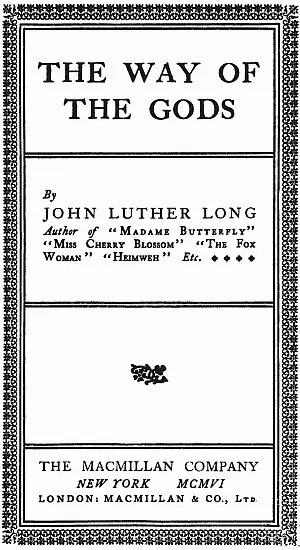
"The Way of the Gods" by John Luther Long is a novel written in the early 20th century. The narrative centers around the character Shijiro Arisuga, a samurai struggling with the weight of duty and honor in a rapidly changing Japan influenced by Western ideals and militarism. Long's work delves into the concepts of happiness and sorrow, portraying the complexities of existence, particularly through the lens of Japanese culture and beliefs. At the start of the story, the opening explores the philosophical underpinnings of joy and sorrow within Japanese society, illustrating that one's happiness often comes at a cost to others. Shijiro recalls five pivotal moments in his life that he deems the happiest, signaling his reflections on loyalty to the emperor and family legacy. The narrative further introduces Shijiro's interactions with various characters, including his uncles, and sets the stage for the conflicts he will face regarding his identity, societal expectations, and the looming presence of love in the form of Yoné, his childhood companion. The text reveals the struggles of a young boy caught between tradition and a desire for personal fulfillment amidst the backdrop of a historic and culturally rich setting.
Introduction adapted from the source catalogue; source summaries may be automatically generated.
Free to read · English · 38,598 words · No account needed
MAKE TIME FOR A GOOD BOOK
On by default. Untick to stop anonymous reading totals. Each page counts after 10 seconds in view. How this works.
Anonymous counting is on unless you have switched it off.
But, just then, they heard the sigh of a moving screen, and the acid face of Hoshiko's mother looked in. She said nothing, only let her eyes rove from face to face. But that was very cooling. She closed the shoji and went away--apparently.
Now, for the benefit of her mother, whom she knew to be still behind the fusuma, Hoshiko tried to look very severe. She had taken the poppies from behind her ear and had pinned a napkin about her hair, and turned up the sleeves of her kimono, making herself all the lovelier as she very well knew in this fashion of a nurse.
"You are to wash your hands in this cold water to refresh you. Then I will take it away and bring you other water for your face."
But, in the end, she washed his hands for him, and his face, too, amid a great deal of laughter and splashing.
"And now," he said, "I will take every advantage of my defenceless enemy. I will make her give me my breakfast."
Though she demurred, Hoshiko was quite mad to do it.
"Beware!" she whispered, as she let a persimmon slip from between her chopsticks into his mouth. "In the East, walls have not only ears but eyes!"
"And no conscience!"
"What would you?"
She hoped that he might desire walls without senses, where they might be
fearlessly alone.
"Another persimmon!" he laughed.
"No," she pouted, for his punishment, "nothing but the rice."
"Not all the hard hearts," he sighed, "are behind the walls!"
Then she gave him the most luscious of the persimmons.
"You haven't told me yet," he insisted, "what I did and what you did while I was unconscious. That is always interesting."
She filled his mouth with rice.
"But what did you do and what did I do?"
It came through the rice.
"Please drink," she said.
"What did you do, what did I do?" he sputtered.
"Pardon me while I wipe your mouth."
"But what--"
"Nothing. I did nothing, you did nothing."
"It must have been very dull for you," sighed the defeated soldier.
"Jizo--" she was praying to the goddess at her small shrine that night--"I am going to conceal and lie! I pray you to intercede with the Lord Shaka for my pardon. He loves me--and he must not know. It is for happiness, Jizo. His happiness, do you understand, dear Jizo?"
She cried out savagely in her further confidences to Jizo that night, when she was ready for bed.
Your reading position is saved on this browser. Take it to another device with a library code. Reading pages adapt to text, rather than matching a printed edition.
BEHIND THE BOOK
This eBook is for the use of anyone anywhere in the United States and most other parts of the world at no cost and with almost no restrictions whatsoever. You may copy it, give it away or re-use it under the terms of the Project Gutenberg License included with this eBook or online at www.gutenberg.org. If you are not located in the United States, you will have to check the laws of the country where you are located before using this eBook. Read the source licence.
The original source file, including credits and licence, is retained by this library. Request an original-format copy at no charge. Please include the book title and Project Gutenberg identifier #33616.
KEEP YOUR CURIOSITY GOING
Coulson Kernahan

Maurice Baring
Frances Wright
Cécile Tormay

Frederic Jesup Stimson

W. H. P. (William Henry Pope) Jarvis