THE CLASSIC COLLECTION✦A dead man’s diaryCLASSIC FREE BOOKS
A dead man’s diary
Coulson Kernahan
THE CLASSIC COLLECTION · 1906
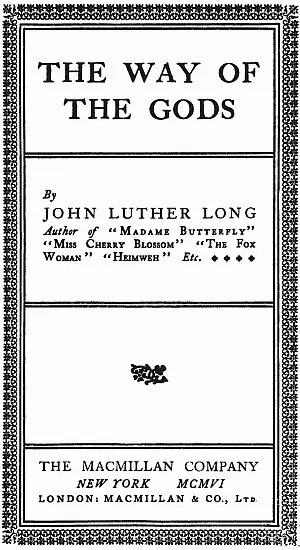
"The Way of the Gods" by John Luther Long is a novel written in the early 20th century. The narrative centers around the character Shijiro Arisuga, a samurai struggling with the weight of duty and honor in a rapidly changing Japan influenced by Western ideals and militarism. Long's work delves into the concepts of happiness and sorrow, portraying the complexities of existence, particularly through the lens of Japanese culture and beliefs. At the start of the story, the opening explores the philosophical underpinnings of joy and sorrow within Japanese society, illustrating that one's happiness often comes at a cost to others. Shijiro recalls five pivotal moments in his life that he deems the happiest, signaling his reflections on loyalty to the emperor and family legacy. The narrative further introduces Shijiro's interactions with various characters, including his uncles, and sets the stage for the conflicts he will face regarding his identity, societal expectations, and the looming presence of love in the form of Yoné, his childhood companion. The text reveals the struggles of a young boy caught between tradition and a desire for personal fulfillment amidst the backdrop of a historic and culturally rich setting.
Introduction adapted from the source catalogue; source summaries may be automatically generated.
Free to read · English · 38,598 words · No account needed
MAKE TIME FOR A GOOD BOOK
On by default. Untick to stop anonymous reading totals. Each page counts after 10 seconds in view. How this works.
Anonymous counting is on unless you have switched it off.
"It is not a heaven," he agreed, when he had passed his hand along an
exquisite arm.
"I am honorably glad that you are not dead," breathed the girl, bravely.
"Are not you?"
And every little atom of her showed that she was glad and begged that he might be. Though the mists were still in the brain of Shijiro Arisuga, he could not help knowing both of these things: her innocence had uncovered them so completely. For a moment he studied her. Then he answered a tardy yes to her question.
"For such as you it is good to live--yes--and--" The soldier stopped to sigh. "Good for others to live near you for the little while."
"For a little while, lord?"
She thought it the mere hyperbole of their race.
"Oh, you shall be old, old, old, and beautiful, with long white hair and perhaps a beard, and all the earth shall worship your piety--"
Arisuga laughed and caught a hand to stop her.
"Lord," she went on, "most vast lord, I will make you. Yes! I have thus far made it to be. When they brought you they said you would die. So said my father and mother. But I--"
She turned and summoned her maid with fierce irrelevance.
"Isonna, come here!"
The maid hastened from the next room, where, it is almost certain, she had lain with her ear to the fusuma, and then Hoshiko's mysterious purpose appeared.
"But I--Isonna and me--this is Isonna, my ugly maid--Isonna and me prayed for you--wept for you; you were so beautiful and bloody. And Benten--see, I have Benten always near! Benten loves the tears of sympathy, and to her we prayed, so--"
"I owe you and Isonna my life," laughed the soldier.
"No, Benten," whispered the girl, now answering his laugh with a smile. "And she will grant other prayers of ours--Isonna and me--will she not, Isonna, you little beast? Why do you not speak?"
Isonna corroborated her mistress by a deep prostration.
"And so we have asked for long life for you, very long, until the pebbles grow to boulders and the moss grows to your shoulders--"
Arisuga laughed, in frank joy of her.
"And suppose, you who are so powerful with the goddess of beauty--for which I do not blame the goddess--suppose I have sworn to die the great death, to release my father's soul from the Meido so that he can be born again, and for the glory of the emperor?"
"Oh!" gasped the girl.
The soldier went on.
"--what will the other gods think of me, saving Benten, if I stop here and forget to die because a woman has hands, a voice, and eyes?"
Your reading position is saved on this browser. Take it to another device with a library code. Reading pages adapt to text, rather than matching a printed edition.
BEHIND THE BOOK
This eBook is for the use of anyone anywhere in the United States and most other parts of the world at no cost and with almost no restrictions whatsoever. You may copy it, give it away or re-use it under the terms of the Project Gutenberg License included with this eBook or online at www.gutenberg.org. If you are not located in the United States, you will have to check the laws of the country where you are located before using this eBook. Read the source licence.
The original source file, including credits and licence, is retained by this library. Request an original-format copy at no charge. Please include the book title and Project Gutenberg identifier #33616.
KEEP YOUR CURIOSITY GOING
Coulson Kernahan

Maurice Baring
Frances Wright
Cécile Tormay

Frederic Jesup Stimson

W. H. P. (William Henry Pope) Jarvis