THE CLASSIC COLLECTION✦A dead man’s diaryCLASSIC FREE BOOKS
A dead man’s diary
Coulson Kernahan
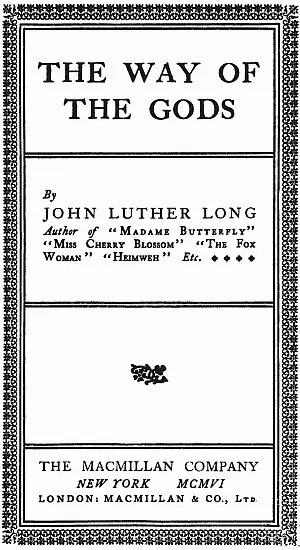
THE CLASSIC COLLECTION · 1906
"The Way of the Gods" by John Luther Long is a novel written in the early 20th century. The narrative centers around the character Shijiro Arisuga, a samurai struggling with the weight of duty and honor in a rapidly changing Japan influenced by Western ideals and militarism. Long's work delves into the concepts of happiness and sorrow, portraying the complexities of existence, particularly through the lens of Japanese culture and beliefs. At the start of the story, the opening explores the philosophical underpinnings of joy and sorrow within Japanese society, illustrating that one's happiness often comes at a cost to others. Shijiro recalls five pivotal moments in his life that he deems the happiest, signaling his reflections on loyalty to the emperor and family legacy. The narrative further introduces Shijiro's interactions with various characters, including his uncles, and sets the stage for the conflicts he will face regarding his identity, societal expectations, and the looming presence of love in the form of Yoné, his childhood companion. The text reveals the struggles of a young boy caught between tradition and a desire for personal fulfillment amidst the backdrop of a historic and culturally rich setting.
Introduction adapted from the source catalogue; source summaries may be automatically generated.
Free to read · English · 38,598 words · No account needed
MAKE TIME FOR A GOOD BOOK
On by default. Untick to stop anonymous reading totals. Each page counts after 10 seconds in view. How this works.
Anonymous counting is on unless you have switched it off.
"I have my eye on it," laughed the image, "and I admit that a few whiches and whos for thats, and--even--er--pardon!--a few of your dashes, would make its teaching more grateful."
"God," adjured I, happily, "thank you! Now do please stop and think! No speech, no thought, goes on without dashes. When we write the speech which flows mellifluous, we do violence to nature. And in all art the tendency is toward nature."
"Recently," began the deity, in that high tone which always meant checkmate to me, "I have seen the statue of an alleged athlete, in which his bunions were reproduced!"
"I saw it, too," I laughed. Indeed, the god and I had stared at it
together.
"Well," the effigy went on, "that was certainly nature!"
"There is a golden mean," I re-quoted. "An artistic attitude toward all manifestations of art. If one has this one will appreciate--er--whether to reproduce the bunions. They may, of course, be picturesque bunions. Why, god, if one should reproduce human speech, as it is spoken, there would be a dash after every third word! Mine are quite within bounds."
"It would look queer," said the god, "and you would be called eccentric instead of original. Please don't do it! In fact stop it! Placate both your readers and your critics."
"Oh, as to that," said I, airily, "the labor would all be lost. Anything which is unusual to the superficial experience of the average person is glibly dubbed eccentric. You know how it is. A reader likes to find the dear old situations in advance of him so that he knows what he is approaching. There is the same fear of the terra incognita in literature that there is in nature. A book or a play which is too novel a tax upon the faculties of a client is not to his liking."
"Who, pray, do you write books for?" asked the effigy, with the
suspicion of a yawn.
"The people who read them," said I, cockily.
"Do They include the critics?"
"Oh, no," said I, hastily.
"Aren't they 'people who read them'?"
"Why, they are critics," cried I. "How can they?"
"That is hard doctrine," said the god, dully. "If you write for the people who read, you must submit to their verdict. And the critics are a part of them."
"A small part. But they pretend to speak for the whole. Permit me to
explain--"
The god politely waited.
Your reading position is saved on this browser. Take it to another device with a library code. Reading pages adapt to text, rather than matching a printed edition.
BEHIND THE BOOK
This eBook is for the use of anyone anywhere in the United States and most other parts of the world at no cost and with almost no restrictions whatsoever. You may copy it, give it away or re-use it under the terms of the Project Gutenberg License included with this eBook or online at www.gutenberg.org. If you are not located in the United States, you will have to check the laws of the country where you are located before using this eBook. Read the source licence.
The original source file, including credits and licence, is retained by this library. Request an original-format copy at no charge. Please include the book title and Project Gutenberg identifier #33616.
KEEP YOUR CURIOSITY GOING
Coulson Kernahan

Maurice Baring
Frances Wright
Cécile Tormay

Frederic Jesup Stimson

W. H. P. (William Henry Pope) Jarvis