
Letters to a Friend, Written to Mrs. Ezra S. Carr, 1866-1879
John Muir
THE CLASSIC COLLECTION · 1878
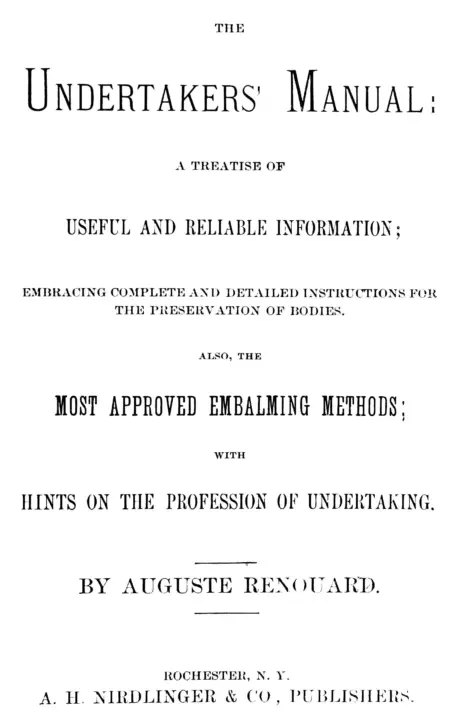
"The Undertakers' Manual" by Auguste Renouard is a treatise on the profession of undertaking, written in the late 19th century. This comprehensive text provides detailed instructions for embalming and body preservation, illuminating the scientific practices behind these procedures while addressing the important role that undertakers play in society. Renouard aims to elevate the profession by offering valuable insights into both the technical and human aspects of undertaking. The opening of the manual introduces the purpose and significance of the work, emphasizing the lack of prior comprehensive resources for undertakers in America. It discusses the need for a sound understanding of anatomy and physiological chemistry as vital for successful embalming practices. Through an introduction by Thomas Gliddon, the author sets a tone of professionalism and responsibility, suggesting that knowledge and skill will enable undertakers to manage their responsibilities with care and respect for the deceased and their families. Renouard outlines the necessity for a detailed grasp of the processes and conditions involved in preserving bodies, foreshadowing a meticulous and enlightening discussion in the subsequent chapters.
Introduction adapted from the source catalogue; source summaries may be automatically generated.
Free to read · English · 53,720 words · No account needed
MAKE TIME FOR A GOOD BOOK
On by default. Untick to stop anonymous reading totals. Each page counts after 10 seconds in view. How this works.
Anonymous counting is on unless you have switched it off.
GLOTTIS. The aperture of the larynx between the arytænoïd cartilages. It is covered by a cartilage called the epi-glottis.
GRANULE. A small particle.
HÆMATOSIN (Gr. haima, blood). A characteristic constituent of the blood, derived from the globules.
HÆMORRHAGE. A rupture of a blood-vessel; a bursting forth of
blood; loss of blood.
HEPATIC. A term applied to any part belonging to the liver.
HUMERUS. The bone of the upper arm.
HUMOR (L. humeo, to be moist). An aqueous substance; as the
humors of the eye.
HYGIENE (Gr. to be well). Health; the preservation of health; that part of medicine which regards the preservation of health.
HYOIDES (the Greek letter upsilon). A bone situated between the root of the tongue and the larynx.
HYPOGASTRIUM. The lower anterior region of the abdomen.
HYPOGLOSSAL. The name of the lingualis, or ninth pair of nerves, situated beneath the tongue.
ICHOR. A thin, acrid discharge, issuing from wounds, ulcers, &c.
JEJUNUM (L. jejunus, hungry). The upper two-fifths of the small
intestines; so named from this portion being generally found
empty.
ILEUM (to turn about). The lower three-fifths of the small
intestines;
so called from their convolutions or peristaltic motions.
ILIAC BONE. Another name for the os innominatum, derived from the circumstance that this compound bone supports the parts which the ancients called ilia, or the flanks.
ILIAC REGION. The region situated on each side of the hypogastrium.
INDEX (L. indico, to point out). The forefinger; the finger usually employed in pointing at any object.
INFRA-SPINATUS. A muscle arising from the scapula below the spine, and inserted into the humerus.
INNOMINATUS (L. in, priv., nomen, name). Hence, Innominatum os, a bone composed of three portions, viz: 1, The ilium, or haunch-bone; 2, The ischium, or hip-bone; 3, The os pubis, or share bone.
INTEGUMENT (L. in, and tego, to cover). The covering of any part of the body, as the cuticle, cutis, &c.
INTER-COSTAL. The name of two sets of muscles between the ribs—the external and the internal.
INTESTINES (L. intus, within). That part of the alimentary canal which extends from the stomach to the anus.
JUGULAR. Belonging to the neck; applied chiefly to the principal
veins of the neck.
KINGDOM. A term denoting any of the principal divisions of nature. Thus we have the organic kingdom, comprehending substances which organize; and the inorganic kingdom, comprehending substances which crystallize.
KNEE-PAN. Patella; the small round bone at the front of the
knee-joint.
KIDNEYS. Two oblong glands, which secrete the urine.
Your reading position is saved on this browser. Take it to another device with a library code. Reading pages adapt to text, rather than matching a printed edition.
BEHIND THE BOOK
This eBook is for the use of anyone anywhere in the United States and most other parts of the world at no cost and with almost no restrictions whatsoever. You may copy it, give it away or re-use it under the terms of the Project Gutenberg License included with this eBook or online at www.gutenberg.org. If you are not located in the United States, you will have to check the laws of the country where you are located before using this eBook. Read the source licence.
The original source file, including credits and licence, is retained by this library. Request an original-format copy at no charge. Please include the book title and Project Gutenberg identifier #70908.
KEEP YOUR CURIOSITY GOING
John Muir

Asa Gray
Asa Gray

Florence Nightingale
Elizabeth Robins Pennell
Denison Olmsted