
Letters to a Friend, Written to Mrs. Ezra S. Carr, 1866-1879
John Muir
THE CLASSIC COLLECTION · 1878
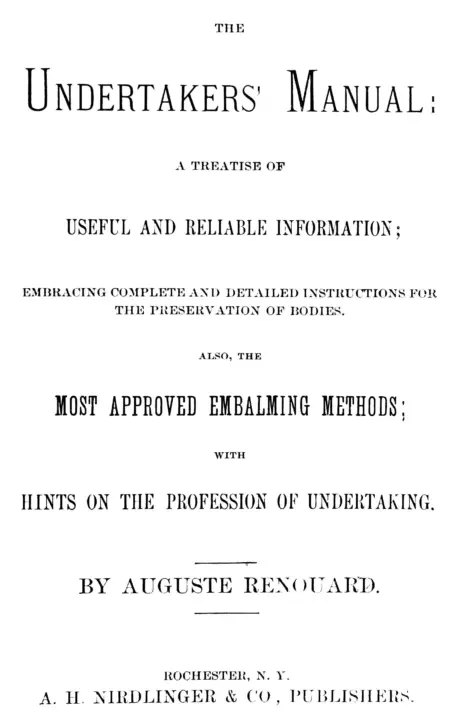
"The Undertakers' Manual" by Auguste Renouard is a treatise on the profession of undertaking, written in the late 19th century. This comprehensive text provides detailed instructions for embalming and body preservation, illuminating the scientific practices behind these procedures while addressing the important role that undertakers play in society. Renouard aims to elevate the profession by offering valuable insights into both the technical and human aspects of undertaking. The opening of the manual introduces the purpose and significance of the work, emphasizing the lack of prior comprehensive resources for undertakers in America. It discusses the need for a sound understanding of anatomy and physiological chemistry as vital for successful embalming practices. Through an introduction by Thomas Gliddon, the author sets a tone of professionalism and responsibility, suggesting that knowledge and skill will enable undertakers to manage their responsibilities with care and respect for the deceased and their families. Renouard outlines the necessity for a detailed grasp of the processes and conditions involved in preserving bodies, foreshadowing a meticulous and enlightening discussion in the subsequent chapters.
Introduction adapted from the source catalogue; source summaries may be automatically generated.
Free to read · English · 53,720 words · No account needed
MAKE TIME FOR A GOOD BOOK
On by default. Untick to stop anonymous reading totals. Each page counts after 10 seconds in view. How this works.
Anonymous counting is on unless you have switched it off.
CÆCUM, or CŒCUM (L. cæcus, blind). The first part of the colon
or blind intestine.
CALLUS (Latin, hardness). New bone, or the substance which serves to join together the ends of a fracture, and to restore destroyed portions of bone.
CAPILLARY (L. capillus, a hair). Resembling a hair in size; a term applied to the vessels which intervene between the minute arteries and veins.
CAPSULA (L. dim. of capsa, a chest). Literally, a little chest. A capsule or bag, which incloses any part.
CARBON (L. carbo, a coal). A substance well known under the form of coal, charcoal, lamp-black, &c. In chemical language, it denotes the pure inflammable principle of charcoal; in its state of absolute purity it constitutes the diamond.
CARBONIC ACID. Carbon and oxygen combined.
CARDIA (Gr. kardia, the heart). The entrance into the stomach; so called from being near the heart.
CARDIAC (Gr. kardia, the heart). Relating to the heart.
CAROTID (Gr. karóō, to induce sleep). The name of two large arteries of the neck; so called from an idea that tying them would induce stupor.
CARPUS (Gr. karpós, fruit). The wrist. The ossa carpi, or carpal bones, are eight in number, and form two rows.
CARTILAGE. Gristle. It is attached to bones, and must be distinguished from the ligaments of joints and tendons of muscles.
CEREBELLUM (dim. of cerebrum). The little brain, situated behind
the larger or cerebrum.
CEREBRUM (Gr. káre, the head). The brain; the chief portion of the brain, occupying the whole upper cavity of the skull.
CEREBRO-SPINAL. System.
CERVIX. The neck; the hinder part of the neck. The fore part
is called collum.
CHEST. Thorax. An old English term, commonly traced to the Latin cista.—“When it is considered that the same word was anciently used for a basket, the appropriation of it to the human thorax will appear quite natural to any one who has ever seen a skeleton.”—Forbes.
CHYLE (Gr. chulòs, juice). The milk-like fluid absorbed by the
lacteal vessels.
CHYLIFICATION (L. fio, to become). The process by which the chyle is separated from the chyme.
CHYME (Gr. chumòs, juice). The semi-fluid matter which passes from the stomach into the duodenum.
CHYMIFICATION (L. fio, to become). The process by which the
aliment is converted into chyme.
CLAVICULA (dim. of clavis, a key). The clavicle, or collar-bone; so called from its resemblance to an ancient key.
COCCYX (Gr. kókkux, a cuckoo). The lower end of the spine; so called from its resemblance to a cuckoo’s beak.
COLON (Gr. kolīn, quasi, koīlon, hollow). The first of the large
intestines, commencing at the cœcum, and terminating at the
rectum.
Your reading position is saved on this browser. Take it to another device with a library code. Reading pages adapt to text, rather than matching a printed edition.
BEHIND THE BOOK
This eBook is for the use of anyone anywhere in the United States and most other parts of the world at no cost and with almost no restrictions whatsoever. You may copy it, give it away or re-use it under the terms of the Project Gutenberg License included with this eBook or online at www.gutenberg.org. If you are not located in the United States, you will have to check the laws of the country where you are located before using this eBook. Read the source licence.
The original source file, including credits and licence, is retained by this library. Request an original-format copy at no charge. Please include the book title and Project Gutenberg identifier #70908.
KEEP YOUR CURIOSITY GOING
John Muir

Asa Gray
Asa Gray

Florence Nightingale
Elizabeth Robins Pennell
Denison Olmsted