
Letters to a Friend, Written to Mrs. Ezra S. Carr, 1866-1879
John Muir
THE CLASSIC COLLECTION · 1878
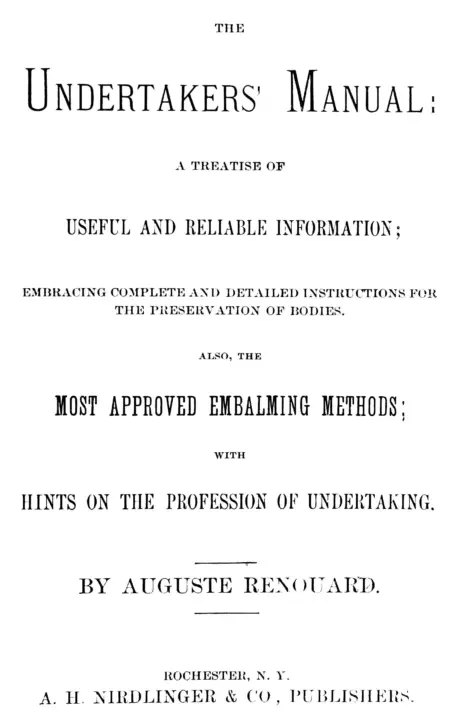
"The Undertakers' Manual" by Auguste Renouard is a treatise on the profession of undertaking, written in the late 19th century. This comprehensive text provides detailed instructions for embalming and body preservation, illuminating the scientific practices behind these procedures while addressing the important role that undertakers play in society. Renouard aims to elevate the profession by offering valuable insights into both the technical and human aspects of undertaking. The opening of the manual introduces the purpose and significance of the work, emphasizing the lack of prior comprehensive resources for undertakers in America. It discusses the need for a sound understanding of anatomy and physiological chemistry as vital for successful embalming practices. Through an introduction by Thomas Gliddon, the author sets a tone of professionalism and responsibility, suggesting that knowledge and skill will enable undertakers to manage their responsibilities with care and respect for the deceased and their families. Renouard outlines the necessity for a detailed grasp of the processes and conditions involved in preserving bodies, foreshadowing a meticulous and enlightening discussion in the subsequent chapters.
Introduction adapted from the source catalogue; source summaries may be automatically generated.
Free to read · English · 53,720 words · No account needed
MAKE TIME FOR A GOOD BOOK
On by default. Untick to stop anonymous reading totals. Each page counts after 10 seconds in view. How this works.
Anonymous counting is on unless you have switched it off.
MAGNESIUM. A metal having the color and lustre of silver.
MASSETER (Gr. to chew). A muscle which assists in chewing.
MASTOID (Gr. a breast). Shaped like the breast or nipple; as applied to a process, and a foramen of the temporal bone.
MEATUS (L. meo, to pass, to flow). Literally, a passage.
MEDULLA. Marrow; a kind of fixed oil, occupying the cavities
of bones.
MEDULLA OBLONGATA. The upper enlarged portion of the spinal
cord.
MEDULLA SPINALIS. The spinal marrow or cord.
MEDULLARY. The designation of the white substance of the
brain.
MESENTERY (Gr. between the bowels). The membrane which
connects the small intestines and the posterior wall of the
abdomen.
META-CARPUS (Gr. after, the wrist). That part of the hand which is situated between the carpus and the fingers.
META-TARSUS. That part of the foot which is situated between
the tarsus and the toes.
MIDRIFF. Diaphragm. The muscle which divides the body into
the thorax and the abdomen.
MITRAL VALVES (L. mitra, a mitre). The name of two valves which guard the left ventricle of the heart.
MOLAR (L. mola, a mill-stone). The double or grinding teeth. Those with two fangs are called bicuspid, or false molars.
MOTOR (L. moveo, to move). A mover; a part whose function is
motion.
MUCUS. The liquid secreted by the mucous surfaces, as of the
nostrils, intended as a protection to the parts exposed to external
influences.
NARCOTICS (Gr. stupor). Medicines which induce sleep or stupor,
as opiates.
NASUS. The nose, or organ of smell; whence nasal, belonging
to the nose.
NERVES (L. nervus, a string). White cords arising from the brain
or the spinal marrow, and distributed to every part of the
system.
NEURON (Gr.) A nerve; a cord arising from the brain or spinal marrow. Whence Neurilemma, the sheath of a nerve; and Neurology, the doctrine of the nerves.
NITROGEN. Azote. An elementary principle, constituting four-fifths of the volume of atmospheric air.
NUTRITION (L. nutrio, to nourish). The process of nourishing
the frame.
OBTURATOR (L. obturo, to stop up). The name of two muscles of
the thigh, and of a nerve.
OCCIPUT (L. ob caput). The back part of the head; the part
opposite
to the front or sinciput.
ŒSOPHAGUS (Gr. to carry, to eat). A canal leading from the
mouth to the stomach.
OLEAGINOUS (L. oleum, oil). That which contains or resembles oil.
OLFACTORY (L. olfacio, to smell). Belonging to the smell; the name of the first pair of cerebral nerves, &c.
OMENTUM. The caul; a fold or reflexion of the peritoneum.
OMO (Gr. the shoulder). Words compounded with this term belong to muscles attached to the scapula.
OPTIC. Belonging to the sight.
Your reading position is saved on this browser. Take it to another device with a library code. Reading pages adapt to text, rather than matching a printed edition.
BEHIND THE BOOK
This eBook is for the use of anyone anywhere in the United States and most other parts of the world at no cost and with almost no restrictions whatsoever. You may copy it, give it away or re-use it under the terms of the Project Gutenberg License included with this eBook or online at www.gutenberg.org. If you are not located in the United States, you will have to check the laws of the country where you are located before using this eBook. Read the source licence.
The original source file, including credits and licence, is retained by this library. Request an original-format copy at no charge. Please include the book title and Project Gutenberg identifier #70908.
KEEP YOUR CURIOSITY GOING
John Muir

Asa Gray
Asa Gray

Florence Nightingale
Elizabeth Robins Pennell
Denison Olmsted