
Letters to a Friend, Written to Mrs. Ezra S. Carr, 1866-1879
John Muir
THE CLASSIC COLLECTION · 1878
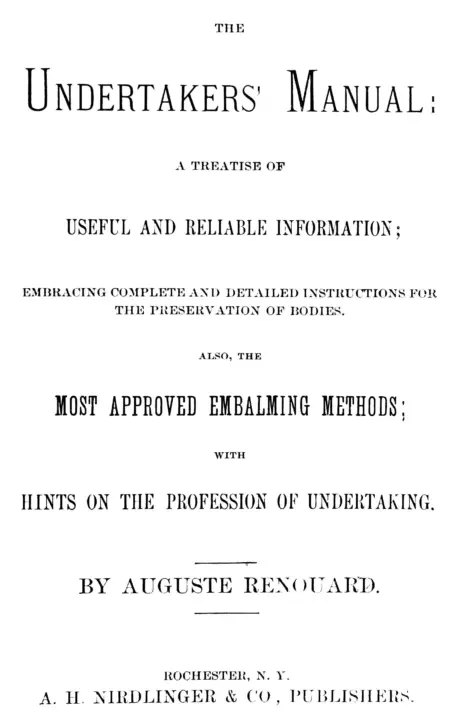
"The Undertakers' Manual" by Auguste Renouard is a treatise on the profession of undertaking, written in the late 19th century. This comprehensive text provides detailed instructions for embalming and body preservation, illuminating the scientific practices behind these procedures while addressing the important role that undertakers play in society. Renouard aims to elevate the profession by offering valuable insights into both the technical and human aspects of undertaking. The opening of the manual introduces the purpose and significance of the work, emphasizing the lack of prior comprehensive resources for undertakers in America. It discusses the need for a sound understanding of anatomy and physiological chemistry as vital for successful embalming practices. Through an introduction by Thomas Gliddon, the author sets a tone of professionalism and responsibility, suggesting that knowledge and skill will enable undertakers to manage their responsibilities with care and respect for the deceased and their families. Renouard outlines the necessity for a detailed grasp of the processes and conditions involved in preserving bodies, foreshadowing a meticulous and enlightening discussion in the subsequent chapters.
Introduction adapted from the source catalogue; source summaries may be automatically generated.
Free to read · English · 53,720 words · No account needed
MAKE TIME FOR A GOOD BOOK
On by default. Untick to stop anonymous reading totals. Each page counts after 10 seconds in view. How this works.
Anonymous counting is on unless you have switched it off.
FEMUR, FEMORIS. Os femoris. The thigh-bone; the longest, largest and heaviest of all the bones of the body.
FIBRE (L. fibra, a filament). A filament or thread, of animal, vegetable or mineral composition.
FIBRIL. A small filament or fibre, as the ultimate division of a
nerve. The term is derived from fibrilla, L. dim. of fibra, a
filament.
FIBRIN. A tough, fibrous mass, which, together with albumen,
forms the basis of muscle.
FIBRO-CARTILAGE. Membraniform cartilage; a substance intermediate between proper cartilage and ligament.
FILAMENT (L. filum, a thread, forma, likeness). Thread-like; applied to the papillæ at the edges of the tongue.
FISSURE. A cleft; a longitudinal opening.
FLEXOR (L. flecto, to bend). A muscle which bends the part into which it is inserted. Its antagonist is termed extensor.
FLUIDS. Substances which have the quality of fluidity, and are, in consequence, of no fixed shape.
FOLLICLE (L. dim. of follis, a pair of bellows). Literally, a little
bag or scrip of leather. In anatomy, a very minute secreting
cavity.
FORAMEN (L. foro, to pierce). An opening.
FOSSA (L. fodio, to dig). A ditch or trench; a little depression,
or sinus.
FUNCTION (L. fungor, to discharge an office). The office of an organ in the animal or vegetable economy; as of the heart in circulation, of the leaf in respiration, &c.
GALL-BLADDER. A membranous reservoir, lodged in a fissure on
the under surface of the right lobe of the liver, and containing
the bile.
GALL-DUCTS. These are the cystic, proceeding from the gall-bladder; the hepatic, proceeding from the liver; and the ductus communis choledochus, resulting from the union of the two preceding.
GANGLION (Gr. gangglíon, a nerve-knot). A small nervous center, or an enlargement in the course of a nerve, sometimes termed a diminutive brain.
GASTER. The Greek term for stomach.
GASTRIC (Gr. gaster, the stomach). Pertaining to the stomach; as
the gastric juice, &c.
GASTRIC JUICE. The peculiar digestive fluid secreted by the
stomach.
GELATINE (L. gelu, frost). The principle of jelly. It is found in the skin, cartilages, tendons, membranes and bones. The purest variety of gelatine is isinglass.
GLAND (L. glans, glandis, an acorn). A soft body, composed of various tissues, vessels, nerves, &c., usually destined to separate some fluids from the blood.
GLENOID (Gr. glēne, a cavity, eīdos, likeness). The name of a part having a shallow cavity; as the socket of the shoulder joint.
GLOBULES RED (L. dim. of globus, a ball). The red coloring matter of the blood; a peculiar animal principle.
GLOSSA, or GLOTTA (Gr. glōtta). The tongue; the organ of speech. Glosso. Terms compounded of this word belong to nerves or muscles attached to the tongue.
Your reading position is saved on this browser. Take it to another device with a library code. Reading pages adapt to text, rather than matching a printed edition.
BEHIND THE BOOK
This eBook is for the use of anyone anywhere in the United States and most other parts of the world at no cost and with almost no restrictions whatsoever. You may copy it, give it away or re-use it under the terms of the Project Gutenberg License included with this eBook or online at www.gutenberg.org. If you are not located in the United States, you will have to check the laws of the country where you are located before using this eBook. Read the source licence.
The original source file, including credits and licence, is retained by this library. Request an original-format copy at no charge. Please include the book title and Project Gutenberg identifier #70908.
KEEP YOUR CURIOSITY GOING
John Muir

Asa Gray
Asa Gray

Florence Nightingale
Elizabeth Robins Pennell
Denison Olmsted