THE CLASSIC COLLECTION✦The RetrospectCLASSIC FREE BOOKS
The Retrospect
Ada Cambridge
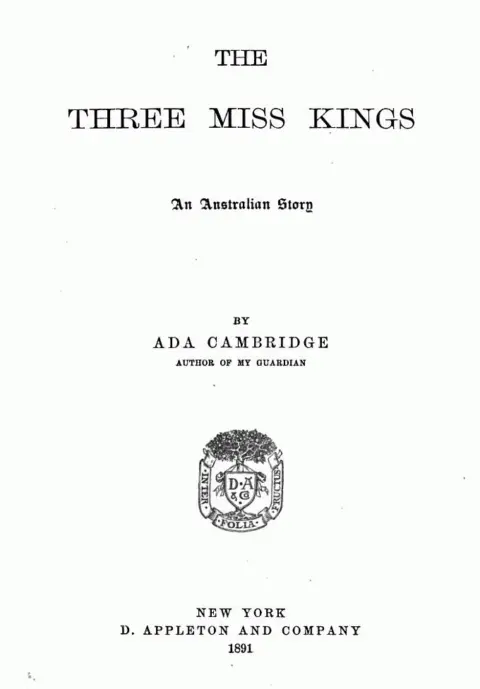
THE CLASSIC COLLECTION · 1891
"The Three Miss Kings: An Australian Story" by Ada Cambridge is a novel written in the late 19th century. It follows the lives of three orphaned sisters—Elizabeth, Patty, and Eleanor King—who find themselves alone in the world with limited financial means after the death of their parents. The story explores their struggles and aspirations as they decide to leave their isolated childhood home to start anew in Melbourne, seeking independence and a broader understanding of life. At the start of the narrative, the sisters reflect on their newfound independence and the choices that lie ahead. They debate potential plans, from traveling to Europe to simply settling in Melbourne, showcasing their varying personalities; Patty is impulsive and eager for adventure, while Elizabeth is more cautious and pragmatic. The depiction of their home environment, including the picturesque yet lonely setting by the Southern Ocean, emphasizes their sheltered upbringing. The challenges they face highlight their naiveté, but also their resilience as they prepare for the transition into a bustling urban life, ready to embrace the unknown that awaits them.
Introduction adapted from the source catalogue; source summaries may be automatically generated.
Free to read · English · 134,667 words · No account needed
MAKE TIME FOR A GOOD BOOK
On by default. Untick to stop anonymous reading totals. Each page counts after 10 seconds in view. How this works.
Anonymous counting is on unless you have switched it off.
Thus this energetic woman, in the headlong ardour of her new conversion. And (if a woman, ready to admit her disabilities as such, may say so) it is surely better to be generous in the cause of a possibly mistaken conviction of your own, than to be selfish in deference to the opinions of other people, which, though they be the product of the combined wisdom of all the legislatures of the world, find no response in the instincts of your human heart. At any rate, I believe we shall be brought to think so some day--that great Someday which looms not far ahead of us, when, as a Cornish proverb puts it, if we have not ruled ourselves by the rudder we shall be ruled by the rock. And so Mrs. Duff-Scott works, and thinks, and writes and (of course) talks, and bothers her husband and her acquaintances for the public weal, and leads her clergyman a life that makes him wish sometimes that he had chosen a less harassing profession; economising her money, and her time, and all she has of this world's goods, that she may fulfil her sacred obligations to her fellow-creatures and help the fortunate new country in which she lives to keep itself from the evil ways that have wrought such trouble and danger to the old ones.
And the man who set her to this good work pursues it himself, not in haste or under fitful and feverish impulses of what we call enthusiasm, but with refreshed energy and redoubled power, by reason of the great "means" that are now at his disposal, the faithful companionship that at once lightens and strengthens the labour of his hands and brain, and the deep passion of love for wife and home which keeps his heart warm with vital benevolence for all the world. Mr. Yelverton has not become more orthodox since his marriage; but that was not to be expected. In these days orthodoxy and goodness are not synonymous terms. It is doubtful, indeed, if orthodoxy has not rather become the synonym for the opposite of goodness, in the eyes of those who judge trees by their fruits and whose ideal of goodness is to love one's neighbour as one's self. While it is patent to the candid observer that the men who have studied the new book of Genesis which latter-day science has written for us, and have known that Exodus from the land of bondage which is the inevitable result of such study, conscientiously pursued, are, as a rule, distinguished by a large-minded justice and charity, sympathy and self-abnegation, a regard for the sacred ties of brotherhood binding man with man, which, being incompatible with the petty meannesses and cruelties so largely practised in sectarian circles, make their unostentatious influence to be felt like sweet and wholesome leaven all around them. Such a man is Elizabeth's husband, and as time goes on she ceases to wish for any change in him save that which means progression in his self-determined course. It was not lightly that he flew in the face of the religious traditions of his youth; rather did he crawl heavily and unwillingly away from them, in irresistible obedience to a conscience so sensitive and well-balanced that it ever pointed in the direction of the truth, like the magnetic needle to the pole, and in which he dared to trust absolutely, no matter how dark the outlook seemed. And now that, after much search, he has found his way, as far as he may hope to find it in this world, he is too intently concerned to discover what may be ahead of him, and in store for those who will follow him, to trouble himself and others with irrelevant trifles--to indulge in spites and jealousies, in ambitions that lead nowhere, in quarrels and controversies about nothing--to waste his precious strength and faculties in the child's play that with so many of us is the occupation of life, and like other child's play, full of pinches and scratches and selfish squabbling over trumpery toys. To one who has learned that "the hope of nature is in man," and something of what great nature is, and what man should be, there no longer exists much temptation to envy, hatred, malice, and uncharitableness, or any other of the vulgar vices of predatory humanity, not yet cured of its self-seeking propensities. He is educated above that level. His recognition of the brotherhood of men, and their common interests and high destiny, makes him feel for others in their differences with him, and patient and forbearing with those whose privileges have been fewer and whose light is less than his. He takes so wide an outlook over life that the little features of the foreground, which loom so large to those who cannot or will not look beyond them, are dwarfed to insignificance; or, rather, he can fix their just relation to the general design in human affairs, and so reads them with their context, as it were, and by the light of truth and justice spread abroad in his own heart--thus proving how different they are in essential value from what they superficially appear. So Mr. Yelverton, despite his constitutional imperiousness, is one of the most tolerant, fine-tempered, and generous of men; and he goes on his way steadily, bending circumstances to his will, but hurting no one in the process--rather lifting up and steadying and strengthening those with whom he comes in contact by the contagion of his bold spirit and his inflexible and incorruptible honesty; and proving himself in private life, as such men mostly do, a faithful exponent and practical illustration of all the domestic virtues.
Your reading position is saved on this browser. Take it to another device with a library code. Reading pages adapt to text, rather than matching a printed edition.
Ada Cambridge
Ada Cambridge
Ada Cambridge
Ada Cambridge
BEHIND THE BOOK
This eBook is for the use of anyone anywhere in the United States and most other parts of the world at no cost and with almost no restrictions whatsoever. You may copy it, give it away or re-use it under the terms of the Project Gutenberg License included with this eBook or online at www.gutenberg.org. If you are not located in the United States, you will have to check the laws of the country where you are located before using this eBook. Read the source licence.
The original source file, including credits and licence, is retained by this library. Request an original-format copy at no charge. Please include the book title and Project Gutenberg identifier #50476.
KEEP YOUR CURIOSITY GOING
Cécile Tormay

Moritz Busch
Coulson Kernahan
John L. Ransom

Maurice Baring
Frances Wright