READ · DISCOVER · ENJOYClassic literature · Always free
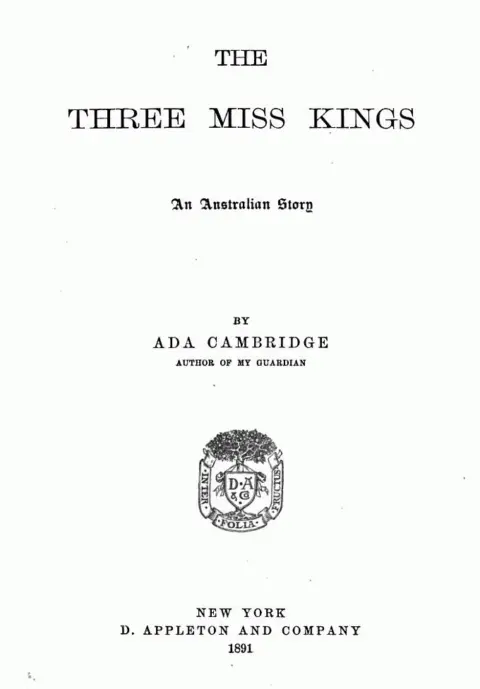
The Three Miss Kings: An Australian Story — digital edition cover

THE CLASSIC COLLECTION · 1891

The Three Miss Kings: An Australian Story

"The Three Miss Kings: An Australian Story" by Ada Cambridge is a novel written in the late 19th century. It follows the lives of three orphaned sisters—Elizabeth, Patty, and Eleanor King—who find themselves alone in the world with limited financial means after the death of their parents. The story explores their struggles and aspirations as they decide to leave their isolated childhood home to start anew in Melbourne, seeking independence and a broader understanding of life. At the start of the narrative, the sisters reflect on their newfound independence and the choices that lie ahead. They debate potential plans, from traveling to Europe to simply settling in Melbourne, showcasing their varying personalities; Patty is impulsive and eager for adventure, while Elizabeth is more cautious and pragmatic. The depiction of their home environment, including the picturesque yet lonely setting by the Southern Ocean, emphasizes their sheltered upbringing. The challenges they face highlight their naiveté, but also their resilience as they prepare for the transition into a bustling urban life, ready to embrace the unknown that awaits them.

Introduction adapted from the source catalogue; source summaries may be automatically generated.

Start reading ↓

Free to read · English · 134,667 words · No account needed

MAKE TIME FOR A GOOD BOOK

The Three Miss Kings: An Australian Story

On by default. Untick to stop anonymous reading totals. Each page counts after 10 seconds in view. How this works.

Anonymous counting is on unless you have switched it off.

The Three Miss Kings: An Australian Story

"I think," said Paul, "that the Miss Kings--the Miss Yelvertons, I suppose I ought to say--would rather be by themselves while you read that paper. It is not just like the will, you know; it is a private matter--not for outsiders to listen to."

Elizabeth rose promptly and went towards him, laying her hand on his arm. "Do you think we consider you an outsider?" she said, reproachfully. "You are one of us--you are in the place of our brother--we want you to help us now more than we have ever done. Come and sit down--that is, of course, if you can spare time for our affairs when you have so many important ones of your own."

He went and sat down, taking the seat by Patty to which Elizabeth pointed him. Patty looked up at him wistfully, and then leaned her elbows on the table and put her face in her hands. Her lover laid his arm gently on the back of her chair.

"Shall I begin, my dear?" asked the lawyer hesitatingly. "I am afraid it will be painful to you, Elizabeth. Perhaps, as Paul says, it would be better for you to read it by yourselves. I will leave it with you for a little while, if you promise faithfully to be very careful with it."

But Elizabeth wished it to be read as the will was read, and the old man, vaguely suspecting that she might be illegally generous to the superseded representative of the Yelverton name and property, was glad to keep the paper in his own hands, and proceeded to recite its contents. "I, Kingscote Yelverton, calling myself John King, do hereby declare," &c.

It was the story of Kingscote Yelverton's unfortunate life, put on record in the form of an affidavit for the benefit of his children, apparently with the intention that they should claim their inheritance when he was gone. The witnesses were an old midwife, long since dead, and a young Scripture reader, now a middle-aged and prosperous ecclesiastic in a distant colony; both of whom the lawyer remembered as features of the "old days" when he himself was a new-comer to the out-of-the-world place that counted Mr. King as its oldest inhabitant. It was a touching little document, in the sad story that it told and the severe formality of the style of telling it. Kingscote Yelverton, it was stated, was the second of three brothers, sons of a long line of Yelvertons of Yelverton, of which three, however, according to hereditary custom, only one was privileged to inherit the ancestral wealth. This one, Patrick, a bachelor, had already come into his kingdom; the youngest, a briefless barrister in comfortable circumstances, had married a farmer's daughter in very early youth (while reading for university honours during a long vacation spent in the farmer's house), and was the father of a sturdy schoolboy while himself not long emancipated from the rule of pastors and masters; and Kingscote was a flourishing young captain in the Guards--when the tragedy which shattered the family to pieces, and threw its vast property into Chancery, took place. Bradenham Abbey was neighbour to Yelverton, and Cuthbert Leigh of Bradenham was kin to the Yelvertons of Yelverton. Cuthbert Leigh had a beautiful daughter by his first wife, Eleanor D'Arcy; when this daughter was sixteen her mother died, and a stepmother soon after took Eleanor D'Arcy's place; and not long after the stepmother came to Bradenham Cuthbert Leigh himself died, leaving an infant son and heir; and not long after that Mrs. Cuthbert Leigh married again, and her new husband administered Bradenham--in the interest of the heir eventually, but of himself and his own children in the meantime. So it happened that Elizabeth Leigh was rather elbowed out of her rights and privileges as her father's daughter; which being the case, her distant cousin and near friend, Mrs. Patrick Yelverton, mother of the ill-fated brothers (who lived, poor soul, to see her house left desolate), fetched the girl away from the home which was hers no more, and took her to live under her own wing at Yelverton. Then the troubles began. Elizabeth was young and fair; indeed, all accounts of her agreed in presenting the portrait of a woman who must have been irresistible to the normal and unappropriated man brought into close contact with her. At Yelverton she was the daily companion of the unwedded master of the house, and he succumbed accordingly. As an impartial chronicler, I may hazard the suggestion that she enjoyed a flirtation within lady-like limits, and was not without some responsibility in the matter. It was clear also that the dowager Mrs. Patrick, anxious to see her first-born suitably married and settled, and placed safely beyond the reach of designing farmers' daughters, contrived her best to effect a union between the two. But while Patrick was over head and ears in love, and Elizabeth was dallying with him, and the old mother planning new furniture for the stately rooms where the queen was to reign who should succeed her, Kingscote the guardsman--Kingscote, the handsome, strong-willed, fiery-tempered second son--came home. To him the girl's heart, with the immemorial and incurable perversity of hearts, turned forthwith, like a flower to the sun; and a very short furlough had but half run out when she was as deeply over head and ears in love with Kingscote as Patrick was with her. Kingscote also loved her passionately--on his own testimony, he loved her as never man loved before, though he made a proud confession that he had still been utterly unworthy of her; and so the materials for the tragedy were laid, like a housemaid's fire, ready for the match that kindled them. Elizabeth found her position untenable amid the strenuous and conflicting attentions bestowed on her by the mother and sons, and went away for a time to visit some of her other relatives; and when her presence and influence were withdrawn from Yelverton, the smothered enmity of the brothers broke out, and they had their first and last and fatal quarrel about her. She had left a miniature of herself hanging in their mother's boudoir; this miniature Patrick laid hands on, and carried off to his private rooms; wherefrom Kingscote, in a violent passion (as Elizabeth's accepted lover), abstracted it by force. Then the master of the house, always too much inclined to assert himself as such, being highly incensed in his turn at the liberty that had been taken with him, marched into his brother's bedroom, where the disputed treasure was hidden, found it, and put it in his breast until he could discover a safer place for it. They behaved like a pair of ill-regulated schoolboys, in short, as men do when love and jealousy combine to derange their nervous systems, and wrought their own irreparable ruin over this miserable trifle. Patrick, flushed with a lurid triumph at his temporary success, strolled away from the house for an aimless walk, but afterwards went to a gamekeeper's cottage to give some instructions that occurred to him. The gamekeeper was not at home, and the squire returned by way of a lonely track through a thick plantation, where some of the keeper's work had to be inspected. Here he met Kingscote, striding along with his gun over his shoulder. The guardsman had discovered his loss, and was in search of his brother, intending to make a calm statement of his right to the possession of the picture by virtue of his rights in the person of the fair original, but at the same time passionately determined that this sort of thing should be put a stop to. There was a short parley, a brief but fierce altercation, a momentary struggle--on one side to keep, on the other to take, the worthless little bone of contention--and it was all over. Patrick, sent backward by a sweep of his strong brother's arm, fell over the gun that had been carelessly propped against a sapling; the stock of the gun, flying up, was caught by a tough twig which dragged across the hammers, and as the man and the weapon tumbled to the ground together one hammer fell, and the exploded charge entered the squire's neck, just under the chin, and, passing upward to the brain, killed him. It was an accident, as all the family believed; but to the author of the mischance it was nothing less than murder. He was guilty of his brother's blood, and he accepted the portion of Cain--to be a fugitive and a vagabond on the face of the earth--in expiation of it. Partly with the idea of sparing pain and disgrace to his family (believing that the only evidence available would convict him of murder in a court of law), and partly because he felt that, if acquitted, it would be too horrible and impossible to take an inheritance that had come to him by such means, in the overwhelming desperation of his remorse and despair he took that determination to blot himself out which was never afterwards revoked. Returning to the house, he collected some money and a few valuables, and, unsuspected and unnoticed, took leave of his home, and his name, and his place in the world, and was half way to London, and beyond recall, before the dead body in the plantation was discovered. In London Elizabeth Leigh was staying with an old Miss D'Arcy, quietly studying her music and taking a rest while the society which was so fond of her was out of town; and the stricken man could not carry out his resolve without bidding farewell to his beloved. He had a clandestine interview with Elizabeth, to whom alone he confided the circumstances of his wretched plight. The girl, of course, advised him to return to Yelverton, and bravely meet and bear whatever might befall; and it would have been well for him and for her if he had taken that advice. But he would not listen to it, nor be turned from his fixed purpose to banish and efface himself, if possible, for the rest of his life; seeing which, the devoted woman chose to share his fate. Whether he could and should have spared her that enormous sacrifice, or whether she was happier in making it than she would otherwise have been, only themselves ever knew. She did her woman's part in helping and sustaining and consoling him through all the blighted years that he was suffered to live and fret her with his brooding melancholy and his broken-spirited moroseness, and doubtless she found her true vocation in that thorny path of love.

Your reading position is saved on this browser. Take it to another device with a library code. Reading pages adapt to text, rather than matching a printed edition.

More from this author

BEHIND THE WORDS

About Ada Cambridge

Ada Cambridge (1844–1926). Explore The Three Miss Kings: An Australian Story, The Retrospect, Materfamilias and other works in this collection. These books span classic fiction, history, travel & exploration.

Explore this author’s books →

THE READERS’ VERDICT

How did this story stay with you?

Not rated yet
Your rating for The Three Miss Kings: An Australian Story

Be the first to share your verdict.

One rating per browser, which you can change or remove. A necessary browser identifier remembers your vote. How ratings work

A GOOD STORY DESERVES COMPANY

Pass this book along.

A great read is even better when it’s shared.

SEND A LITTLE INSPIRATION

Share this book

BEHIND THE BOOK

Edition & source details.

Title
The Three Miss Kings: An Australian Story
Author
Ada Cambridge
First publication (Open Library catalogue match)
1891
Digital edition publisher
Project Gutenberg
Gutenberg release date
2015-11-18
Language
English
Source edition imprint
Not stated in source catalogue
Source identifier
Project Gutenberg #50476
Contributors
No additional named contributors in source metadata

Public-domain source & licence

This eBook is for the use of anyone anywhere in the United States and most other parts of the world at no cost and with almost no restrictions whatsoever. You may copy it, give it away or re-use it under the terms of the Project Gutenberg License included with this eBook or online at www.gutenberg.org. If you are not located in the United States, you will have to check the laws of the country where you are located before using this eBook. Read the source licence.

Full source licence and obtaining an original copy

The original source file, including credits and licence, is retained by this library. Request an original-format copy at no charge. Please include the book title and Project Gutenberg identifier #50476.

the full Project Gutenberg License must appear
prominently whenever any copy of a Project Gutenberg work (any work
on which the phrase “Project Gutenberg” appears, or with which the
phrase “Project Gutenberg” is associated) is accessed, displayed,
performed, viewed, copied or distributed:

This eBook is for the use of anyone anywhere in the United States and most
other parts of the world at no cost and with almost no restrictions
whatsoever. You may copy it, give it away or re-use it under the terms
of the Project Gutenberg™ License included with this eBook or online
at www.gutenberg.org. If you
are not located in the United States, you will have to check the laws
of the country where you are located before using this eBook.

1.E.2. If an individual Project Gutenberg electronic work is
derived from texts not protected by U.S. copyright law (does not
contain a notice indicating that it is posted with permission of the
copyright holder), the work can be copied and distributed to anyone in
the United States without paying any fees or charges. If you are
redistributing or providing access to a work with the phrase “Project
Gutenberg” associated with or appearing on the work, you must comply
either with the requirements of paragraphs 1.E.1 through 1.E.7 or
obtain permission for the use of the work and the Project Gutenberg
trademark as set forth in paragraphs 1.E.8 or 1.E.9.

1.E.3. If an individual Project Gutenberg electronic work is posted
with the permission of the copyright holder, your use and distribution
must comply with both paragraphs 1.E.1 through 1.E.7 and any
additional terms imposed by the copyright holder. Additional terms
will be linked to the Project Gutenberg License for all works
posted with the permission of the copyright holder found at the
beginning of this work.

1.E.4. Do not unlink or detach or remove the full Project Gutenberg
License terms from this work, or any files containing a part of this
work or any other work associated with Project Gutenberg.

1.E.5. Do not copy, display, perform, distribute or redistribute this
electronic work, or any part of this electronic work, without
prominently displaying the sentence set forth in paragraph 1.E.1 with
active links or immediate access to the full terms of the Project
Gutenberg License.

1.E.6. You may convert to and distribute this work in any binary,
compressed, marked up, nonproprietary or proprietary form, including
any word processing or hypertext form. However, if you provide access
to or distribute copies of a Project Gutenberg work in a format
other than “Plain Vanilla ASCII” or other format used in the official
version posted on the official Project Gutenberg website
(www.gutenberg.org), you must, at no additional cost, fee or expense
to the user, provide a copy, a means of exporting a copy, or a means
of obtaining a copy upon request, of the work in its original “Plain
Vanilla ASCII” or other form. Any alternate format must include the
full Project Gutenberg License as specified in paragraph 1.E.1.

1.E.7. Do not charge a fee for access to, viewing, displaying,
performing, copying or distributing any Project Gutenberg works
unless you comply with paragraph 1.E.8 or 1.E.9.

1.E.8. You may charge a reasonable fee for copies of or providing
access to or distributing Project Gutenberg electronic works
provided that:

• You pay a royalty fee of 20% of the gross profits you derive from
the use of Project Gutenberg works calculated using the method
you already use to calculate your applicable taxes. The fee is owed
to the owner of the Project Gutenberg trademark, but he has
agreed to donate royalties under this paragraph to the Project
Gutenberg Literary Archive Foundation. Royalty payments must be paid
within 60 days following each date on which you prepare (or are
legally required to prepare) your periodic tax returns. Royalty
payments should be clearly marked as such and sent to the Project
Gutenberg Literary Archive Foundation at the address specified in
Section 4, “Information about donations to the Project Gutenberg
Literary Archive Foundation.”

• You provide a full refund of any money paid by a user who notifies
you in writing (or by e-mail) within 30 days of receipt that s/he
does not agree to the terms of the full Project Gutenberg™
License. You must require such a user to return or destroy all
copies of the works possessed in a physical medium and discontinue
all use of and all access to other copies of Project Gutenberg™
works.

• You provide, in accordance with paragraph 1.F.3, a full refund of
any money paid for a work or a replacement copy, if a defect in the
electronic work is discovered and reported to you within 90 days of
receipt of the work.

• You comply with all other terms of this agreement for free
distribution of Project Gutenberg™ works.


1.E.9. If you wish to charge a fee or distribute a Project
Gutenberg™ electronic work or group of works on different terms than
are set forth in this agreement, you must obtain permission in writing
from the Project Gutenberg Literary Archive Foundation, the manager of
the Project Gutenberg™ trademark. Contact the Foundation as set
forth in Section 3 below.

1.F.

1.F.1. Project Gutenberg volunteers and employees expend considerable
effort to identify, do copyright research on, transcribe and proofread
works not protected by U.S. copyright law in creating the Project
Gutenberg™ collection. Despite these efforts, Project Gutenberg™
electronic works, and the medium on which they may be stored, may
contain “Defects,” such as, but not limited to, incomplete, inaccurate
or corrupt data, transcription errors, a copyright or other
intellectual property infringement, a defective or damaged disk or
other medium, a computer virus, or computer codes that damage or
cannot be read by your equipment.

1.F.2. LIMITED WARRANTY, DISCLAIMER OF DAMAGES - Except for the “Right
of Replacement or Refund” described in paragraph 1.F.3, the Project
Gutenberg Literary Archive Foundation, the owner of the Project
Gutenberg™ trademark, and any other party distributing a Project
Gutenberg™ electronic work under this agreement, disclaim all
liability to you for damages, costs and expenses, including legal
fees. YOU AGREE THAT YOU HAVE NO REMEDIES FOR NEGLIGENCE, STRICT
LIABILITY, BREACH OF WARRANTY OR BREACH OF CONTRACT EXCEPT THOSE
PROVIDED IN PARAGRAPH 1.F.3. YOU AGREE THAT THE FOUNDATION, THE
TRADEMARK OWNER, AND ANY DISTRIBUTOR UNDER THIS AGREEMENT WILL NOT BE
LIABLE TO YOU FOR ACTUAL, DIRECT, INDIRECT, CONSEQUENTIAL, PUNITIVE OR
INCIDENTAL DAMAGES EVEN IF YOU GIVE NOTICE OF THE POSSIBILITY OF SUCH
DAMAGE.

1.F.3. LIMITED RIGHT OF REPLACEMENT OR REFUND - If you discover a
defect in this electronic work within 90 days of receiving it, you can
receive a refund of the money (if any) you paid for it by sending a
written explanation to the person you received the work from. If you
received the work on a physical medium, you must return the medium
with your written explanation. The person or entity that provided you
with the defective work may elect to provide a replacement copy in
lieu of a refund. If you received the work electronically, the person
or entity providing it to you may choose to give you a second
opportunity to receive the work electronically in lieu of a refund. If
the second copy is also defective, you may demand a refund in writing
without further opportunities to fix the problem.

1.F.4. Except for the limited right of replacement or refund set forth
in paragraph 1.F.3, this work is provided to you ‘AS-IS’, WITH NO
OTHER WARRANTIES OF ANY KIND, EXPRESS OR IMPLIED, INCLUDING BUT NOT
LIMITED TO WARRANTIES OF MERCHANTABILITY OR FITNESS FOR ANY PURPOSE.

1.F.5. Some states do not allow disclaimers of certain implied
warranties or the exclusion or limitation of certain types of
damages. If any disclaimer or limitation set forth in this agreement
violates the law of the state applicable to this agreement, the
agreement shall be interpreted to make the maximum disclaimer or
limitation permitted by the applicable state law. The invalidity or
unenforceability of any provision of this agreement shall not void the
remaining provisions.

1.F.6. INDEMNITY - You agree to indemnify and hold the Foundation, the
trademark owner, any agent or employee of the Foundation, anyone
providing copies of Project Gutenberg™ electronic works in
accordance with this agreement, and any volunteers associated with the
production, promotion and distribution of Project Gutenberg™
electronic works, harmless from all liability, costs and expenses,
including legal fees, that arise directly or indirectly from any of
the following which you do or cause to occur: (a) distribution of this
or any Project Gutenberg work, (b) alteration, modification, or
additions or deletions to any Project Gutenberg work, and (c) any
Defect you cause.

Section 2. Information about the Mission of Project Gutenberg

Project Gutenberg is synonymous with the free distribution of
electronic works in formats readable by the widest variety of
computers including obsolete, old, middle-aged and new computers. It
exists because of the efforts of hundreds of volunteers and donations
from people in all walks of life.

Volunteers and financial support to provide volunteers with the
assistance they need are critical to reaching Project Gutenberg’s
goals and ensuring that the Project Gutenberg collection will
remain freely available for generations to come. In 2001, the Project
Gutenberg Literary Archive Foundation was created to provide a secure
and permanent future for Project Gutenberg and future
generations. To learn more about the Project Gutenberg Literary
Archive Foundation and how your efforts and donations can help, see
Sections 3 and 4 and the Foundation information page at www.gutenberg.org.

Section 3. Information about the Project Gutenberg Literary Archive Foundation

The Project Gutenberg Literary Archive Foundation is a non-profit
501(c)(3) educational corporation organized under the laws of the
state of Mississippi and granted tax exempt status by the Internal
Revenue Service. The Foundation’s EIN or federal tax identification
number is 64-6221541. Contributions to the Project Gutenberg Literary
Archive Foundation are tax deductible to the full extent permitted by
U.S. federal laws and your state’s laws.

The Foundation’s business office is located at 41 Watchung Plaza #516,
Montclair NJ 07042, USA, +1 (862) 621-9288. Email contact links and up
to date contact information can be found at the Foundation’s website
and official page at www.gutenberg.org/contact

Section 4. Information about Donations to the Project Gutenberg
Literary Archive Foundation

Project Gutenberg™ depends upon and cannot survive without widespread
public support and donations to carry out its mission of
increasing the number of public domain and licensed works that can be
freely distributed in machine-readable form accessible by the widest
array of equipment including outdated equipment. Many small donations
($1 to $5,000) are particularly important to maintaining tax exempt
status with the IRS.

The Foundation is committed to complying with the laws regulating
charities and charitable donations in all 50 states of the United
States. Compliance requirements are not uniform and it takes a
considerable effort, much paperwork and many fees to meet and keep up
with these requirements. We do not solicit donations in locations
where we have not received written confirmation of compliance. To SEND
DONATIONS or determine the status of compliance for any particular state
visit www.gutenberg.org/donate.

While we cannot and do not solicit contributions from states where we
have not met the solicitation requirements, we know of no prohibition
against accepting unsolicited donations from donors in such states who
approach us with offers to donate.

International donations are gratefully accepted, but we cannot make
any statements concerning tax treatment of donations received from
outside the United States. U.S. laws alone swamp our small staff.

Please check the Project Gutenberg web pages for current donation
methods and addresses. Donations are accepted in a number of other
ways including checks, online payments and credit card donations. To
donate, please visit: www.gutenberg.org/donate.

Section 5. General Information About Project Gutenberg electronic works

Professor Michael S. Hart was the originator of the Project
Gutenberg concept of a library of electronic works that could be
freely shared with anyone. For forty years, he produced and
distributed Project Gutenberg eBooks with only a loose network of
volunteer support.

Project Gutenberg eBooks are often created from several printed
editions, all of which are confirmed as not protected by copyright in
the U.S. unless a copyright notice is included. Thus, we do not
necessarily keep eBooks in compliance with any particular paper
edition.

Most people start at our website which has the main PG search
facility: www.gutenberg.org.

This website includes information about Project Gutenberg,
including how to make donations to the Project Gutenberg Literary
Archive Foundation, how to help produce our new eBooks, and how to
subscribe to our email newsletter to hear about new eBooks.


KEEP YOUR CURIOSITY GOING

Your next chapter awaits.

Your privacy choices

Reading is always free. You can change these settings at any time.

Book banners link to our books on simonward.net. They do not use advertising cookies or tracking.

Privacy & cookie policy · Reading data and privacy controls