THE CLASSIC COLLECTION✦The RetrospectCLASSIC FREE BOOKS
The Retrospect
Ada Cambridge
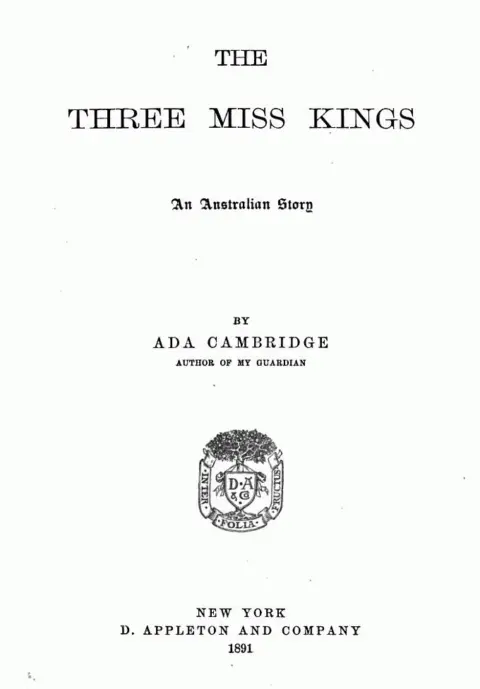
THE CLASSIC COLLECTION · 1891
"The Three Miss Kings: An Australian Story" by Ada Cambridge is a novel written in the late 19th century. It follows the lives of three orphaned sisters—Elizabeth, Patty, and Eleanor King—who find themselves alone in the world with limited financial means after the death of their parents. The story explores their struggles and aspirations as they decide to leave their isolated childhood home to start anew in Melbourne, seeking independence and a broader understanding of life. At the start of the narrative, the sisters reflect on their newfound independence and the choices that lie ahead. They debate potential plans, from traveling to Europe to simply settling in Melbourne, showcasing their varying personalities; Patty is impulsive and eager for adventure, while Elizabeth is more cautious and pragmatic. The depiction of their home environment, including the picturesque yet lonely setting by the Southern Ocean, emphasizes their sheltered upbringing. The challenges they face highlight their naiveté, but also their resilience as they prepare for the transition into a bustling urban life, ready to embrace the unknown that awaits them.
Introduction adapted from the source catalogue; source summaries may be automatically generated.
Free to read · English · 134,667 words · No account needed
MAKE TIME FOR A GOOD BOOK
On by default. Untick to stop anonymous reading totals. Each page counts after 10 seconds in view. How this works.
Anonymous counting is on unless you have switched it off.
As for Patty, he made up his mind that he could never forgive her. Now and then he would steal out upon his balcony to listen to a Schubert serenade or a Beethoven sonata in the tender stillness of a summer night, and then he would have that sensation of bleeding at the heart which melted, and unnerved, and unmanned him; but, for the most part, every sight and sound and reminiscence of her were so many fiery styptics applied to his wound, scorching up all tender emotions in one great angry pain. Outwardly he shunned her, cut her--withered her up, indeed--with his ostentatiously expressed indifference; but secretly he spent hours of the day and night dogging her from place to place, when he ought to have been at work or in his bed, merely that he might get a glimpse of her in a crowd, and some notion of what she was doing. He haunted the Exhibition with the same disregard for the legitimate attractions of that social head-centre as prevailed with the majority of its visitors, to whom it was a daily trysting-place; and there he had the doubtful satisfaction of seeing her every now and then. Once she was in the Indian Court, so fragrant with sandalwood, and she was looking with ardent eyes at gossamer muslins and embroidered cashmeres, while young Westmoreland leaned on the glass case beside her in an attitude of insufferable familiarity. It was an indication, to the jealous lover, that the woman who had elevated her sex from the rather low place that it had held in his estimation before he knew her, and made it sacred to him for her sake, was, after all, "no better than the rest of them." He had dreamed of her as a man's true helpmate and companion, able to walk hand in hand with him on the high roads of human progress, and finding her vocation and her happiness in that spiritual and intellectual fellowship; and here she was lost in the greedy contemplation of a bit of fine embroidery that had cost some poor creature his eyesight already, and was presently to cost again what would perhaps provision a starving family for a twelvemonth--just like any other ignorant and frivolous female who had sold her soul to the demon of fashion. He marched home to Myrtle Street with the zeal of the reformer (which draws its inspiration from such unsuspected sources) red-hot in his busy brain. He lit his pipe, spread out his paper, dipped his pen in the ink-bottle, and began to deal with the question of "Woman's Clothes in Relation to her Moral and Intellectual Development" in what he conceived to be a thoroughly impersonal and benevolent temper. His words should be brief, he said to himself, but they should be pregnant with suggestive truth. He would lay a light touch upon this great sore that had eaten so deeply into one member of the body politic, causing all the members to suffer with it; but he would diagnose it faithfully, without fear or favour, and show wherein it had hindered the natural advancement of the race, and to what fatal issues its unchecked development tended. It was a serious matter, that had too long been left unnoticed by the leaders of the thought of the day. "It is a problem," he wrote, with a splutter of his pen, charging his grievance full tilt with his most effective term; "it is, we conscientiously believe, one of the great problems of this problem-haunted and problem-fighting age--one of the wrongs that it is the mission of the reforming Modern Spirit to set right--though the subject is so inextricably entangled and wrapped up in its amusing associations that at present its naked gravity is only recognised by the philosophic few. It is all very well to make fun of it; and, indeed, it is a very good thing to make fun of it--for every reform must have a beginning, and there is no better weapon than just and judicious ridicule wherewith Reason can open her attack upon the solid and solemn front of time-honoured Prejudice. The heavy artillery of argument has no effect until the enemy has contracted an internal weakness by being made to imbibe the idea that he is absurd. A little wit, in the early stage of the campaign, is worth a deal of logic. But still there it stands--this great, relentless, crushing, cruel CUSTOM (which requires capital letters to emphasise it suitably)--and there are moments when we can't be witty about it--when our hearts burn within us at the spectacle of our human counterpart still, with a few bright exceptions, in the stage of intellectual childhood, while we fight the battle of the world's progress alone--"
Your reading position is saved on this browser. Take it to another device with a library code. Reading pages adapt to text, rather than matching a printed edition.
Ada Cambridge
Ada Cambridge
Ada Cambridge
Ada Cambridge
BEHIND THE BOOK
This eBook is for the use of anyone anywhere in the United States and most other parts of the world at no cost and with almost no restrictions whatsoever. You may copy it, give it away or re-use it under the terms of the Project Gutenberg License included with this eBook or online at www.gutenberg.org. If you are not located in the United States, you will have to check the laws of the country where you are located before using this eBook. Read the source licence.
The original source file, including credits and licence, is retained by this library. Request an original-format copy at no charge. Please include the book title and Project Gutenberg identifier #50476.
KEEP YOUR CURIOSITY GOING
Cécile Tormay

Moritz Busch
Coulson Kernahan
John L. Ransom

Maurice Baring
Frances Wright