THE CLASSIC COLLECTION✦The RetrospectCLASSIC FREE BOOKS
The Retrospect
Ada Cambridge
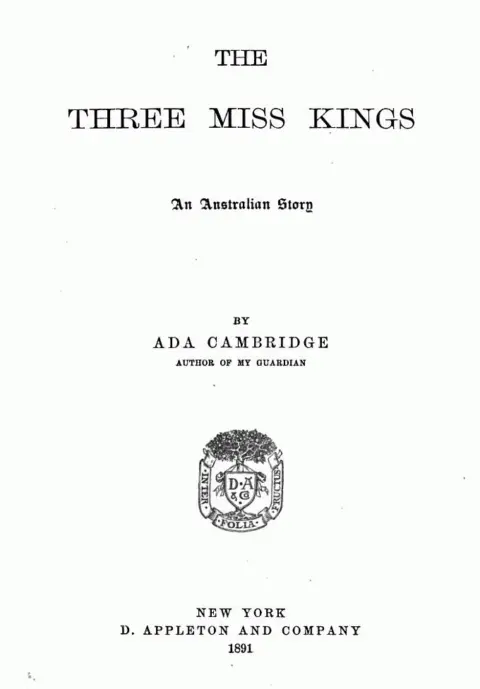
THE CLASSIC COLLECTION · 1891
"The Three Miss Kings: An Australian Story" by Ada Cambridge is a novel written in the late 19th century. It follows the lives of three orphaned sisters—Elizabeth, Patty, and Eleanor King—who find themselves alone in the world with limited financial means after the death of their parents. The story explores their struggles and aspirations as they decide to leave their isolated childhood home to start anew in Melbourne, seeking independence and a broader understanding of life. At the start of the narrative, the sisters reflect on their newfound independence and the choices that lie ahead. They debate potential plans, from traveling to Europe to simply settling in Melbourne, showcasing their varying personalities; Patty is impulsive and eager for adventure, while Elizabeth is more cautious and pragmatic. The depiction of their home environment, including the picturesque yet lonely setting by the Southern Ocean, emphasizes their sheltered upbringing. The challenges they face highlight their naiveté, but also their resilience as they prepare for the transition into a bustling urban life, ready to embrace the unknown that awaits them.
Introduction adapted from the source catalogue; source summaries may be automatically generated.
Free to read · English · 134,667 words · No account needed
MAKE TIME FOR A GOOD BOOK
On by default. Untick to stop anonymous reading totals. Each page counts after 10 seconds in view. How this works.
Anonymous counting is on unless you have switched it off.
"Come, come," said the fairy godmother rather impatiently, when something like a fine aroma of badinage was beginning to perfume the conversation, "you must not stop us now. We want to have a long morning. You can join us at the Exhibition presently, if you like, and bring Mr. Westmoreland." She indicated the young man who had been talking to her while her spouse made the acquaintance of her companions, and who happened to be one of the three husbands whom she had selected for those young ladies. He was the richest of them all, and the most stupid, and therefore he seemed to be cut out for Patty, who, being so intellectual and so enterprising, would not only make a good use of his money, but would make the best that was to be made of him. "My dears," she said, turning towards the girls, "let me introduce Mr. Westmoreland to you. Mr. Westmoreland, Miss King--Miss Eleanor King--Miss Patty King."
The heavy young man made a heavy bow to each, and then stared straight at Eleanor, and studied her with calm attention until the carriage bore her from his sight. She, with her tender blue eyes and her yellow hair, and her skin like the petals of a blush rose, was what he was pleased to call, in speaking of her a little later to a confidential friend, the "girl for him." Of Patty he took no notice whatever.
Mrs. Duff-Scott, on her way to Carlton, stopped to speak to an acquaintance who was driving in an opposite direction, and by the time she reached the Exhibition, she found that her husband's hansom had arrived before her, and that he and Mr. Westmoreland were waiting at the entrance to offer their services as escort to the party. The major was the best of husbands, but he was not in the habit of paying her these small attentions; and Mr. Westmoreland had never been known, within her memory of him, to put himself to so much trouble for a lady's convenience. Wherefore the fairy godmother smiled upon them both, and felt that the Fates were altogether propitious to her little schemes. They walked up the pathway in a group, fell necessarily into single file in the narrow passage where they received and returned their tickets, and collected in a group again under the great dome, where they stood to look round on the twenty acres of covered space heaped with the treasures of those nations which Victoria welcomed in great letters on the walls. Mrs. Duff-Scott hooked her gold-rimmed glasses over her nose, and pointed out to her husband wherein the building was deficient, and wherein superfluous, in its internal arrangements and decorations. In her opinion--which placed the matter beyond discussion--the symbolical groups over the arches were all out of drawing, the colouring of the whole place vulgar to a degree, and the painted clouds inside the cupola enough to make one sick. The major endorsed her criticisms, perfunctorily, with amused little nods, glancing hither and thither in the directions she desired. "Ah, my dear," said he, "you mustn't expect everybody to have such good taste as yours." Mr. Westmoreland seemed to have exhausted the Exhibition, for his part; he had seen it all the day before, he explained, and he did not see what there was to make a fuss about. With the exception of some mysteries in the basement, into which he darkly hinted a desire to initiate the major presently, it had nothing about it to interest a man who, like him, had just returned from Europe and had seen the Paris affair. But to our girls it was an enchanted palace of delights--far exceeding their most extravagant anticipations. They gave no verbal expression to their sentiments, but they looked at each other with faces full of exalted emotion, and tacitly agreed that they were perfectly satisfied. The fascination of the place, as a storehouse of genuine samples of the treasures of that great world which they had never seen, laid hold of them with a grip that left a lasting impression. Even the rococo magnificence of the architecture and its adornments, which Mrs. Duff-Scott, enlightened by a large experience, despised, affected their untrained imaginations with all the force of the highest artistic sublimity. A longing took possession of them all at the same moment to steal back to-morrow--next day--as soon as they were free again to follow their own devices--and wander about the great and wonderful labyrinth by themselves and revel unobserved in their secret enthusiasms.
Your reading position is saved on this browser. Take it to another device with a library code. Reading pages adapt to text, rather than matching a printed edition.
Ada Cambridge
Ada Cambridge
Ada Cambridge
Ada Cambridge
BEHIND THE BOOK
This eBook is for the use of anyone anywhere in the United States and most other parts of the world at no cost and with almost no restrictions whatsoever. You may copy it, give it away or re-use it under the terms of the Project Gutenberg License included with this eBook or online at www.gutenberg.org. If you are not located in the United States, you will have to check the laws of the country where you are located before using this eBook. Read the source licence.
The original source file, including credits and licence, is retained by this library. Request an original-format copy at no charge. Please include the book title and Project Gutenberg identifier #50476.
KEEP YOUR CURIOSITY GOING
Cécile Tormay

Moritz Busch
Coulson Kernahan
John L. Ransom

Maurice Baring
Frances Wright