THE CLASSIC COLLECTION✦A dead man’s diaryCLASSIC FREE BOOKS
A dead man’s diary
Coulson Kernahan
THE CLASSIC COLLECTION · 1890
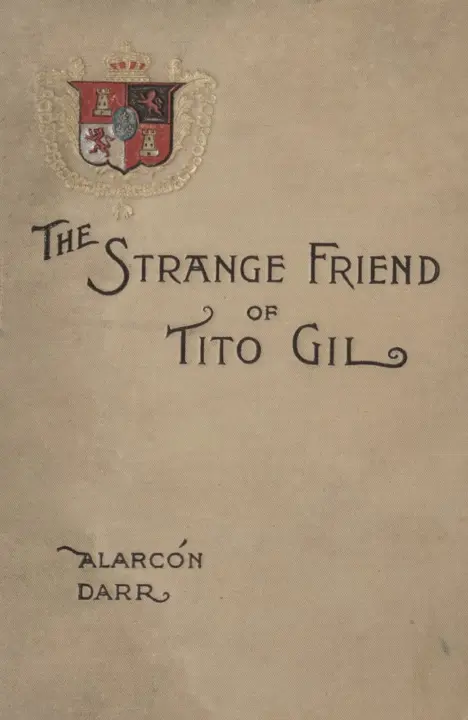
"The Strange Friend of Tito Gil" by Pedro Antonio de Alarcón is a novel written in the late 19th century. The book tells the story of Tito Gil, a poor shoemaker’s son who, after a series of misfortunes and transformations, becomes entangled with the enigmatic figure of Death, who claims to be his friend and offers him extraordinary powers. The novel explores themes of love, hardship, and the twists of fate that lead Tito on a quest to reconnect with his childhood love, Elena. At the start of the story, we meet Tito Gil, who has transitioned from being a page in a noble household to a destitute shoemaker after the death of his benefactor, Count Rionuevo. Struggling with heartbreak and poverty, Tito’s life takes a dark turn when he encounters a mysterious figure who reveals himself to be Death, stating that he is bound to Tito by the remorse for the misfortunes he has caused. As Tito grapples with despair, he is offered the chance to become a physician and win back Elena, but must navigate the complexities of fate, love, and the deeper implications of his newfound abilities, leading to a series of encounters that will ultimately challenge his understanding of life and death.
Introduction adapted from the source catalogue; source summaries may be automatically generated.
Free to read · English · 19,982 words · No account needed
MAKE TIME FOR A GOOD BOOK
On by default. Untick to stop anonymous reading totals. Each page counts after 10 seconds in view. How this works.
Anonymous counting is on unless you have switched it off.
“It is the ocean,” said Death. “We have just crossed Germany and are entering the North Sea.”
“Ah, no!” said Tito, overcome with instinctive terror. “Take me in another direction. I would like to see the Sun.”
“I will take thee to see the Sun, although we must go backward for it. Thus thou wilt see the curious spectacle of time turning backwards.”
He turned the chariot in space, and they commenced to run to the
southwest.
A moment afterward Tito heard the sound of waves.
“We are in the Mediterranean,” said Death. “Now we cross the Strait of Gibraltar. Here is the Atlantic Ocean.”
“The Atlantic!” exclaimed Tito, with respect. He saw nothing but sky and water, or, more properly speaking, sky alone.
The chariot appeared to wander about in space, beyond the terrestrial
atmosphere.
The stars shone in every direction round about him wherever he fixed his
gaze.
So passed another moment.
At the end of it he perceived in the distance a purple line which separated those two heavens, the one floating the other immovable.
This purple line turned to red, and then to orange; afterwards it became brilliant as gold, illuminating the surface of the waters. The stars disappeared by degrees, and one would have said that day was about to dawn. All at once the moon again appeared, but it had hardly shone a moment when the light of the horizon eclipsed it in brilliancy.
“It is the dawn,” said Tito.
“On the contrary,” responded Death. “It is twilight, only that as we travel behind the sun, and much faster, the west appears to be the aurora, and the aurora the west. Here are the beautiful Azores!”
In truth a lovely group of islands appeared in the midst of the ocean.
The sad, evening light, breaking through the clouds and penetrating the mist of the rivers, gave an enchanting aspect to the archipelago.
Tito and Death passed over that oasis in the marine desert without
stopping a moment.
In ten minutes more the sun appeared from the bosom of the waves, and rose a little on the horizon.
But Death stopped the chariot and the sun again sank.
They moved again and the sun rose. There were two twilights in one.
All this astonished Tito greatly.
They drove further and further, engulfing themselves in the day and ocean. Nevertheless Tito’s watch indicated quarter past nine at night.
A few moments afterward North America appeared in the seas. Tito saw in passing, the eagerness of men; how they tilled the fields, bustled in the streets of cities, and skirted the coast in vessels.
Your reading position is saved on this browser. Take it to another device with a library code. Reading pages adapt to text, rather than matching a printed edition.
BEHIND THE BOOK
This eBook is for the use of anyone anywhere in the United States and most other parts of the world at no cost and with almost no restrictions whatsoever. You may copy it, give it away or re-use it under the terms of the Project Gutenberg License included with this eBook or online at www.gutenberg.org. If you are not located in the United States, you will have to check the laws of the country where you are located before using this eBook. Read the source licence.
The original source file, including credits and licence, is retained by this library. Request an original-format copy at no charge. Please include the book title and Project Gutenberg identifier #64456.
KEEP YOUR CURIOSITY GOING
Coulson Kernahan

Maurice Baring
Frances Wright
Cécile Tormay

Frederic Jesup Stimson

W. H. P. (William Henry Pope) Jarvis