THE CLASSIC COLLECTION✦A dead man’s diaryCLASSIC FREE BOOKS
A dead man’s diary
Coulson Kernahan
THE CLASSIC COLLECTION · 1890
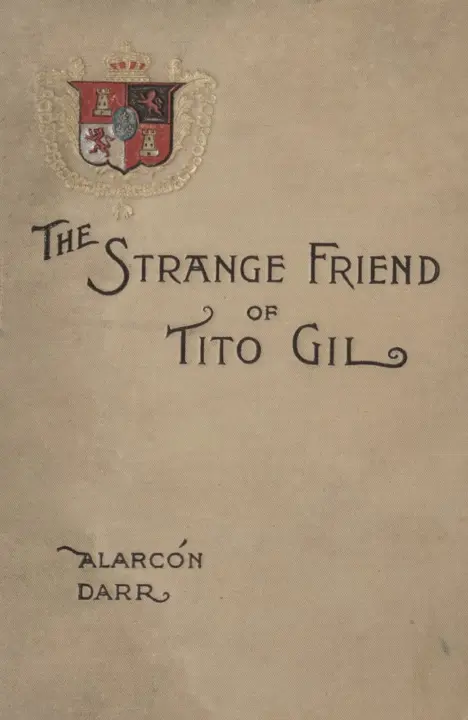
"The Strange Friend of Tito Gil" by Pedro Antonio de Alarcón is a novel written in the late 19th century. The book tells the story of Tito Gil, a poor shoemaker’s son who, after a series of misfortunes and transformations, becomes entangled with the enigmatic figure of Death, who claims to be his friend and offers him extraordinary powers. The novel explores themes of love, hardship, and the twists of fate that lead Tito on a quest to reconnect with his childhood love, Elena. At the start of the story, we meet Tito Gil, who has transitioned from being a page in a noble household to a destitute shoemaker after the death of his benefactor, Count Rionuevo. Struggling with heartbreak and poverty, Tito’s life takes a dark turn when he encounters a mysterious figure who reveals himself to be Death, stating that he is bound to Tito by the remorse for the misfortunes he has caused. As Tito grapples with despair, he is offered the chance to become a physician and win back Elena, but must navigate the complexities of fate, love, and the deeper implications of his newfound abilities, leading to a series of encounters that will ultimately challenge his understanding of life and death.
Introduction adapted from the source catalogue; source summaries may be automatically generated.
Free to read · English · 19,982 words · No account needed
MAKE TIME FOR A GOOD BOOK
On by default. Untick to stop anonymous reading totals. Each page counts after 10 seconds in view. How this works.
Anonymous counting is on unless you have switched it off.
“Search for those papers, Duke,” said Tito to Monteclaro, “and do me the kindness to speak to Elena.”
“Come! Doctor, come! The king is dying!” exclaimed Don Miguel de Guerra,
interrupting him.
“Follow me, Duke,” said the youth, with great respect, “it has struck twelve, and I can give you some very important news, I do not know whether good or bad. It is this; I can tell you whether or not Louis I. will die to-day.”
The morning of the thirty-first of August had dawned, when Louis I. was to deliver up his spirit to his Creator.
Tito discovered the certainty of it by seeing Death standing in the middle of the room with his eyes fixed on the sick king.
“To-day the king dies,” whispered Tito, in Monteclaro’s ear. “This news is the wedding present which I make to Elena. If you know its value, guard it in secret, and let it govern your conduct toward Philip V.”
“But Elena is promised to another,” replied the Duke.
“The nephew of the Countess of Rionuevo died this afternoon,” interrupted
Tito.
“Oh! what has befallen us!” exclaimed the Duke. “Who are you—you whom I knew as a child, and who now terrify me with such power and science?”
“The queen calls,” said a lady at this moment to the Duke of Monteclaro, who seemed stupefied.
The lady was Elena.
The Duke approached the queen, leaving the two lovers alone in the middle of the room. Not alone, for Death was but three steps off.
The two stood mutely gazing at each other as if bewildered, and fearful that their mutual presence might be a dream which would pass away should they move a hand or utter the lightest breath.
On meeting, a few hours before in that same place, both had experienced, mingled with an ineffable happiness, a certain secret anguish, like that which two friends feel, after a long separation, on recognizing each other in a prison, on the morning of execution, unconscious accomplices of a fatal crime, and victims of the same persecution. One might also say that the sad joy with which Tito and Elena recognized each other, was equal to the bitter pleasure which the corpse of a jealous husband would experience (if corpses feel) in the tomb, on hearing the door of the cemetery open at night, knowing that it is his wife whom they are bringing to inter. “So you are here!” the poor corpse would say; “it is now four years that I have been alone, thinking of what you were doing in the world, you, so beautiful, so unloving, that you discarded your mourning the very year of my death. You have waited long; but you are here, and if love is no longer possible between us, neither is infidelity or forgetfulness. We belong to each other negatively. Although nothing unites us, we are united, because nothing can separate us. For the jealousies, uncertainties, anxieties of life, you have substituted an eternity of love and remembrance. I pardon you all.”
Your reading position is saved on this browser. Take it to another device with a library code. Reading pages adapt to text, rather than matching a printed edition.
BEHIND THE BOOK
This eBook is for the use of anyone anywhere in the United States and most other parts of the world at no cost and with almost no restrictions whatsoever. You may copy it, give it away or re-use it under the terms of the Project Gutenberg License included with this eBook or online at www.gutenberg.org. If you are not located in the United States, you will have to check the laws of the country where you are located before using this eBook. Read the source licence.
The original source file, including credits and licence, is retained by this library. Request an original-format copy at no charge. Please include the book title and Project Gutenberg identifier #64456.
KEEP YOUR CURIOSITY GOING
Coulson Kernahan

Maurice Baring
Frances Wright
Cécile Tormay

Frederic Jesup Stimson

W. H. P. (William Henry Pope) Jarvis