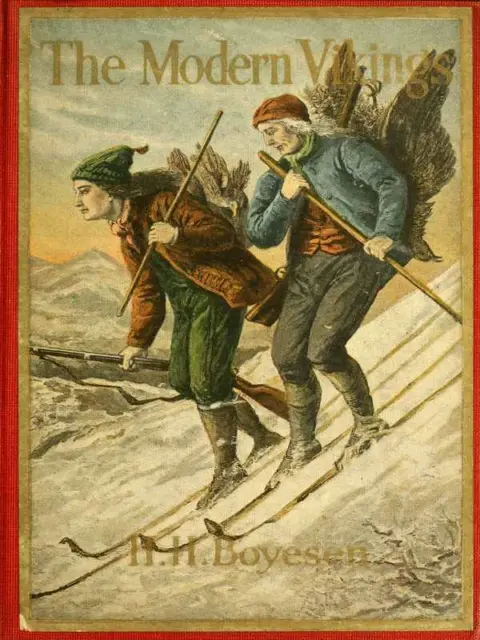
The Modern Vikings: Stories of Life and Sport in the Norseland
Hjalmar Hjorth Boyesen
THE CLASSIC COLLECTION · 1888
"The Story of Norway" by Hjalmar Hjorth Boyesen is a historical account written in the late 19th century. The book aims to narrate the history of Norway from its early settlements through significant historical events and figures, while focusing on dramatic phases rather than institutional growth. The author particularly highlights the foundational role of the Norsemen, their migration patterns, and cultural history, which laid the groundwork for Norway's development as a nation. The opening of the book introduces readers to the Norsemen, detailing their origins as an Aryan race and their migration to Scandinavia. Boyesen explores the physical traits and societal structure of early Norse settlers, emphasizing their love for independence and innate aptitude for self-governance despite their violent tendencies. The author paints a vivid picture of the Norwegian landscape and the challenges faced by its inhabitants. He discusses the significance of their communal gatherings, or "thing", in maintaining order and governance among the tribes, and establishes the foundation for the complex history that will follow in later chapters. Overall, the beginning sets up a rich exploration of Norway's historical narrative while providing context for its cultural identity.
Introduction adapted from the source catalogue; source summaries may be automatically generated.
Free to read · English · 131,464 words · No account needed
MAKE TIME FOR A GOOD BOOK
On by default. Untick to stop anonymous reading totals. Each page counts after 10 seconds in view. How this works.
Anonymous counting is on unless you have switched it off.
As Earl Haakon saw the first of the Jomsvikings sailing up the sound, he disposed his own ships in battle-array. He gave his oldest son Erik command of the right wing, placed Sweyn on the left, and himself commanded the centre. Opposite to Sweyn were the ships of the famous Jomsviking Vagn Aakesson, whose impetuosity and daring had made him dreaded far and wide. The young Earl Sweyn was no match for such an antagonist, and after a gallant resistance he began to retreat. His brother Erik, seeing the imminent danger, rowed around to his wing, drove Vagn back, and forced his brother to resume his position. Then he hastened back to his own wing, and came just in time to check the progress of Bue the Big (Digre), who commanded the corresponding wing of the Jomsvikings. The battle now grew furious, and the carnage on both sides was tremendous. The spears and arrows fell in rattling showers about Earl Haakon, as he stood in the prow of his ship, and so many hit him that his shirt of mail was torn into strips, and he was forced to throw it away. The ships of the vikings were higher than those of the Norsemen, and the advantage which this afforded the former told at first heavily against the latter. Then, it is told, Earl Haakon suddenly disappeared, and the legend relates that he took his youngest son Erling, went ashore with him, and sacrificed him to the gods for victory. Instantly the skies grew black, and a violent hail-storm beat down, pelting the faces of the Jomsvikings and almost blinding them. Every grain of hail, says the saga, weighed two ounces. Some even declared that they saw the maidens of Odin, the Valkyrias, Thorgerd and Irp, standing in the prow of Earl Haakon's ship, sending forth a deadlier hail of unerring arrows. The Jomsvikings fought half blindly, fell on the slippery decks in a slush of blood and melting hail, but in spite of the twilight and confusion yet held their own. Then suddenly their chief, Earl Sigvalde, turned and fled. Vagn Aakesson, who saw him, cried out in a frenzy of rage: "Why dost thou flee, thou evil hound, and leave thy men in the lurch? That shame shall cling to thee all thy days." Earl Sigvalde made no reply; and it was well for him that he did not; for in the same instant a spear was hurled forth from Vagn's hand, transfixing the man at the helm. A moment before Vagn had seen his chieftain there, and it was for him the spear was intended. Confusion now became general; and all Earl Sigvalde's men, seeing that his standard was gone, fell out of line and fled. At last only Vagn Aakesson and Bue the Big were left. Earl Haakon pulled up alongside the ship of the latter and a combat ensued, which, in wildness and fury, has scarcely a parallel in the records of the sagas. Two great champions of the Jomsvikings, Haavard the Hewer (Huggende) and Aslak Rock-skull (Holmskalle), vaulted over the gunwale of the earl's ship and made tremendous havoc, until an Icelander seized an anvil which was used for sharpening the weapons and dashed it against Aslak's head, splitting his skull. Haavard had both his feet cut off, but fought on furiously, standing on his knees. The spears whizzed about the earl's ears and the arrows flew past him with their angry twang. His men fell and the Jomsvikings were pressing forward. Then, in the nick of time, came his son Erik, and, with a throng of his men, boarded the galley of Bue the Big. In their first onset Bue received a terrible cut across the nose. "Now," he cried, "I fear the Danish maidens will no more kiss me." Then, seeing that resistance was vain, he seized two chests full of gold and shouted: "Overboard all Bue's men," and leaped into the sea. Vagn Aakesson's galley was likewise boarded, and there was a repetition of former scenes of carnage. When all but thirty of his men were dead he at last surrendered. The captives were brought ashore and ordered to sit down in a row upon a long log. Their feet were tied together with a rope, while their hands remained free. One of Earl Erik's men, Thorkell Leira, whom Vagn at that memorable funeral feast had promised to kill, was granted the privilege to reciprocate the intended favor toward Vagn. With his axe uplifted he rushed at the captives, and, beginning at one end of the log, struck off one head after another. He meant to keep Vagn until the last, in order to increase his agony. But Vagn sat chatting merrily with his men; and there was much joking and laughter.
Your reading position is saved on this browser. Take it to another device with a library code. Reading pages adapt to text, rather than matching a printed edition.
Hjalmar Hjorth Boyesen
Hjalmar Hjorth Boyesen
Hjalmar Hjorth Boyesen
Hjalmar Hjorth Boyesen
BEHIND THE BOOK
This eBook is for the use of anyone anywhere in the United States and most other parts of the world at no cost and with almost no restrictions whatsoever. You may copy it, give it away or re-use it under the terms of the Project Gutenberg License included with this eBook or online at www.gutenberg.org. If you are not located in the United States, you will have to check the laws of the country where you are located before using this eBook. Read the source licence.
The original source file, including credits and licence, is retained by this library. Request an original-format copy at no charge. Please include the book title and Project Gutenberg identifier #34646.
KEEP YOUR CURIOSITY GOING
Cécile Tormay

Moritz Busch
John L. Ransom
Frances Wright
Cécile Tormay

Mabel Potter Daggett