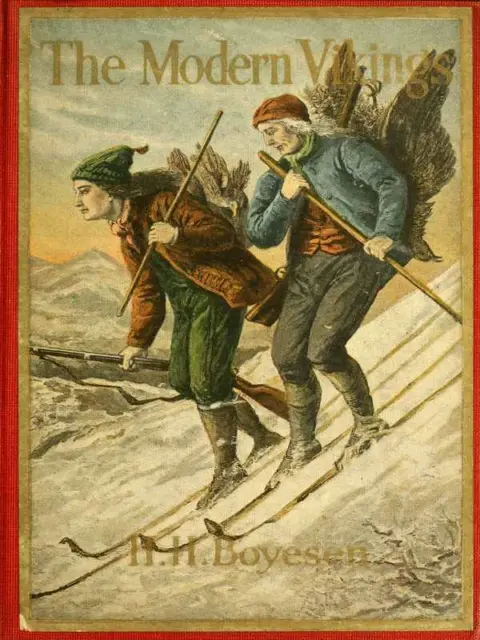
The Modern Vikings: Stories of Life and Sport in the Norseland
Hjalmar Hjorth Boyesen
THE CLASSIC COLLECTION · 1888
"The Story of Norway" by Hjalmar Hjorth Boyesen is a historical account written in the late 19th century. The book aims to narrate the history of Norway from its early settlements through significant historical events and figures, while focusing on dramatic phases rather than institutional growth. The author particularly highlights the foundational role of the Norsemen, their migration patterns, and cultural history, which laid the groundwork for Norway's development as a nation. The opening of the book introduces readers to the Norsemen, detailing their origins as an Aryan race and their migration to Scandinavia. Boyesen explores the physical traits and societal structure of early Norse settlers, emphasizing their love for independence and innate aptitude for self-governance despite their violent tendencies. The author paints a vivid picture of the Norwegian landscape and the challenges faced by its inhabitants. He discusses the significance of their communal gatherings, or "thing", in maintaining order and governance among the tribes, and establishes the foundation for the complex history that will follow in later chapters. Overall, the beginning sets up a rich exploration of Norway's historical narrative while providing context for its cultural identity.
Introduction adapted from the source catalogue; source summaries may be automatically generated.
Free to read · English · 131,464 words · No account needed
MAKE TIME FOR A GOOD BOOK
On by default. Untick to stop anonymous reading totals. Each page counts after 10 seconds in view. How this works.
Anonymous counting is on unless you have switched it off.
In the twenty-sixth year of his reign (961) Haakon was summering with his men-at-arms on his estate Fitje in Hoerdaland. A large number of guests were with him, among whom the scald Eyvind Skaldespilder (Scald-Spoiler),[A] who was on his mother's side a great-grandson of Harold the Fairhaired. The king was seated at the breakfast-table, when the sentinels saw a large fleet of ships sailing in through the fjord. They called the scald Eyvind aside, and begged him to decide whether those were not hostile ships. Eyvind sprang into the hall where the king was sitting, and sang a verse, announcing the approach of the sons of Erik. Haakon arose and looked at the ships. Then he turned to his men and said: "Here many ships are coming against us, and our force is but small. It is plainly to be seen that we shall have to fight against heavier odds than ever before; for the sons of Gunhild come with a larger force to-day than on previous occasions. Loath I am to bring my best men into too great a danger; and loath I am, too, to flee, unless wise men decide that it would be foolhardy to await the foe."
[Footnote A: Skaldespilder means waster or spoiler of scalds, because no other scald could bear comparison with him.]
Eyvind Scald-Spoiler replied in verse that it would ill befit a man like King Haakon to flee from the sons of Gunhild. "Manly speech is that, and in accordance with my mind," answered the king; and when the other warriors with one accord clamored for battle, he put on his armor, buckled his sword about his loins, and seized spear and shield. On his head he wore a golden helmet which flashed in the sun. Beautiful he was to behold, with his mild and noble countenance, and his bright hair streaming down over his shoulders. Upon the fields without he arranged his men in battle array, and raised his standards. The sons of Erik disembarked with a large army, commanded by the third of the brothers, Harold, and his two uncles, Eyvind Skreyja and Alf Askman. The battle which now commenced was wild and bloody. The army of the sons of Gunhild was six times as numerous as that of King Haakon. But Haakon, knowing his Norsemen well, did not lose heart. Wherever the fight was hottest, there flashed his golden helmet. He joked with Eyvind, the scald, when he passed him, and improvised a verse in reply to the one with which he was greeted. The fiercer the conflict grew, the higher rose the king's spirits. At last, when the heat oppressed him, he flung away his armor and stormed forward at the head of his men. The supply of spears and arrows soon ran short, and the hostile ranks clashed together and fought, hand to hand, with their swords. The shining helmet made the king very conspicuous, and Eyvind Scald-Spoiler noticed that it served as a target for the Danish spears. He therefore took a hood and pulled it over the helmet. Eyvind Skreyja, who was just rushing forward to meet the king, thereby lost sight of him, and he cried out: "What has become of the king of the Norsemen? Does he hide himself, or is he afraid? No more do I see the golden helmet?" "Keep on as thou art steering, if thou wishest to find the king of the Norsemen," shouted Haakon, and throwing away his shield, seized his sword with both hands, and sprang forward where all could see him. Eyvind Skreyja bounded forward with uplifted sword, but one of the king's men caught the blow upon his shield, and in the same instant Haakor, cleft Eyvind's head and neck down to the shoulders. The example of their king fired the Norsemen's courage, while the fall of their greatest champion brought confusion to the Danes. The former charged with renewed fury, while the latter were pressed down to the beach, and leaped into the ocean; many were killed or drowned, but a few, including Harold Eriksson, saved themselves by swimming, and were picked up by the ships. While pursuing the fleeing foe, Haakon was hit in his right arm by a peculiarly shaped arrow, and all efforts to staunch the blood proved in vain. It was said that Gunhild had bewitched this arrow and given it to her chamberlain, with the charge that he should shoot it off against King Haakon. As night approached, the king grew weaker and weaker, and fainted repeatedly. One of his friends offered to take his body over to England, when he was dead, so that he might be buried in Christian soil. But Haakon replied: "I am not worthy of it. I have lived like a heathen, and therefore it is meet that I should be buried like a heathen."
Your reading position is saved on this browser. Take it to another device with a library code. Reading pages adapt to text, rather than matching a printed edition.
Hjalmar Hjorth Boyesen
Hjalmar Hjorth Boyesen
Hjalmar Hjorth Boyesen
Hjalmar Hjorth Boyesen
BEHIND THE BOOK
This eBook is for the use of anyone anywhere in the United States and most other parts of the world at no cost and with almost no restrictions whatsoever. You may copy it, give it away or re-use it under the terms of the Project Gutenberg License included with this eBook or online at www.gutenberg.org. If you are not located in the United States, you will have to check the laws of the country where you are located before using this eBook. Read the source licence.
The original source file, including credits and licence, is retained by this library. Request an original-format copy at no charge. Please include the book title and Project Gutenberg identifier #34646.
KEEP YOUR CURIOSITY GOING
Cécile Tormay

Moritz Busch
John L. Ransom
Frances Wright
Cécile Tormay

Mabel Potter Daggett