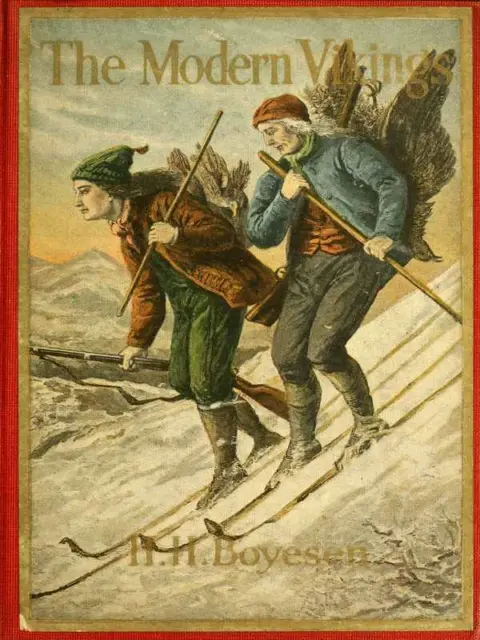
The Modern Vikings: Stories of Life and Sport in the Norseland
Hjalmar Hjorth Boyesen
THE CLASSIC COLLECTION · 1888
"The Story of Norway" by Hjalmar Hjorth Boyesen is a historical account written in the late 19th century. The book aims to narrate the history of Norway from its early settlements through significant historical events and figures, while focusing on dramatic phases rather than institutional growth. The author particularly highlights the foundational role of the Norsemen, their migration patterns, and cultural history, which laid the groundwork for Norway's development as a nation. The opening of the book introduces readers to the Norsemen, detailing their origins as an Aryan race and their migration to Scandinavia. Boyesen explores the physical traits and societal structure of early Norse settlers, emphasizing their love for independence and innate aptitude for self-governance despite their violent tendencies. The author paints a vivid picture of the Norwegian landscape and the challenges faced by its inhabitants. He discusses the significance of their communal gatherings, or "thing", in maintaining order and governance among the tribes, and establishes the foundation for the complex history that will follow in later chapters. Overall, the beginning sets up a rich exploration of Norway's historical narrative while providing context for its cultural identity.
Introduction adapted from the source catalogue; source summaries may be automatically generated.
Free to read · English · 131,464 words · No account needed
MAKE TIME FOR A GOOD BOOK
On by default. Untick to stop anonymous reading totals. Each page counts after 10 seconds in view. How this works.
Anonymous counting is on unless you have switched it off.
When Erik was fourteen years old, he was married to Margaret of Scotland, the daughter of his grandfather's enemy, King Alexander III. The young queen died, however, a year later, after having given birth to a daughter, who, on the death of King Alexander (1284), was acknowledged as the heir to the throne of Scotland. While yet a child (1290), the Maid of Norway, as she was called, embarked for the land which she was to rule, but died before reaching it. Her father then, as his daughter's heir, laid claim to the Scottish crown, but the armed interference of King Edward I. of England compelled him to abandon his candidacy. He had at that time another controversy on his hands, which threatened serious results.
The queen-dowager, Ingeborg, was the daughter of the Danish king, Erik Plowpenny. His nephew, Erik Glipping, who succeeded his father, Christopher I., refused to surrender her inheritance, which consisted in landed estates in different parts of the kingdom. Magnus Law-Mender had vainly insisted upon the surrender of the property, and Erik, at the instigation of his mother, resumed negotiations, and, when these resulted in nothing, made threatening demonstrations. The Norse baron, Sir Alf Erlingsson, a special favorite of the queen, began to prey upon the shipping in the Sound, and by his recklessness and daring, made his name dreaded among seamen and merchants. He did, indeed, inflict much injury upon Danish commerce, and ravaged the coasts of Jutland and Halland; but the principal sufferers were the cities of the Hanseatic League, which, by the concessions of Magnus Law-Mender, had obtained a virtual monopoly of the foreign trade of Norway. Their ships were now seized without mercy by the noble pirate, who added insult to injury by once appearing incognito among them in an open boat, and bargaining with them about the price which they had set upon his head. It was of no use that the League sent out ships of war to capture him; he out-manoeuvred them, deceived them, sent them on a wild-goose chase, and ended by capturing his would-be captors. Though not officially authorized to carry on war in this fashion, Sir Alf perceived that his performances were winked at by the queen-dowager, who was actually so gratified at his success, that she had him created an earl, and induced the king to use him as his ambassador to England. As allies of the King of Denmark, the Hanseatic cities were, in the queen's opinion, entitled to no consideration, but she forgot in her blind hostility that they had it in their power to take revenge. Partly on account of the risk, partly as a measure of retaliation, the Hansa forbade the importation of grain and other staples of food to Norway, and the result was famine and misery. The hostilities with Denmark in the meanwhile continued, but were, after the death of Queen Ingeborg (1287), conducted, not by piracy, but by open warfare. A conspiracy was formed against the life of King Erik Glipping, and he was murdered, while on the chase (1286), by Marshal Stig, Count Jacob of Halland, and others. The murderers, who were outlawed in Denmark, found a refuge in Norway, and accompanied King Erik on his campaign against their native country in 1289. The city of Elsinore was burned, and the Norwegian fleet lay for four weeks near Copenhagen, serving as a basis of operations for the outlawed king-slayers, who satisfied their private vengeance by burning cities and castles. Three similar expeditions, during the following six years, brought Erik neither honor nor profit in proportion to the cost of the enterprise; although, in the end, the Danish king, Erik Menved, was compelled to conclude an armistice for three years at Hinsgavl, in Funen (1295), at which he made a definite promise of the surrender of the disputed property. The king-slayers were permitted to return unmolested to their homes, and their estates were to be restored to them.
Your reading position is saved on this browser. Take it to another device with a library code. Reading pages adapt to text, rather than matching a printed edition.
Hjalmar Hjorth Boyesen
Hjalmar Hjorth Boyesen
Hjalmar Hjorth Boyesen
Hjalmar Hjorth Boyesen
BEHIND THE BOOK
This eBook is for the use of anyone anywhere in the United States and most other parts of the world at no cost and with almost no restrictions whatsoever. You may copy it, give it away or re-use it under the terms of the Project Gutenberg License included with this eBook or online at www.gutenberg.org. If you are not located in the United States, you will have to check the laws of the country where you are located before using this eBook. Read the source licence.
The original source file, including credits and licence, is retained by this library. Request an original-format copy at no charge. Please include the book title and Project Gutenberg identifier #34646.
KEEP YOUR CURIOSITY GOING
Cécile Tormay

Moritz Busch
John L. Ransom
Frances Wright
Cécile Tormay

Mabel Potter Daggett