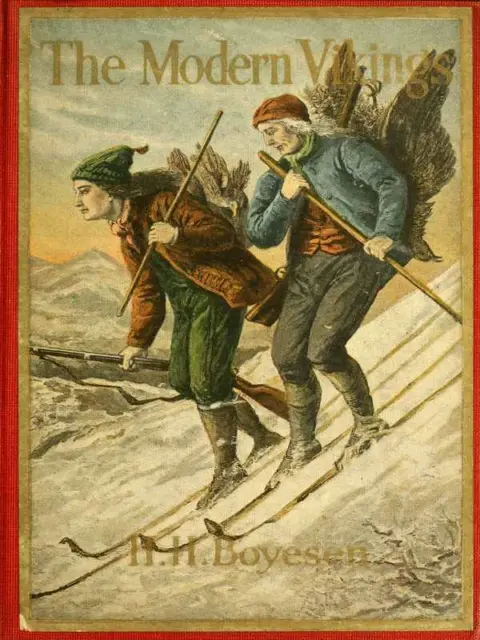
The Modern Vikings: Stories of Life and Sport in the Norseland
Hjalmar Hjorth Boyesen
THE CLASSIC COLLECTION · 1888
"The Story of Norway" by Hjalmar Hjorth Boyesen is a historical account written in the late 19th century. The book aims to narrate the history of Norway from its early settlements through significant historical events and figures, while focusing on dramatic phases rather than institutional growth. The author particularly highlights the foundational role of the Norsemen, their migration patterns, and cultural history, which laid the groundwork for Norway's development as a nation. The opening of the book introduces readers to the Norsemen, detailing their origins as an Aryan race and their migration to Scandinavia. Boyesen explores the physical traits and societal structure of early Norse settlers, emphasizing their love for independence and innate aptitude for self-governance despite their violent tendencies. The author paints a vivid picture of the Norwegian landscape and the challenges faced by its inhabitants. He discusses the significance of their communal gatherings, or "thing", in maintaining order and governance among the tribes, and establishes the foundation for the complex history that will follow in later chapters. Overall, the beginning sets up a rich exploration of Norway's historical narrative while providing context for its cultural identity.
Introduction adapted from the source catalogue; source summaries may be automatically generated.
Free to read · English · 131,464 words · No account needed
MAKE TIME FOR A GOOD BOOK
On by default. Untick to stop anonymous reading totals. Each page counts after 10 seconds in view. How this works.
Anonymous counting is on unless you have switched it off.
When the spirit of rebellion which the duke had bred in his surroundings had thrown away all restraint, it began to react upon himself, spurring him on to deed, and counteracting his natural indecision of character. He was now nearly fifty years old, and if he ever were to gain the crown, there was no time to be lost. Accordingly he mustered courage in 1239 to summon the Troenders to Oere-thing, and to proclaim himself king of all Norway. When the canons of the cathedral refused to permit the shrine of St. Olaf to be used for the ceremony, Skule's son, Peter,[B] jumped up on the altar, pulled the coffin up, and had it removed, by force, to the thing. In order that Haakon should gain no intelligence of what had taken place, all the roads which led out of the city were guarded, but for all that, one man, named Grim Keikan, managed to make his escape and to warn the king of the threatening danger. It was in the middle of the night that the king received this message, and he went instantly to the queen's rooms and demanded admittance. The queen, aroused from her sleep, asked anxiously what news he brought.
[Footnote B: Peter was an illegitimate child. His mother was the wife of
Andres Skjaldarband.]
"Only this trifle," he said, "that there are now two kings in Norway."
"Only one is the right king," she answered gravely, "and that one are
you."
It had been Skule's first plan to surprise Haakon in Bergen, and capture him. But he soon learned that the king had heard of his exploits, and was prepared to receive him. He then sent out bands of warriors to different parts of the country to kill the royal prefects and all prominent friends of the king. A great many excellent men, who were utterly unprepared for hostilities, were thus foully murdered; churches were violated, and many atrocities committed. The duke, in the meanwhile, remained quietly in Nidaros where he occupied himself in writing letters to foreign princes and potentates, informing them of the step he had taken, and endeavoring to stir up difficulties for Haakon by unscrupulous misrepresentations. When, however, he learned that the king was coming with a large force to attack him, he started (Feb., 1240) with six hundred men across the mountains to the Oplands. Here he was met by his son-in-law, Squire Knut, who had been appointed earl in his place, and defeated him and the able commander, Arnbjoern Jonsson, at Laaka. It was now high time for the king to appear upon the scene, if he were to prevent the rebellion from assuming such proportion, as to be beyond his power to quell it. The danger suddenly developed in him a decision and promptness of action, which went far to raise the sinking courage of his men. He declined the archbishop's offer to open negotiations once more; arrived, after a voyage of unprecedented rapidity, in Viken, and rowed, under cover of a fog, up the Folden Fjord to Oslo. In view of the possibility of his death, he had made all preparations for the succession, but he was resolved to sell his life dearly. The Varbelgs, who had not the faintest suspicion that he was near, were sleeping soundly after a night's carouse, when suddenly the war-horn resounded, and the storm-bell rang. The prows of the royal fleet were then seen emerging from the fog and making for the piers. The duke, as soon as the alarm was given, tumbled out of bed and flung on his clothes. The dawn was just reddening in the east, and the fog was lifting. The ships were now at the piers, and the troops were disembarking. The Varbelgs supposed, at first, that it was Earl Knut, who had come to revenge his defeat at Laaka. But they were soon undeceived. When they caught sight of the royal banner they knew that King Haakon was not far away. Strangely enough, though they saw him storming forward, every moment exposing himself to danger, nay, even rushing on ahead of his men, they were not eager to kill him. They feared that the duke's cause was lost, and though they fought bravely, they had no hope of victory. The duke fled and was pursued by the Birchlegs; but they did not succeed in overtaking him. Many men fell in that fight, but many more sought refuge in the churches and were pardoned.
Your reading position is saved on this browser. Take it to another device with a library code. Reading pages adapt to text, rather than matching a printed edition.
Hjalmar Hjorth Boyesen
Hjalmar Hjorth Boyesen
Hjalmar Hjorth Boyesen
Hjalmar Hjorth Boyesen
BEHIND THE BOOK
This eBook is for the use of anyone anywhere in the United States and most other parts of the world at no cost and with almost no restrictions whatsoever. You may copy it, give it away or re-use it under the terms of the Project Gutenberg License included with this eBook or online at www.gutenberg.org. If you are not located in the United States, you will have to check the laws of the country where you are located before using this eBook. Read the source licence.
The original source file, including credits and licence, is retained by this library. Request an original-format copy at no charge. Please include the book title and Project Gutenberg identifier #34646.
KEEP YOUR CURIOSITY GOING
Cécile Tormay

Moritz Busch
John L. Ransom
Frances Wright
Cécile Tormay

Mabel Potter Daggett