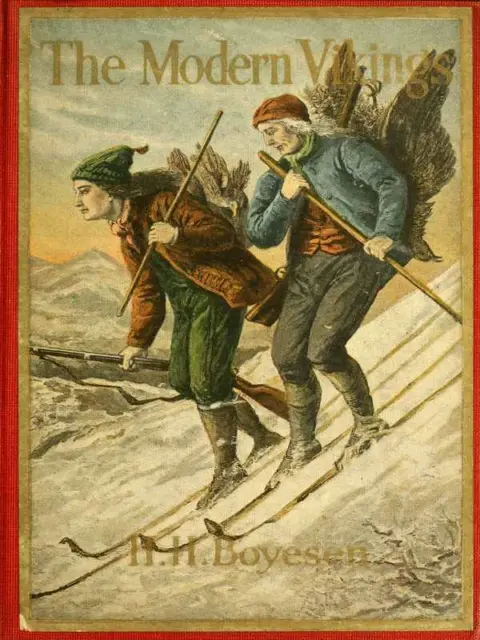
The Modern Vikings: Stories of Life and Sport in the Norseland
Hjalmar Hjorth Boyesen
THE CLASSIC COLLECTION · 1888
"The Story of Norway" by Hjalmar Hjorth Boyesen is a historical account written in the late 19th century. The book aims to narrate the history of Norway from its early settlements through significant historical events and figures, while focusing on dramatic phases rather than institutional growth. The author particularly highlights the foundational role of the Norsemen, their migration patterns, and cultural history, which laid the groundwork for Norway's development as a nation. The opening of the book introduces readers to the Norsemen, detailing their origins as an Aryan race and their migration to Scandinavia. Boyesen explores the physical traits and societal structure of early Norse settlers, emphasizing their love for independence and innate aptitude for self-governance despite their violent tendencies. The author paints a vivid picture of the Norwegian landscape and the challenges faced by its inhabitants. He discusses the significance of their communal gatherings, or "thing", in maintaining order and governance among the tribes, and establishes the foundation for the complex history that will follow in later chapters. Overall, the beginning sets up a rich exploration of Norway's historical narrative while providing context for its cultural identity.
Introduction adapted from the source catalogue; source summaries may be automatically generated.
Free to read · English · 131,464 words · No account needed
MAKE TIME FOR A GOOD BOOK
On by default. Untick to stop anonymous reading totals. Each page counts after 10 seconds in view. How this works.
Anonymous counting is on unless you have switched it off.
While thus indefatigably engaged in quelling rebellion, Sverre had another struggle on his hands which made even heavier demands upon his vigilance and energy. The church is not apt to look with favor upon one who deserts it, even for a throne, and the fact that the king had been admitted to the lowest order of the priesthood, so far from reconciling the priests to his authority, placed them in a hostile attitude to him. In spite of this, however, there is little doubt but that he could have bought their friendship by making the proper concessions. If he had been willing to ratify the agreement between Archbishop Eystein and Erling Skakke, hold his crown in fief from St. Olaf, which was but another name for the hierarchy, and give the bishops the right to exact similar conditions from his successors, his former deaconship would have proved no obstacle to his receiving the support of the Church. Sverre knew, however, too well the spirit of the priesthood to venture upon such concessions. It was his policy to make the monarchy strong enough to quell the unruly spirit of the aristocracy and give peace and security to the people. The Church had from the beginning taken sides against him, and secretly or openly aided every band of rebels which had endeavored to overthrow his government. No wonder that, apart from all other considerations, he was not favorably disposed toward the Church.
When Archbishop Eystein died, after having made a pretended peace with the king, Bishop Erik, of Stavanger, was elected as his successor. It is said that Eystein, on his death-bed, obtained Sverre's reluctant consent to this choice. At all events, Erik was chosen, and was no sooner warm in his seat, than he showed his disposition toward the king. Without consulting Sverre, he named for his successor to the bishopric of Stavanger one of his bitterest enemies, Nicholas Arnesson, a half-brother of King Inge Crookback. Sverre naturally objected, first because Nicholas had never taken orders, secondly because his election had taken place in an illegal manner, the king having not been present. For all that, he agreed in the end to waive his objections, because his queen, Margaret (a sister of the Swedish king, Knut Eriksson), interposed in Nicholas' behalf. The latter, who was a master of intrigue, had, by his humility and flatteries, gained the favor of the queen, and even Sverre, who was ordinarily a keen judge of men, was made to waver in his distrust of him. He was, however, soon to have his eyes opened. As soon as Nicholas had received his investiture, he again joined the ranks of the king's enemies, making common cause with the archbishop, who was indefatigably quarrelling with Sverre about the alleged prerogatives of his office. First, he wanted the fines and penances, payable to the Church in Troendelag, to be rendered according to actual weight in silver, and not in the coin of the realm, which was but worth half its nominal value. Secondly, he wished to reserve for himself and his fellow bishops the right of making all clerical appointments, and thirdly, he claimed the privilege of surrounding himself with a kind of ecclesiastical court, and keeping ninety to one hundred men-at-arms in his service, although the law only allowed him thirty. To settle these points, Sverre summoned the archbishop to Frosta-thing, and, after having read him the law, decided against him. Full of wrath, the haughty prelate left the country, seeking refuge with Archbishop Absalon in Denmark, who received him cordially. Here he composed a letter to the Pope in which he bitterly complained of the king's usurpations and infringements of the rights of the Church. The Pope responded by putting Sverre in the ban and releasing his subjects from their oath of allegiance. Before the bull reached Norway, however, Sverre had induced the bishops, remaining in the country, to crown him at Bergen (June 29, 1194). Even Bishop Nicholas, who had recently been transferred from Stavanger to Oslo, had participated in this ceremony, though probably much against his will. Sverre treated the papal bull, at first, as a mere fraudulent invention of archbishops, Erik and Absalon, but that he was far from believing this to be the case is shown by the fact that he sent embassadors to Rome to present counter charges against the archbishop, and to explain the causes of the controversy from his point of view. As far as we know these embassadors accomplished nothing, and on their homeward way they died suddenly in Denmark (1197), having probably been poisoned. Soon after, a falsified papal bull was published by Sverre, in which the ban was revoked. It is not improbable that he was himself responsible for this falsification. It was a question of "to be or not to be" with him, and he had been long enough connected with the Church to know how to soothe his conscience in such a matter. It is, moreover, scarcely credible that any one else would have committed the fraud in his favor.
Your reading position is saved on this browser. Take it to another device with a library code. Reading pages adapt to text, rather than matching a printed edition.
Hjalmar Hjorth Boyesen
Hjalmar Hjorth Boyesen
Hjalmar Hjorth Boyesen
Hjalmar Hjorth Boyesen
BEHIND THE BOOK
This eBook is for the use of anyone anywhere in the United States and most other parts of the world at no cost and with almost no restrictions whatsoever. You may copy it, give it away or re-use it under the terms of the Project Gutenberg License included with this eBook or online at www.gutenberg.org. If you are not located in the United States, you will have to check the laws of the country where you are located before using this eBook. Read the source licence.
The original source file, including credits and licence, is retained by this library. Request an original-format copy at no charge. Please include the book title and Project Gutenberg identifier #34646.
KEEP YOUR CURIOSITY GOING
Cécile Tormay

Moritz Busch
John L. Ransom
Frances Wright
Cécile Tormay

Mabel Potter Daggett