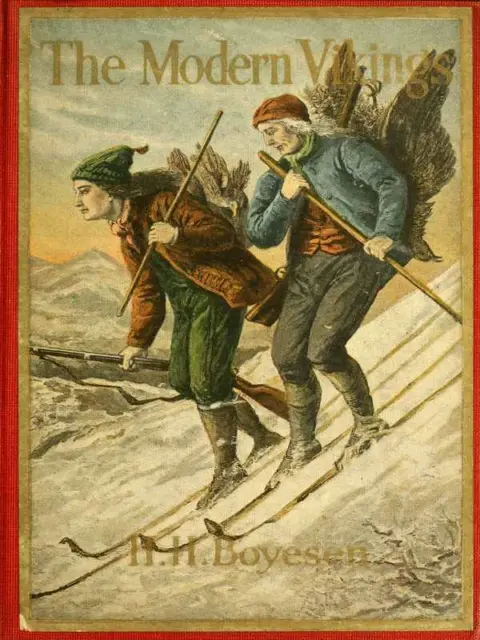
The Modern Vikings: Stories of Life and Sport in the Norseland
Hjalmar Hjorth Boyesen
THE CLASSIC COLLECTION · 1888
"The Story of Norway" by Hjalmar Hjorth Boyesen is a historical account written in the late 19th century. The book aims to narrate the history of Norway from its early settlements through significant historical events and figures, while focusing on dramatic phases rather than institutional growth. The author particularly highlights the foundational role of the Norsemen, their migration patterns, and cultural history, which laid the groundwork for Norway's development as a nation. The opening of the book introduces readers to the Norsemen, detailing their origins as an Aryan race and their migration to Scandinavia. Boyesen explores the physical traits and societal structure of early Norse settlers, emphasizing their love for independence and innate aptitude for self-governance despite their violent tendencies. The author paints a vivid picture of the Norwegian landscape and the challenges faced by its inhabitants. He discusses the significance of their communal gatherings, or "thing", in maintaining order and governance among the tribes, and establishes the foundation for the complex history that will follow in later chapters. Overall, the beginning sets up a rich exploration of Norway's historical narrative while providing context for its cultural identity.
Introduction adapted from the source catalogue; source summaries may be automatically generated.
Free to read · English · 131,464 words · No account needed
MAKE TIME FOR A GOOD BOOK
On by default. Untick to stop anonymous reading totals. Each page counts after 10 seconds in view. How this works.
Anonymous counting is on unless you have switched it off.
Then he rose, gave the queen a slap, and flung the book into the fire. But in the same instant, a young taper-bearer, named Ottar Birting, jumped forward, snatched the book from the flames, and stepped fearlessly before the king. "Different it is now, my lord," he said, "from the time, when thou didst sail with pomp and splendor to Norway, and all thy friends hastened with joy to meet thee. * * * Now the days of sorrow have come upon us; for to this glorious feast many of thy friends have come, but they cannot be glad because of thy sad condition. Be now so kind, good my lord, to accept this advice. Rejoice by thy gentleness first the queen, whom thou hast so sorely offended, and then all thy chieftains, thy men-at-arms, thy friends, and thy servants."
"How darest thou, ugly, low-born tenant's son, give me counsel?" cried the king, springing up and drawing his sword.
All the guests expected, in the next moment, to see Ottar's head roll on the floor. But Ottar stood, gazing calmly into the king's face, and did not stir from the spot. Then Sigurd suddenly stayed his hand and let the sword fall gently upon his shoulder. He rebuked his liegemen, for not having protested against his insane acts, and thanked the youth for his courage.
"Go, therefore, Ottar," he finished; "and take thy seat among the liegemen. Thou shalt no more wait upon any one."
Ottar Birting became in later years a man of great fame and authority.
It may have been due to the unsoundness of his mind that Sigurd, in the last years of his life committed an act, which, however generous it may seem, was scarcely politically defensible. In the year 1129, a young Irishman named Harold Gilchrist arrived in Norway and declared that he was a son of Magnus Barefoot. It was known that King Magnus had had a mistress in Ireland, and during his last battle he is said to have recited a verse about an Irish girl, whom he loved above all others. It is therefore probable that Harold Gilchrist was, or at least believed himself to be, heir to the throne of Norway. He went to King Sigurd, who listened to his story, and allowed him to prove the truth of his statement by submitting to the ordeal by fire. He walked over the red-hot ploughshares and endured the test successfully. It was the priests who had charge of such ordeals, and it was believed that they had the result in their power. Harold Gilchrist, or Gille, as the Norsemen called him, was now acknowledged by the king as his brother, on condition that he should make no claim to the government, as long as Sigurd or his son Magnus was alive. It was, however, no easy task for the king to secure for the long-necked, thin-legged, and lanky Irishman the respect which was due to a member of the royal family. In the first place Harold's appearance was against him, and in the second place, he stammered and could scarcely make himself understood in Norwegian. The king's son, Magnus, hated and ridiculed him, and among the liegemen there were many who believed him to be an unscrupulous adventurer. A few years before his death, Sigurd put away Queen Malmfrid, disregarding the warning of Bishop Magne, and married a beautiful and high-born woman, named Cecilia. He did not long survive this marriage. Many of his friends urged him, for the good of his soul, to dissolve it. But the fascination, which Cecilia exercised over him, was so great, that he could not bear the thought of losing her. At last, when he was taken ill, she herself suggested a separation.
Your reading position is saved on this browser. Take it to another device with a library code. Reading pages adapt to text, rather than matching a printed edition.
Hjalmar Hjorth Boyesen
Hjalmar Hjorth Boyesen
Hjalmar Hjorth Boyesen
Hjalmar Hjorth Boyesen
BEHIND THE BOOK
This eBook is for the use of anyone anywhere in the United States and most other parts of the world at no cost and with almost no restrictions whatsoever. You may copy it, give it away or re-use it under the terms of the Project Gutenberg License included with this eBook or online at www.gutenberg.org. If you are not located in the United States, you will have to check the laws of the country where you are located before using this eBook. Read the source licence.
The original source file, including credits and licence, is retained by this library. Request an original-format copy at no charge. Please include the book title and Project Gutenberg identifier #34646.
KEEP YOUR CURIOSITY GOING
Cécile Tormay

Moritz Busch
John L. Ransom
Frances Wright
Cécile Tormay

Mabel Potter Daggett