A Treatise on Mechanics
Henry Kater & Dionysius Lardner
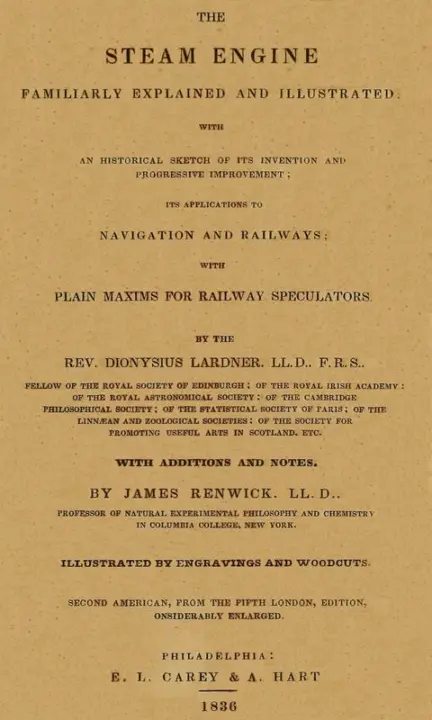
THE CLASSIC COLLECTION · 1836
"The Steam Engine Familiarly Explained and Illustrated" by Dionysius Lardner is a scientific publication written in the early 19th century. This work delves into the mechanics of the steam engine, exploring its invention, historical development, and various applications, particularly in navigation and railways. Aimed primarily at a general audience, the book seeks to demystify the principles of steam power and its significance in technological advancement. The opening of the text introduces the complexity and historical significance of the steam engine, emphasizing its vital role in advancing human progress. The author outlines the book's objective to elucidate the fundamental concepts related to motion and mechanical systems, which underpin the functionality of the steam engine. Lardner discusses the necessity of human ingenuity in harnessing natural forces and introduces key concepts of pressure, heat, and motion, setting the groundwork for an in-depth exploration of steam power throughout the chapters that follow.
Introduction adapted from the source catalogue; source summaries may be automatically generated.
Free to read · English · 106,763 words · No account needed
MAKE TIME FOR A GOOD BOOK
On by default. Untick to stop anonymous reading totals. Each page counts after 10 seconds in view. How this works.
Anonymous counting is on unless you have switched it off.
Vacuum, production of, by experiment, 37
Vapour, elastic, force of, 35
Valves, Watt's method of working the, 109
Walker and Rastrick, Messrs., apparent discrepancy of their estimated expense of locomotive power, 189
Washborough takes out a patent for Watt's invention of the rotatory
motion, 100
Water, sea, injurious to marine boilers, 245.
How remedied by blowing out, 246
Watt, James, important discoveries of, 39.
His acquaintance with Dr. Robinson and first experiments on the steam
engine, 73.
His subsequent improvements, 75.
His method of condensation, 76.
His first introduction of the air-pump into the steam engine, 77.
Further improvements, 78.
His difficulties, 78.
Description of his single-acting engine, 80.
His introduction to Dr. Roebuck, 88.
Erects his first engine on the estate of the Duke of Hamilton, 88.
After further improvements, obtains a patent for this engine, in
conjunction with Roebuck, 88.
His difficulties owing to Dr. Roebuck's failure, and subsequent
connexion with Bolton, 88.
Obtains an extension of his patent, 89.
Ingenious invention of, to determine the rate of remuneration he
should receive, 89.
His invention of the parallel motion, 95.
His method for producing a rotatory motion anticipated by Washborough,
who takes out a patent for it, 101.
His contrivance of the governor, 104.
His method of working the valves, 109.
His suggestion of the D valve, 113
Wood, Mr. Nicholas, 168
Woolf, Mr., his improvements in the steam engine, 134. Obtains a patent for the double-cylinder engine, 137
With their applications; especially to the pursuits of Surveyors, Architects, Mechanics, and Civil Engineers. With numerous engravings.
"Only let men awake, and fix their eyes, one while on the nature of things, another while on the application of them to the use and service of mankind."--Lord Bacon.
Extract of a Letter from WALTER R. JOHNSON, Professor of Mechanics and Natural Philosophy in the Franklin Institute.
"This treatise is intended and admirably calculated to supply the deficiency in the means of mathematical instruction to those who have neither time nor inclination to peruse numerous abstract treatises in the same departments. It has, besides the claims of a good elementary manual, the merit of embracing several of the most interesting and important departments of Mechanics, applying to these the rules and principles embraced in the earlier sections of the work.
"Questions in Statics, Dynamics, Hydrostatics, Hydrodynamics, &c., are treated with a clearness and precision which must increase the powers of the student over his own intellectual resources by the methodical habits which a perusal of such works cannot fail to impart.
Your reading position is saved on this browser. Take it to another device with a library code. Reading pages adapt to text, rather than matching a printed edition.
Henry Kater & Dionysius Lardner
BEHIND THE BOOK
This eBook is for the use of anyone anywhere in the United States and most other parts of the world at no cost and with almost no restrictions whatsoever. You may copy it, give it away or re-use it under the terms of the Project Gutenberg License included with this eBook or online at www.gutenberg.org. If you are not located in the United States, you will have to check the laws of the country where you are located before using this eBook. Read the source licence.
The original source file, including credits and licence, is retained by this library. Request an original-format copy at no charge. Please include the book title and Project Gutenberg identifier #55428.
KEEP YOUR CURIOSITY GOING
Cécile Tormay

Moritz Busch
John L. Ransom
Frances Wright
Cécile Tormay

Mabel Potter Daggett