A Treatise on Mechanics
Henry Kater & Dionysius Lardner
THE CLASSIC COLLECTION · 1836
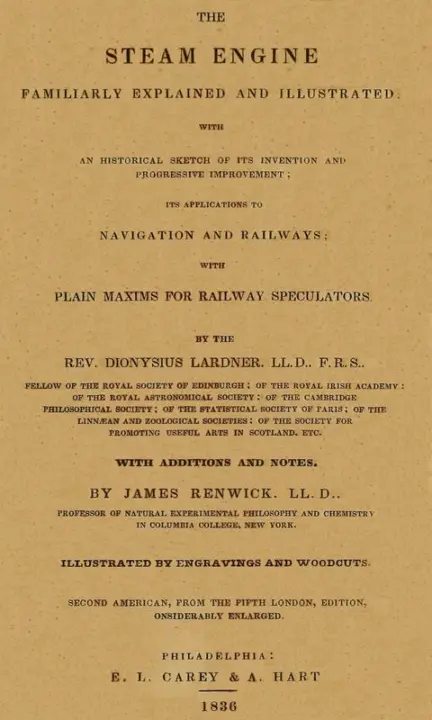
"The Steam Engine Familiarly Explained and Illustrated" by Dionysius Lardner is a scientific publication written in the early 19th century. This work delves into the mechanics of the steam engine, exploring its invention, historical development, and various applications, particularly in navigation and railways. Aimed primarily at a general audience, the book seeks to demystify the principles of steam power and its significance in technological advancement. The opening of the text introduces the complexity and historical significance of the steam engine, emphasizing its vital role in advancing human progress. The author outlines the book's objective to elucidate the fundamental concepts related to motion and mechanical systems, which underpin the functionality of the steam engine. Lardner discusses the necessity of human ingenuity in harnessing natural forces and introduces key concepts of pressure, heat, and motion, setting the groundwork for an in-depth exploration of steam power throughout the chapters that follow.
Introduction adapted from the source catalogue; source summaries may be automatically generated.
Free to read · English · 106,763 words · No account needed
MAKE TIME FOR A GOOD BOOK
On by default. Untick to stop anonymous reading totals. Each page counts after 10 seconds in view. How this works.
Anonymous counting is on unless you have switched it off.
Machines, definition of, 19
Manufactures, motions required in, 19
Morgan, Mr., his patent paddle-wheel, 259
Morland, Sir Samuel, his application of steam to raise water, 47
Motion, a primary agent in the cultivation of cotton, 18.
Variety of, 19
Murray, Mr., description of his suggested slide valve, 113
Newcomen, Thomas, and John Cawley, turn their attention to the
practicability of applying steam engines to the drainage of
mines, 61
Newcomen, Thomas, his construction of the atmospheric engine, 63
"Novelty," description of the, 175
Ogle, Mr., his steam carriage, 239
Oldham, Mr., his modification of the self-regulating furnace, 132
Paddle-wheel, the common one, 257. Mr. Morgan's patent one, 259
Papin, Denis, his contrivance, by which atmospheric pressure is rendered available as a mechanical agent, 48. Description of his steam engine, 71
Parallel motion, description of the, 95
Piston, its velocity, 302
Post-office steam packets, their speed, 268
Potter, Humphrey, his contrivance for working the valves, 67
Power of a steam engine, how estimated, 291
Railroads, first introduction of locomotives on, 151. Important effects to be expected from their adoption, 155. Imaginary difficulty respecting the progression of carriages on, 160. Various methods resorted to, to remedy this supposed difficulty, 161. One of these methods described, 162. Comparative estimate of the expenses of locomotive and stationary engines, 168. Difficulties arising from changes of level, 192. Their great extension, 206. Comparison of, with turnpike roads, 213. Inclined planes on, 194
Railway speculators, plain rules for, 307
Roads, their resistance to draft, 213.
Compared with railroads, 213
Robinson, Dr., 73
Roebuck, Dr., assistance rendered by him to Watt, 87.
His embarrassments, 88
"Rocket," description of the, 171
Savery, Thomas, obtains a patent for an engine to raise water, 49. His discovery of the principle of condensation, 49. Constructs the first engine brought into operation, 50. Description of, 51. Inefficiency of, 57. Great consumption of fuel necessary in his engines, 60. Different purposes to which he proposed to apply the steam engine, 61. Limited power of his engine, 69
"Sanspareil", description of the, 173
Smeaton turns his attention to the details of the atmospheric engines, 73
Solids converted into liquids by the application of heat, 27
Solomon De Caus, description of the apparatus of, 43
Somerset, Edward, Marquis of Worcester, invention of the steam engine ascribed to him, 45. Description of his contrivance, 45. Similar to Savery's, 46. His "Century of Inventions," 46
Steam carriages, Mr. Gurney's, 216.
Mr. Hancock's, 235.
Mr. Ogle's, 238.
Dr. Church's, 239
Steam, its properties described, 30.
Its mechanical power in proportion to the water evaporated, 277.
Its volume, 279.
Its quantity of heat, 279.
Its power in respect of fuel, 280.
Its expansive action, how advantageous, 280.
Combination of expansion with condensation, 285.
High-pressure, its expansive action, 288.
Examples illustrative of its mechanical force, 305
Your reading position is saved on this browser. Take it to another device with a library code. Reading pages adapt to text, rather than matching a printed edition.
Henry Kater & Dionysius Lardner
BEHIND THE BOOK
This eBook is for the use of anyone anywhere in the United States and most other parts of the world at no cost and with almost no restrictions whatsoever. You may copy it, give it away or re-use it under the terms of the Project Gutenberg License included with this eBook or online at www.gutenberg.org. If you are not located in the United States, you will have to check the laws of the country where you are located before using this eBook. Read the source licence.
The original source file, including credits and licence, is retained by this library. Request an original-format copy at no charge. Please include the book title and Project Gutenberg identifier #55428.
KEEP YOUR CURIOSITY GOING
Cécile Tormay

Moritz Busch
John L. Ransom
Frances Wright
Cécile Tormay

Mabel Potter Daggett