A Treatise on Mechanics
Henry Kater & Dionysius Lardner
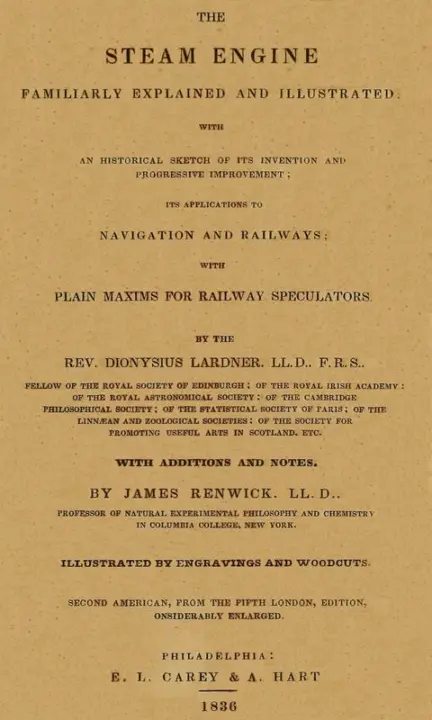
THE CLASSIC COLLECTION · 1836
"The Steam Engine Familiarly Explained and Illustrated" by Dionysius Lardner is a scientific publication written in the early 19th century. This work delves into the mechanics of the steam engine, exploring its invention, historical development, and various applications, particularly in navigation and railways. Aimed primarily at a general audience, the book seeks to demystify the principles of steam power and its significance in technological advancement. The opening of the text introduces the complexity and historical significance of the steam engine, emphasizing its vital role in advancing human progress. The author outlines the book's objective to elucidate the fundamental concepts related to motion and mechanical systems, which underpin the functionality of the steam engine. Lardner discusses the necessity of human ingenuity in harnessing natural forces and introduces key concepts of pressure, heat, and motion, setting the groundwork for an in-depth exploration of steam power throughout the chapters that follow.
Introduction adapted from the source catalogue; source summaries may be automatically generated.
Free to read · English · 106,763 words · No account needed
MAKE TIME FOR A GOOD BOOK
On by default. Untick to stop anonymous reading totals. Each page counts after 10 seconds in view. How this works.
Anonymous counting is on unless you have switched it off.
Steam engine, first mover in, 19.
Physical effects connected with, 20.
Claims to the invention of, 38.
Efficacy of, as a mechanical agent, 39.
First brought into operation by Savery, 50.
Its inefficiency, 58.
First proposed to be applied to the drainage of mines, 61.
Accidental discovery of condensation by jet, 65.
Further improvements by Humphrey Potter and Beighton, 67, 68.
Description of Papin's engine, 71.
First experiments of Watt and subsequent improvements, 73.
Dr. Black's theory of latent heat, 76.
Watt's method of condensation, 76.
Further improvements of Watt, 77.
Description of Watt's single-acting engine, 80.
The cold water pump, 86.
The hot water pump, 86.
Erection of a specimen engine at Soho, and gradual demand for them, 89.
The single-acting engine inapplicable to manufactures, 91.
The double-acting engine, 92.
Invention of the parallel motion, 95.
Introduction of the rotatory motion, 100.
The fly-wheel, 104.
The governor, 105.
The throttle valve, 105.
The eccentric, 111.
The D valve, 113.
The four-way cock, 115.
Methods for ascertaining the level of water in the boiler, 118.
The engine made to feed its own boiler, 120.
Waste of water prevented, 121.
The steam gauge, 122.
Barometer gauge, 123.
The damper, 125.
Methods proposed for preventing the waste of fuel, 128.
Mr. Brunton's furnace described, 130.
Mr. Oldham's modification of the self-regulating furnace, 132.
Improvements by Hornblower and Woolf, 134.
Description of the improvements of Mr. Cartwright, 142.
High-pressure engines, 145.
Leupold's engine described, 147.
Construction of the first high-pressure engine by Messrs. Trevithick
and Vivian, 148.
First application of the steam engine to propel carriages on
railroads, 151.
How applied to navigation, 242.
Marine engine; its form and arrangement, 243.
Mr. Howard's patent engine described, 253.
Mr. Hall's engine described, 248
Steam gauge, the, 122
Steam navigation, incredulity which existed respecting, 159. The limit of its present powers, 264
Steam vessels, their average speed, 265.
Their average consumption of fuel, 265.
Proportion of their power to their tonnage, 266.
Speed of post-office packets, 268.
Iron steam vessels, 269.
American vessel called the "Cigar Boat," its great speed, 270
Stephenson's, Mr., description of an engine constructed by him, 164. Premium awarded to this engine by the Liverpool and Manchester Railway Directors, 170. His method of dividing the flues, 179
Stephenson and Lock, Messrs., appointed by the Directors of the Liverpool and Manchester Railroad to make reports on the merits of various railroads, 167
Sun and planet wheels, 101
Thermometer, description of, 24
Throttle valve, use of, 104
Traction, force of, on a railroad, 192
Tredgold,70
Trevithick and Vivian, Messrs., construct the first high-pressure engine used in this country, 148
United States, steam communication with, 274
Your reading position is saved on this browser. Take it to another device with a library code. Reading pages adapt to text, rather than matching a printed edition.
Henry Kater & Dionysius Lardner
BEHIND THE BOOK
This eBook is for the use of anyone anywhere in the United States and most other parts of the world at no cost and with almost no restrictions whatsoever. You may copy it, give it away or re-use it under the terms of the Project Gutenberg License included with this eBook or online at www.gutenberg.org. If you are not located in the United States, you will have to check the laws of the country where you are located before using this eBook. Read the source licence.
The original source file, including credits and licence, is retained by this library. Request an original-format copy at no charge. Please include the book title and Project Gutenberg identifier #55428.
KEEP YOUR CURIOSITY GOING
Cécile Tormay

Moritz Busch
John L. Ransom
Frances Wright
Cécile Tormay

Mabel Potter Daggett