THE CLASSIC COLLECTION✦To Cuba and BackCLASSIC FREE BOOKS
To Cuba and Back
Richard Henry Dana
THE CLASSIC COLLECTION · 1851
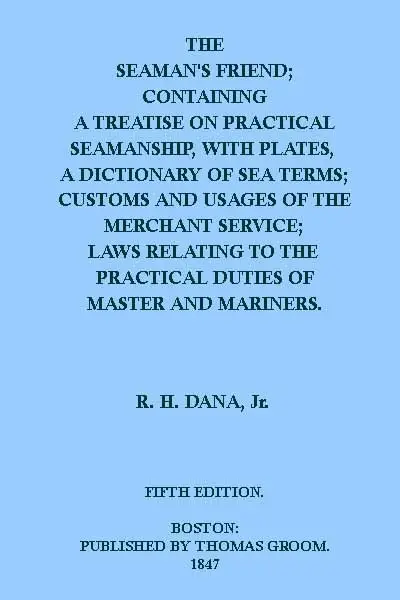
"The Seaman's Friend" by Richard Henry Dana is a comprehensive guide on practical seamanship written in the early 19th century. This work serves as a crucial resource for sailors, providing detailed information about ship construction, rigging, and the laws and customs governing maritime life. It is particularly aimed at those new to sea life and includes technical diagrams and practical advice for both novice and experienced mariners. The beginning of the book outlines its purpose and dedication to various stakeholders in the maritime industry, including sailors, ship owners, and legal authorities. It introduces the first section, which focuses on practical seamanship, including the construction of vessels and the management of sails and rigging. The text elaborates on the technical specifications and proportions vital for building and operating merchant vessels, offering insights into the various kinds of equipment and terminology pertinent to seamanship. This foundational content sets the stage for deeper explorations into the complexities of maritime duties and regulations as the book progresses.
Introduction adapted from the source catalogue; source summaries may be automatically generated.
Free to read · English · 87,833 words · No account needed
MAKE TIME FOR A GOOD BOOK
On by default. Untick to stop anonymous reading totals. Each page counts after 10 seconds in view. How this works.
Anonymous counting is on unless you have switched it off.
Limber-streak. The streak of foot-waling nearest the keelson.
LIST. The inclination of a vessel to one side; as, a list to port, or
a list to starboard.
LIZARD. A piece of rope, sometimes with two legs, and one or more iron thimbles spliced into it. It is used for various purposes. One with two legs, and a thimble to each, is often made fast to the topsail tye, for the buntlines to reeve through. A single one is sometimes used on the swinging-boom topping-lift.
LOCKER. A chest or box, to stow anything away in.
Chain-locker. Where the chain cables are kept.
Boatswain's locker. Where tools and small stuff for working upon
rigging are kept.
LOG, or LOG-BOOK. A journal kept by the chief officer, in which the situation of the vessel, winds, weather, courses, distances, and everything of importance that occurs, is noted down.
Log. A line with a piece of board, called the log-chip, attached to it, wound upon a reel, and used for ascertaining the ship's rate of sailing. (See page 17.)
LONG-BOAT. The largest boat in a merchant vessel. When at sea, it is carried between the fore and main masts.
LONGERS. The longest casks, stowed next the keelson.
LONG-TIMBERS. Timbers in the cant-bodies, reaching from the dead-wood to the head of the second futtock.
LOOF. That part of a vessel where the planks begin to bend as they
approach the stern.
LOOM. That part of an oar which is within the row-lock. Also, to appear above the surface of the water; to appear larger than nature, as in a fog.
LUBBER'S HOLE. A hole in the top, next the mast.
LUFF. To put the helm so as to bring the ship up nearer to the wind. Spring-a-luff! Keep your luff! &c. Orders to luff. Also, the roundest part of a vessel's bow. Also, the forward leech of fore-and-aft sails.
LUFF-TACKLE. A purchase composed of a double and single block. (See
page 54.)
Luff-upon-luff. A luff tackle applied to the fall of another.
LUGGER. A small vessel carrying lug-sails.
Lug-sail. A sail used in boats and small vessels, bent to a yard which hangs obliquely to the mast.
LURCH. The sudden rolling of a vessel to one side.
LYING-TO. (See LIE-TO.)
MADE. A made mast or block is one composed of different pieces. A ship's lower mast is a made spar, her topmast is a whole spar.
MALL, or MAUL. (Pronounced mawl.) A heavy iron hammer used in driving
bolts. (See TOP-MAUL.)
MALLET. A small maul, made of wood; as, caulking-mallet; also, serving-mallet, used in putting service on a rope.
MANGER. A coaming just within the hawse hole. Not much in use.
Your reading position is saved on this browser. Take it to another device with a library code. Reading pages adapt to text, rather than matching a printed edition.
BEHIND THE BOOK
This eBook is for the use of anyone anywhere in the United States and most other parts of the world at no cost and with almost no restrictions whatsoever. You may copy it, give it away or re-use it under the terms of the Project Gutenberg License included with this eBook or online at www.gutenberg.org. If you are not located in the United States, you will have to check the laws of the country where you are located before using this eBook. Read the source licence.
The original source file, including credits and licence, is retained by this library. Request an original-format copy at no charge. Please include the book title and Project Gutenberg identifier #40958.
KEEP YOUR CURIOSITY GOING

John Muir

Asa Gray
Asa Gray

Florence Nightingale
Elizabeth Robins Pennell
Denison Olmsted