THE CLASSIC COLLECTION✦To Cuba and BackCLASSIC FREE BOOKS
To Cuba and Back
Richard Henry Dana
THE CLASSIC COLLECTION · 1851
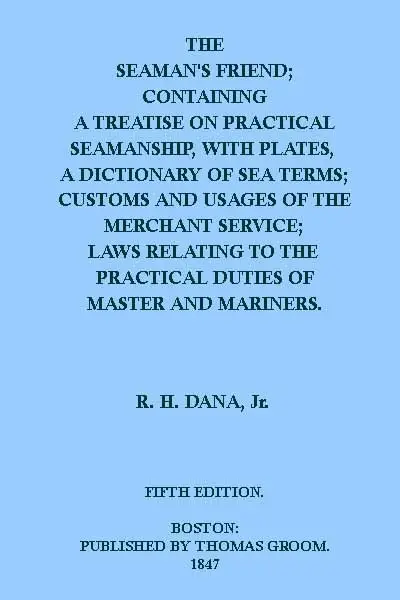
"The Seaman's Friend" by Richard Henry Dana is a comprehensive guide on practical seamanship written in the early 19th century. This work serves as a crucial resource for sailors, providing detailed information about ship construction, rigging, and the laws and customs governing maritime life. It is particularly aimed at those new to sea life and includes technical diagrams and practical advice for both novice and experienced mariners. The beginning of the book outlines its purpose and dedication to various stakeholders in the maritime industry, including sailors, ship owners, and legal authorities. It introduces the first section, which focuses on practical seamanship, including the construction of vessels and the management of sails and rigging. The text elaborates on the technical specifications and proportions vital for building and operating merchant vessels, offering insights into the various kinds of equipment and terminology pertinent to seamanship. This foundational content sets the stage for deeper explorations into the complexities of maritime duties and regulations as the book progresses.
Introduction adapted from the source catalogue; source summaries may be automatically generated.
Free to read · English · 87,833 words · No account needed
MAKE TIME FOR A GOOD BOOK
On by default. Untick to stop anonymous reading totals. Each page counts after 10 seconds in view. How this works.
Anonymous counting is on unless you have switched it off.
Requisites. Wages. Watch. Day's work. Working ship. Helm. Duties aloft
and about decks.
Boy is the term, as I have said before, for all green hands, whatever may be their size or age; and also for boys, who, though they have been at sea before, are not large and strong enough for ordinary seamen. It is the common saying, that a boy does not ship to know anything. Accordingly, if any person ships as a boy, and upon boy's wages, no fault can be found with him, though he should not know the name of a rope in the ship, or even the stem from the stern. In the navy, the boys are divided into three classes, according to their size and experience, and different duties are put upon them. In the merchant service, all except able and ordinary seamen are generally upon the same wages, though boys' wages vary in different voyages. Sometimes they get nothing, being considered as apprentices; and from that they rise to three, five, and sometimes eight dollars per month. Whatever boys' wages may be, a person who ships for them for that voyage, whether more or less, is rated as boy, and his duty is according to his rate.
In the ordinary day's work, the boys are taught to draw and knot yarns, make spunyarn, foxes, sennit, &c., and are employed in passing a ball or otherwise assisting the able seamen in their jobs. Slushing masts, sweeping and clearing up decks, holding the log-reel, coiling up rigging, and loosing and furling the light sails, are duties that are invariably put upon the boys or green hands. They stand their watches like the rest, are called with all hands, go aloft to reef and furl, and work whenever and wherever the men do, the only difference being in the kind of work upon which they are put. In reefing, the boys lay in toward the slings of the yard, and in furling, they go out to the yard-arms. They are sent aloft immediately, as soon as they get to sea, to accustom them to the motion of a vessel, and to moving about in the rigging and on the yards. Loosing and furling the royals, setting topgallant studdingsails and reeving the gear, shaking out reefs, learning the names and uses of all the ropes, and to make the common hitches, bends, and knots, reeving all the studdingsail gear, and rigging in and out booms, and the like, is the knowledge first instilled into beginners. There is a good deal of difference in the manner in which boys are put forward in different vessels. Sometimes, in large vessels, where there are plenty of men, the boys never take the wheel at all, and are seldom put upon any but the most simple and inferior duties. In others, they are allowed to take the wheel in light winds, and gradually, if they are of sufficient age and strength, become regular helmsmen. So, also, in their duties aloft; if they are favored, they may be kept at the royals and topgallant sails, and gradually come to the earing of a mizzen topsail. In work upon rigging, however, a green hand makes but little progress beyond ropeyarns and spunyarn, during his first voyage; since there are men enough to do the jobs, and he can be employed to more advantage in the inferior work, and in making and taking in light sails, steering in light winds, &c.; a competent knowledge of which duty is sufficient to enable him to ship for an ordinary seaman upon the next voyage. It is generally while in the grade of ordinary seaman that the use of the marlinspike is learned. Whatever knowledge a boy may have acquired, or whatever may be his age or strength, so long as he is rated as a boy, (and the rates are not changed during a voyage unless a person changes his ship,) he must do the inferior duties of a boy. If decks are to be cleared up or swept, rigging to be coiled up, a man is to be helped in his job, or any duty to be done aloft or about decks which does not require the strength or skill of a seaman, a boy is always expected to start first and do it, though not called upon by name.
Your reading position is saved on this browser. Take it to another device with a library code. Reading pages adapt to text, rather than matching a printed edition.
BEHIND THE BOOK
This eBook is for the use of anyone anywhere in the United States and most other parts of the world at no cost and with almost no restrictions whatsoever. You may copy it, give it away or re-use it under the terms of the Project Gutenberg License included with this eBook or online at www.gutenberg.org. If you are not located in the United States, you will have to check the laws of the country where you are located before using this eBook. Read the source licence.
The original source file, including credits and licence, is retained by this library. Request an original-format copy at no charge. Please include the book title and Project Gutenberg identifier #40958.
KEEP YOUR CURIOSITY GOING

John Muir

Asa Gray
Asa Gray

Florence Nightingale
Elizabeth Robins Pennell
Denison Olmsted